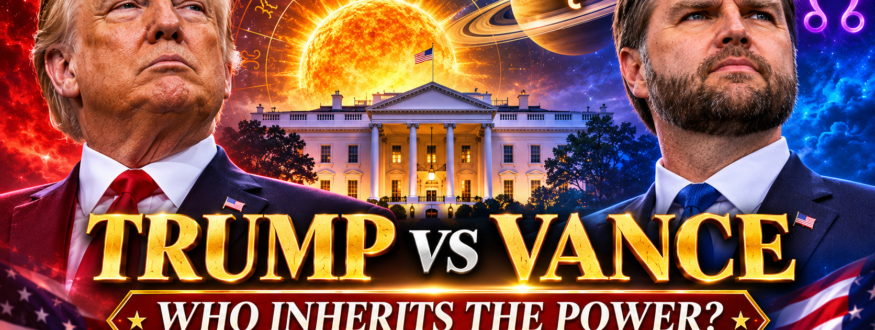
Trump vs JD Vance’s Political Destiny: Who Will Inherit the Power? | Vedic Astrology and the 2028 Succession Battle
November 12, 2026 | American Politics, Presidential Succession, Saturn, Rahu and Mundane Vedic Astrology
Donald Trump engineered one of the most extraordinary political comebacks in American history. But as his second presidency approaches its halfway point, a new question is beginning to dominate Washington: who will inherit his political empire when he leaves the White House?
For months, Vice President JD Vance appeared to be the natural heir to Trump’s political movement.
Young, ambitious, articulate and closely associated with the MAGA coalition, Vance possessed many of the qualities required to lead the Republican Party into its next chapter.
But the November 3, 2026, midterm elections have complicated that narrative.
Republicans lost control of Congress. The Iran war became a source of internal disagreement. And Vance began publicly articulating a political identity that was not entirely dependent on the president.
Then came November 12.
Trump unexpectedly redirected his vice president away from efforts to negotiate an end to the Iran war, instructing him instead to concentrate on alleged crime and corruption in Democratic-controlled cities and states.
Was this merely a change in administrative responsibilities?
Or did it reveal the first signs of a much larger political succession struggle?
For students of Vedic astrology, the story raises a fascinating question.
What happens when the Sun, representing established authority, encounters the ambitions of a potential successor — and Saturn begins testing the durability of political power?
The answer requires us to explore the traditional Jyotish symbolism of the Sun, Saturn, Rahu, the 10th house of career and the planetary periods associated with political elevation.
From Trump’s Critic to His Vice President: The Extraordinary Rise of JD Vance
JD Vance’s political journey is unusual even by American standards.
Born on August 2, 1984, in Middletown, Ohio, Vance grew up in a working-class family environment shaped by economic insecurity and difficult personal circumstances.
His memoir, Hillbilly Elegy, published in 2016, brought him national recognition.
The book explored family life, social mobility and the challenges confronting working-class communities in parts of America.
Vance subsequently entered politics, winning election to the United States Senate from Ohio in 2022.
But perhaps the most remarkable aspect of his political transformation was his changing relationship with Donald Trump.
During the 2016 presidential campaign, Vance was a prominent critic of Trump.
Over time, however, he became one of the president’s most influential defenders.
Trump selected him as his vice-presidential running mate in 2024.
The partnership helped establish Vance as one of the most prominent younger figures within the Republican Party.
At just 40 years old when he assumed office in January 2025, Vance represented a potential generational transition within the MAGA movement.
Yet political succession is rarely straightforward.
A leader may choose a deputy for loyalty and political compatibility.
But the same deputy can eventually become a contender for independent authority.
That is the dilemma now facing the Republican Party.
November 2026: The Midterm Defeat That Changed Everything
The November 3 midterm elections represented a major setback for Republicans.
The party lost control of Congress, leaving Trump’s administration facing a much more difficult legislative environment.
For JD Vance, the defeat created both a political problem and an opportunity.
As vice president, he is closely associated with the administration.
Yet as a potential 2028 presidential candidate, he must also consider how voters will judge the Republican Party’s performance under Trump.
Following the election, Vance publicly argued that the Iran war had contributed to the Republican defeat.
He also emphasized the need to address affordability, economic concerns and the party’s relationship with foreign military commitments.
These comments attracted considerable attention because they suggested a different emphasis from Trump’s continued defence of the war.
However, Reuters reported that people familiar with Vance’s strategy did not regard his statements as an outright break with the president.
The distinction is important.
A politician can seek to establish an independent identity while remaining loyal to the administration in which he serves.
Nevertheless, the election revealed a difficult strategic reality.
To inherit Trump’s political coalition, Vance may need Trump’s supporters. To win a national election in 2028, he may also need to persuade voters who rejected the Republican Party in 2026.
Reconciling those objectives could become the defining challenge of his political career.
The Iran War: The Foreign Policy Disagreement That Exposed a Political Divide
The war involving the United States and Iran has become one of the most consequential foreign policy issues of Trump’s second presidency.
The conflict has also created a complicated political environment for JD Vance.
Vance has long expressed scepticism about prolonged American military involvement overseas.
His political identity has emphasized restraint, economic nationalism and avoiding open-ended foreign conflicts.
Yet as vice president, he has also been required to support the administration’s foreign policy decisions.
Following the Republican midterm losses, Vance became more explicit in his criticism of the political consequences of the Iran war.
He argued that the conflict had contributed to voter dissatisfaction and called for renewed attention to domestic economic priorities.
Meanwhile, Trump continued to defend his decision to confront Iran militarily.
The disagreement created an intriguing political contrast.
Trump emphasized the necessity of his administration’s military strategy.
Vance emphasized the electoral and economic consequences of prolonged conflict.
Neither position automatically establishes a personal rivalry.
But the differences are politically significant because foreign policy may become a defining issue in the 2028 Republican presidential contest.
November 12: Trump Redirects Vance Away From Iran Diplomacy
The most dramatic development occurred on November 12, 2026.
Trump announced that the United States did not need an agreement with Iran and directed Vance to focus on alleged corruption and crime in Democratic-run jurisdictions.
The announcement followed reports that Vance had been considering renewed direct diplomatic engagement with Iranian officials.
The Wall Street Journal reported on November 11 that Vance was exploring possible face-to-face talks with a senior Iranian security official.
The following day, Trump publicly changed the vice president’s priorities.
According to Reuters, Trump instructed Vance to concentrate on domestic matters rather than continuing his Iran diplomacy efforts.
The president’s announcement effectively interrupted the diplomatic role that had been emerging for Vance.
But what does this development mean politically?
There are several possible interpretations.
Trump may simply have decided that negotiations with Iran were no longer useful.
He may have wanted Vance to concentrate on domestic political issues after the Republican midterm defeat.
Or the decision may reflect broader disagreements within the administration over foreign policy strategy.
What the available reporting does not establish is that Trump removed Vance because he feared his presidential ambitions.
That remains speculation.
Nevertheless, the change illustrates the limits of vice-presidential authority.
Even a politically influential vice president operates within an administration ultimately directed by the president.
And that distinction brings us to one of the most important principles in political Vedic astrology.
The Sun: The Planet of Kingship, Authority and Political Power
In classical Jyotish, the Sun — Surya — is the natural significator of kingship, government, sovereignty, dignity and executive authority.
The Sun represents the central figure around whom a governing structure operates.
In the traditional language of astrology, it is the king.
Other planets may represent advisers, administrators, military leaders or social institutions.
But the Sun symbolizes the ultimate seat of authority.
This makes the Sun especially relevant when studying presidents, prime ministers, monarchs and other executive leaders.
Trump and the solar principle
Donald Trump’s political identity is closely associated with personal leadership.
His influence over the Republican Party has frequently depended on his public image, his relationship with voters and his ability to define the movement’s political direction.
Within the present administration, Trump remains the president.
Vance remains the vice president.
Their constitutional responsibilities are not equivalent.
From a symbolic astrological perspective, the distinction resembles the relationship between an established sovereign and a potential successor.
The successor may possess ambition, talent and public support.
But those qualities do not automatically transfer executive authority.
The Sun represents the throne. The challenge for a successor is learning how to approach that throne without appearing to undermine the person who currently occupies it.
This is a philosophical comparison, not a claim that a particular Sun transit caused the November 12 announcement.
Saturn: When the Authority of the King Meets Institutional Reality
Saturn — Shani — is traditionally associated with discipline, endurance, responsibility, restrictions, institutions, labour and the passage of time.
In mundane astrology, these themes are especially relevant to political accountability and the structures within which governments operate.
The Sun represents executive authority.
Saturn represents the responsibilities and limitations that authority must confront.
Their contrasting symbolism provides a useful framework for examining the relationship between a president and the institutions surrounding him.
Why Saturn matters after the midterms
The Republican defeat has changed the political environment in which Trump exercises power.
An opposition-controlled Congress can create legislative obstacles, demand information and investigate government decisions.
These are real constitutional constraints.
From a Jyotish perspective, they resemble Saturn’s association with institutional limitations and accountability.
But Saturn’s symbolism is not restricted to Trump.
It also applies to Vance.
If Vance hopes to become president, he must demonstrate political endurance, administrative competence and the ability to manage difficult circumstances.
Saturn may symbolize the discipline required to move from political celebrity to durable leadership.
Is the Sun–Saturn relationship always negative?
No.
Although the Sun and Saturn are traditionally regarded as natural enemies in many classical Jyotish frameworks, their actual results depend on placement, strength, lordship and other planetary relationships.
A difficult Sun–Saturn combination may indicate tension between personal authority and institutional obligations.
A constructive relationship may symbolize leadership strengthened through discipline and responsibility.
Therefore, the Sun–Saturn theme should not be reduced to a simplistic prediction of conflict between Trump and Vance.
It is a symbolic framework for understanding the tensions between authority, succession and institutional responsibility.
Rahu: The Planet of Extraordinary Ambition and Political Reinvention
If the Sun represents established authority, Rahu offers a different kind of symbolism.
Rahu is associated with unconventional advancement, worldly desire, fascination, disruption and the pursuit of extraordinary achievements.
In modern political astrology, Rahu is frequently connected with mass appeal, unconventional political movements and dramatic changes in public status.
Its effects depend on its sign dispositor, house placement, conjunctions, aspects and operating planetary periods.
JD Vance and political reinvention
Vance’s career has involved several significant transformations.
He moved from a difficult working-class upbringing to higher education and professional success.
He became a bestselling author.
He entered national politics.
He changed from a prominent Trump critic to the president’s running mate.
He then became vice president of the United States.
This trajectory provides an interesting thematic comparison with Rahu’s association with unconventional advancement and the crossing of established boundaries.
But such a comparison does not prove that Rahu is responsible for Vance’s career.
A genuine natal assessment would require calculating his horoscope and examining the relevant planetary periods.
The danger of ambition without independence
Rahu also introduces a political dilemma.
A successor must develop enough ambition to become a credible leader.
Yet excessive ambition may create suspicion among established political allies.
For Vance, this creates a delicate balancing act.
He must demonstrate that he possesses the qualities required to lead the Republican Party.
But he must also avoid alienating the Trump supporters whose backing could be essential to his future.
In the language of Jyotish, Rahu may symbolize the desire to rise, while Saturn represents the discipline required to remain elevated.
The 10th House: The Astrological Foundation of Political Elevation
The 10th house, known as Karma Bhava, governs profession, worldly activity, authority, reputation and public responsibilities.
It is one of the most important houses in political astrology.
A strong 10th house may support professional achievement, leadership and recognition.
However, no single placement guarantees election to high office.
A rigorous assessment requires examination of the 10th lord, planetary aspects, yogas, dasha periods and relevant divisional charts.
For a politician seeking the presidency, several additional factors become important.
The 1st house: Personal identity and leadership
The Ascendant and its lord describe the individual’s overall constitution, self-expression and capacity to act.
The 6th house: Political competition
The 6th house is associated with opponents, conflict, service, struggle and the ability to overcome obstacles.
It may be considered when examining electoral competition.
The 9th house: Fortune, guidance and political patronage
The 9th house represents dharma, higher principles, teachers, fortune and guidance.
In political interpretation, its symbolism may extend to influential mentors and ideological foundations.
The 10th house: Authority and public office
The 10th house is central to the exercise of professional and governmental responsibility.
The 11th house: Support networks and gains
The 11th house is associated with gains, networks, influential associations and the fulfilment of objectives.
For a politician, these themes may correspond symbolically with political alliances and organizational support.
Together, these houses provide a more comprehensive framework for examining political advancement.
Vimshottari Dasha: Can Planetary Periods Indicate a Rise to Power?
One of the most important predictive systems in Vedic astrology is Vimshottari Dasha.
This system divides life into planetary periods known as Mahadashas and Antardashas.
The operating periods are interpreted in relation to the natal horoscope.
In political astrology, periods involving the Ascendant lord, 9th lord, 10th lord or planets forming significant Raja Yogas may be examined for career advancement.
However, a planet does not automatically produce political elevation merely because its period begins.
Its strength, functional role, house placement and relationships with other planets must be considered.
Raja Yoga and political authority
Classical Jyotish recognizes numerous combinations associated with authority, status and worldly success.
Among them are combinations involving the lords of Kendras and Trikonas.
Such relationships can form Raja Yogas, depending on the specific horoscope.
A powerful Raja Yoga may symbolize the potential for high achievement.
But the timing and manifestation of its results require additional examination.
For JD Vance, a serious prediction about 2028 would require a verified birth time, a properly calculated sidereal horoscope and the relevant planetary periods.
Without those details, it would be inappropriate to claim that his horoscope guarantees the presidency.
The 2028 Succession Question: JD Vance or Marco Rubio?
The political succession debate is not limited to Trump and Vance.
Secretary of State Marco Rubio has also emerged as a prominent figure in discussions about the Republican Party’s future.
Reuters has reported that Trump has privately raised the question of whether Vance or Rubio might become his political successor.
The two men represent different strengths within the administration.
Vance has cultivated an identity emphasizing economic nationalism, scepticism toward prolonged military involvement and the concerns of working-class voters.
Rubio has developed a prominent role in foreign policy and has generally defended the administration’s more forceful approach toward Iran.
Both possess significant political experience.
Both are associated with Trump’s administration.
And both could potentially appeal to different segments of the Republican electorate.
However, Vance has not formally announced a presidential campaign.
Rubio has also indicated that he would not seek the nomination if Vance runs, although political circumstances can change.
Trump has not formally endorsed either man as his successor.
The outcome remains uncertain.
The astrological symbolism of succession
In classical Jyotish, the 10th house represents authority and public office.
The 9th house can symbolize guidance and patronage.
The 11th house may represent alliances and political gains.
Rahu can signify unconventional advancement.
Saturn represents endurance and the long-term demands of leadership.
These principles offer a framework for studying political succession.
But they do not establish which Republican candidate will win the nomination or the presidency.
Could Trump’s Endorsement Decide Vance’s Future?
Trump’s influence within the Republican Party remains considerable.
For Vance, an endorsement from the president could provide substantial advantages in a future Republican primary.
It could strengthen his position among loyal MAGA voters and reduce competition from other potential candidates.
But an endorsement also presents complications.
A candidate closely associated with an outgoing administration may inherit both its achievements and its political liabilities.
The November 2026 midterms have demonstrated that Republican candidates cannot rely exclusively on Trump’s personal popularity.
Vance must therefore consider two different political audiences.
The first consists of Republican primary voters, many of whom remain deeply committed to Trump.
The second consists of the broader national electorate, including independent voters and those dissatisfied with the administration.
Winning over both groups may require different political messages.
And that is where the succession question becomes particularly complicated.
The political qualities required to inherit a movement are not necessarily identical to those required to win a national presidential election.
What Does the November 2026 Planetary Climate Symbolize?
Using the Lahiri sidereal zodiac, several planetary themes are relevant to a broader discussion of political power during November 2026.
Saturn is moving retrograde through Pisces.
Jupiter has entered Leo.
Rahu and Ketu are approaching their next major sign transition in early December, according to the transit convention used in this analysis.
Each carries a different symbolic meaning.
Saturn in Pisces
Saturn’s transit can be interpreted through themes of institutional obligations, responsibility, restrictions and the long-term consequences of policy decisions.
For political leaders, this provides a symbolic background for examining the demands of governance.
Jupiter in Leo
Leo is ruled by the Sun and is traditionally associated with royalty, authority and leadership.
Jupiter’s presence in Leo may be interpreted symbolically through the relationship between wisdom, counsel and political power.
However, Jupiter’s results depend on the natal chart and the houses involved.
Rahu and Ketu
The lunar nodes are traditionally associated with disruption, changing attachments and unconventional developments.
Their movement can be examined in mundane astrology, particularly when related to a country’s horoscope or the charts of political leaders.
But broad transit symbolism is not sufficient to establish a precise political prediction.
The important distinction is that these planetary movements provide an interpretive backdrop, not evidence that the planets caused the Republican defeat or the changes in Vance’s responsibilities.
Three Possible Political Paths for JD Vance Before 2028
The next two years could unfold in several ways.
Scenario 1: Vance becomes Trump’s chosen successor
Vance maintains a strong relationship with Trump, consolidates support among Republican voters and eventually receives the president’s endorsement.
This would give him an important advantage in the Republican nomination contest.
Astrologically, such a development could be studied through favourable relationships involving the 9th, 10th and 11th houses, along with relevant planetary periods.
Scenario 2: Vance establishes a more independent political identity
Vance increasingly emphasizes his own policy priorities, particularly affordability and foreign policy restraint.
He attempts to retain Trump’s supporters while appealing to voters who want a different direction.
This could strengthen his national appeal, but it might also create tensions within the Republican coalition.
The symbolic themes of the Sun, Saturn and Rahu would be relevant to an astrological discussion of authority, independence and ambition.
Scenario 3: Another Republican emerges as the preferred successor
If Vance’s political position weakens, Rubio or another Republican contender could gain momentum.
This possibility would depend on the administration’s performance, the political environment and the decisions of party leaders and voters.
In Jyotish, such developments might be examined through the comparative strength of the candidates’ career-related planetary periods.
But without verified birth data and detailed calculations, no astrological ranking of the candidates can be responsibly established.
Is This a Political Rivalry — or the Natural Evolution of Power?
Perhaps the most important question is whether the emerging differences between Trump and Vance represent an actual rivalry.
The evidence currently supports a more nuanced interpretation.
Vance has publicly differentiated himself from aspects of the administration’s Iran policy.
He has begun emphasizing themes that could form the basis of a future presidential campaign.
Trump has redirected his responsibilities.
And Republican officials are increasingly discussing the party’s future beyond Trump’s presidency.
But these developments do not establish a personal feud.
Political succession often begins long before a leader leaves office.
Potential successors must develop independent reputations while remaining connected to the institutions and alliances that helped them rise.
This is especially challenging when the established leader possesses an unusually strong personal following.
For Vance, the challenge may be less about defeating Trump than about convincing voters that he can preserve the movement’s appeal while adapting it to a changing political environment.
Final Thoughts: Who Will Inherit Trump’s Political Power?
Donald Trump’s political career has repeatedly defied conventional expectations.
His return to the White House in 2025 confirmed his extraordinary influence over the Republican Party.
But the November 2026 midterm defeat has introduced new uncertainty.
JD Vance now stands at a potentially defining moment.
He possesses national visibility, executive experience and strong connections within the conservative movement.
Yet he also faces the difficult task of developing an independent political identity while serving a president whose influence remains central to the party.
The Iran diplomacy controversy has made that balancing act more visible.
For students of Vedic astrology, the story reflects several enduring principles.
The Sun represents established authority.
Saturn represents the responsibilities and limitations of power.
Rahu symbolizes ambition, unconventional advancement and the desire for greater influence.
The 10th house represents public office and professional achievement.
And the operating planetary periods provide a traditional framework for examining when career opportunities may become prominent.
But no planetary combination can establish the outcome of a future election.
Ultimately, Trump’s successor will be determined through political decisions, party contests and the democratic process.
The question is not simply whether JD Vance possesses the ambition to become president.
It is whether he can transform the political influence he inherited from Trump into an independent mandate of his own.
That may prove to be the defining struggle of the Republican Party’s next chapter.
Frequently Asked Questions
Is JD Vance running for president in 2028?
As of November 12, 2026, Vance has not formally announced a presidential campaign. He is widely discussed as a potential Republican contender.
Did JD Vance break with Donald Trump over Iran?
Vance publicly criticized the political consequences of the Iran war and called for a change in emphasis. However, the available reporting does not establish a complete personal or political break between the two leaders.
Why did Trump remove Vance from Iran diplomacy?
On November 12, Trump directed Vance to concentrate on alleged domestic crime and corruption instead of Iran negotiations. The announcement followed Trump’s statement that the United States did not need an agreement with Iran.
Who could succeed Trump in 2028?
JD Vance and Marco Rubio are among the prominent Republicans discussed as potential successors. No candidate has been formally designated by Trump.
Which planet represents political authority in Vedic astrology?
The Sun is the natural significator of kingship, government and executive authority. The 10th house and its lord are also important.
Does Rahu indicate political ambition?
Rahu is traditionally associated with worldly desire, unconventional advancement and fascination. Its role in political success depends on the complete horoscope.
Can Saturn indicate conflicts with political authority?
Saturn may symbolize restrictions, institutional responsibilities and tensions involving authority. However, its actual results depend on house lordship, placement, aspects and operating planetary periods.
Which planetary periods support political elevation?
Periods associated with the Ascendant lord, 9th lord, 10th lord or significant Raja Yoga-producing planets may be examined for career advancement. No single dasha automatically guarantees political office.
Can Vedic astrology predict the 2028 U.S. presidential election?
Traditional mundane astrology includes methods for studying political developments, but its predictive reliability has not been scientifically established. Specific predictions require defined horoscopes, verified data and explicit interpretive methods.
Written for NJ Shivoham | Vedic Astrology, World Politics & Mundane Jyotish
Editorial Disclaimer: Political reporting and traditional astrological symbolism are presented separately. This article does not claim that Donald Trump and JD Vance are engaged in a confirmed personal feud or that planetary movements determine electoral outcomes.
#JDVance #DonaldTrump #TrumpVsVance #Election2028 #VedicAstrology #PoliticalAstrology #Saturn #Rahu #SunSaturn #MundaneAstrology #NJShivoham
