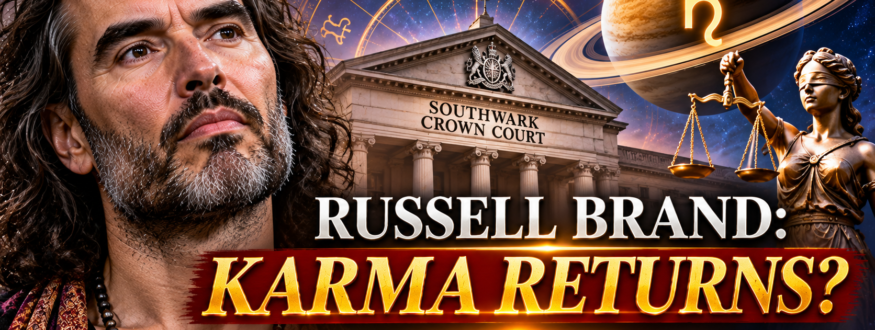
Russell Brand’s Karmic Reckoning: Can Spirituality Erase the Past? | Saturn, Venus, Rahu and Vedic Astrology
November 12, 2026 | Celebrity News, Vedic Astrology, Karma and Spirituality
He was once the rebellious face of British comedy. He became a Hollywood actor, married a global pop superstar, reinvented himself as a political commentator and eventually embraced spirituality, meditation and Christianity.
But in November 2026, Russell Brand’s extraordinary public journey reached a devastating legal turning point.
On November 5, a jury at London’s Southwark Crown Court convicted the British comedian and actor of one count of rape and three counts of sexual assault involving four women.
Four days later, on November 9, Brand was sentenced to 10 years and six months in prison.
The offences occurred between 2004 and 2009, during the years when Brand’s entertainment career was gathering momentum.
Brand denied the charges throughout the trial, maintaining that his sexual encounters had been consensual. The jury nevertheless convicted him of four offences. He was acquitted of two other rape charges and one charge of attempted indecent assault.
The court’s findings brought renewed attention not only to Brand’s conduct but also to the broader entertainment industry’s treatment of women who reported sexual abuse.
For students of Vedic astrology, the case raises a profound philosophical question:
Can spiritual transformation erase the consequences of actions committed many years earlier?
To examine that question, we must distinguish three very different things: criminal accountability, spiritual development and the traditional Jyotish concept of karma.
From Rebellious Comedian to Hollywood Celebrity: The Rise of Russell Brand
Russell Brand was born on June 4, 1975, in Essex, England.
His career began in stand-up comedy and television presenting, where his flamboyant personality, rapid speech and provocative humour attracted considerable attention.
During the 2000s, he became one of Britain’s most recognizable entertainment personalities.
His career expanded into Hollywood with films including Forgetting Sarah Marshall, Get Him to the Greek and Arthur.
His highly publicized marriage to American singer Katy Perry further increased his international celebrity status. The couple married in 2010 and divorced in 2012.
But Brand’s public identity was never confined to acting and comedy.
He spoke openly about his experiences with addiction and recovery, wrote books exploring his personal struggles and increasingly presented himself as someone seeking meaning beyond fame and material success.
Over time, his interests expanded into meditation, spiritual philosophy, social criticism and alternative political commentary.
He developed a substantial online following through discussions about government, media institutions, wellness and personal transformation.
His public journey appeared to follow a familiar narrative: a celebrity moving from excess and controversy toward introspection and spiritual reinvention.
But the events of November 2026 raised a difficult question about the relationship between personal transformation and responsibility for past conduct.
November 5, 2026: The Conviction That Changed Everything
Following a four-week trial, the jury at Southwark Crown Court found Brand guilty of raping one woman and sexually assaulting three others.
The offences occurred between 2004 and 2009.
Prosecutors argued that Brand had used his growing fame and influence to exploit women and disregard their consent.
The women who testified described experiences that had continued to affect their lives long after the offences.
Brand denied wrongdoing and maintained that he had never engaged in non-consensual sexual activity.
The jury’s verdict established his criminal guilt on four counts.
He was acquitted of three other charges.
These distinctions matter. A conviction is a legal finding, while an acquittal means the prosecution did not establish guilt on that charge to the required criminal standard.
The trial also drew attention to the difficulties faced by people reporting sexual violence involving influential public figures.
Some of the women described fearing that Brand’s fame and professional standing would make their accounts less likely to be believed.
Their testimony became central to the proceedings.
November 9: Russell Brand Sentenced to 10 Years and Six Months
On November 9, Judge Joel Bennathan sentenced Brand to a total of ten years and six months in prison.
The sentence included nine years for rape, together with sentences for the sexual assaults.
The court ordered that Brand serve two-thirds of the sentence in custody before becoming eligible for release on licence.
The judge criticized Brand’s conduct and his use of celebrity influence.
The Crown Prosecution Service emphasized that fame, status and the passage of time do not diminish the importance of consent.
The sentencing also gave the women an opportunity to describe the lasting consequences of the offences through victim personal statements.
Their experiences are essential to understanding the significance of the case.
This is not simply a story about a celebrity losing his reputation.
It is a story about women who experienced sexual violence, pursued justice and participated in a demanding legal process.
That distinction must remain central to any responsible discussion of the case.
Saturn: The Planet of Time, Responsibility and Consequences
In classical Vedic astrology, Saturn is known as Shani.
Saturn is traditionally associated with time, discipline, endurance, labour, responsibility, limitation and the consequences of action.
It is frequently described in popular Jyotish as the planet of karma.
However, the expression requires careful interpretation.
Saturn does not automatically punish wrongdoing.
Nor does a difficult Saturn transit establish that a person has committed a crime.
In classical astrology, Saturn’s results depend on its sign, house, lordship, strength, aspects, associations and operating planetary periods.
A strong Saturn can signify perseverance, professional longevity, maturity and responsibility.
Under challenging circumstances, Saturn may symbolize delays, restrictions, difficult obligations or prolonged struggles.
Why Saturn’s symbolism is relevant to this story
The offences for which Brand was convicted occurred approximately seventeen to twenty-two years before his sentencing.
The passage of time did not prevent prosecution.
The legal process eventually resulted in a conviction and imprisonment.
This creates an obvious symbolic parallel with Saturn’s association with time and enduring responsibility.
But the court’s decision resulted from testimony, evidence, legal procedures and judicial findings — not from a demonstrated planetary influence.
Saturn provides a philosophical language for reflecting on consequences. It does not replace the evidence that established criminal guilt.
Venus: Pleasure, Relationships and the Ethics of Desire
Venus, known as Shukra, occupies an important position in Vedic astrology.
Traditionally, Venus signifies beauty, relationships, pleasure, affection, refinement, artistic expression and material comforts.
Venus is also associated with sexuality and romantic attraction.
But an essential distinction must be made.
Venus does not signify sexual violence, and no Venus placement can establish that a person is predisposed to commit a sexual offence.
Sexual assault is a violation of consent and personal autonomy.
It cannot be explained or excused by describing a planet as afflicted.
The deeper philosophical question
In classical Indian thought, kama — desire or pleasure — is one of the four Purusharthas, or recognized aims of human life.
The others are dharma, artha and moksha.
Kama is not inherently immoral.
Pleasure, affection, intimacy and emotional fulfilment are legitimate dimensions of human experience.
However, the pursuit of desire must remain consistent with dharma, ethical conduct and respect for others.
This distinction is central to the philosophical discussion.
The issue is not desire itself.
It is whether an individual’s actions respect the dignity, freedom and consent of other people.
Venus symbolizes the human capacity for pleasure and relationship. Dharma establishes the ethical responsibilities within which those relationships must exist.
Rahu: Fame, Fascination and the Pursuit of Extraordinary Experiences
Rahu is one of the most intriguing grahas in Vedic astrology.
Traditionally classified as a shadow planet, Rahu is associated with worldly appetite, unconventional advancement, fascination, disruption and the pursuit of experiences beyond ordinary boundaries.
Its effects are determined through its dispositor, conjunctions, aspects, house position and planetary periods.
Modern astrologers frequently associate Rahu with celebrity culture, mass attention and unconventional public identities.
Russell Brand’s career provides an interesting thematic comparison.
He moved from provocative comedy to mainstream celebrity, Hollywood films, political commentary and spiritual content.
His public identity changed repeatedly.
These transformations resemble some of the unconventional and disruptive qualities traditionally associated with Rahu.
But they do not establish the condition of Rahu in his natal horoscope.
Rahu and the limits of worldly influence
One of the recurring themes in Indian philosophy is that worldly recognition does not necessarily indicate spiritual wisdom.
A person may possess influence, wealth and public admiration while remaining responsible for their conduct.
The philosophical contrast between Rahu and Jupiter is useful here.
Rahu can symbolize intense worldly pursuit.
Jupiter represents wisdom, ethical guidance and dharma.
But no astrological combination can establish whether a particular person is morally trustworthy.
Such judgments must be grounded in conduct and evidence.
Can Spirituality Erase the Past?
This is perhaps the most important question raised by Brand’s public transformation.
In recent years, he increasingly discussed spiritual practices, meditation, faith and personal redemption.
In 2024, he publicly embraced Christianity and was baptized.
His religious journey attracted attention from followers who viewed it as part of a broader transformation.
But can spiritual practice remove responsibility for earlier actions?
From the perspective of Indian philosophy, the answer requires distinguishing inner transformation from external consequences.
A person may sincerely change their beliefs, values or conduct.
Such transformation can be meaningful.
But it does not automatically reverse harm already caused or eliminate legal responsibility.
The three traditional categories of karma
Many Vedantic and later Hindu philosophical traditions distinguish three forms of karma.
Sanchita Karma
The accumulated store of karma associated with actions across previous existence.
Prarabdha Karma
That portion of accumulated karma understood to have begun bearing fruit in the present life.
Agami Karma
New karma generated through present actions.
These categories are philosophical concepts, not methods for identifying criminal guilt or calculating legal sentences.
They illustrate the broader idea that actions and their consequences are not necessarily simultaneous.
However, it would be inappropriate to claim that Brand’s conviction proves a specific category of karma was operating.
The conviction was established through the criminal justice system.
The philosophical concepts may help readers reflect on responsibility, but they cannot explain why the offences occurred or why the jury reached its verdict.
Prayaschitta: Can Repentance and Spiritual Practice Change Karma?
Within Hindu traditions, Prayaschitta refers broadly to acts of repentance, expiation and moral correction.
Different texts and traditions prescribe different practices.
These may include confession, restitution, disciplined conduct, charity, prayer, austerity and other forms of ethical or religious observance.
But the purpose of genuine repentance is not simply to escape consequences.
It involves acknowledging wrongdoing, correcting conduct and taking responsibility wherever possible.
A person cannot undo another individual’s suffering merely by adopting a new spiritual identity.
Nor should religious practice be used as a substitute for justice.
This principle is particularly important when discussing sexual violence.
Survivors are not obligated to forgive an offender because that person expresses remorse or adopts a religious practice.
Forgiveness, where it occurs, belongs to the individual who has experienced harm.
Spiritual transformation may change how a person chooses to live in the future. It does not erase the rights of those harmed in the past.
The 6th, 8th, 10th and 12th Houses: A Classical Jyotish Framework
For astrologers interested in studying major legal and professional developments, several houses are traditionally relevant.
HouseTraditional SignificationsRelevant Theme6th HouseConflict, adversaries, litigation, serviceLegal disputes and opposition8th HouseVulnerability, sudden change, hidden mattersDifficult revelations and major transitions10th HouseCareer, authority, public activityProfessional standing and reputation12th HouseLoss, expenditure, confinement, seclusionImprisonment, separation and withdrawal
These houses can be examined within a properly calculated horoscope.
But their presence or activation does not establish criminal conduct.
For example, the 12th house has many positive significations, including meditation, charity, foreign residence and spiritual liberation.
The 8th house can symbolize longevity, research and transformation.
The 6th house can support the ability to overcome obstacles.
The 10th house can signify professional achievement.
Astrological interpretation requires the entire horoscope rather than isolated house meanings.
Russell Brand’s Birth Chart: What Can Be Established?
Russell Brand was born on June 4, 1975, in England.
His birth date is publicly documented.
However, precise analysis of his Ascendant, house placements, divisional charts and Vimshottari dasha requires a reliably sourced birth time.
A complete Jyotish assessment would need to establish:
- The sidereal planetary positions using a specified ayanamsha, such as Lahiri.
- The Ascendant and relevant house lords.
- The natal positions and strength of Saturn, Venus and Rahu.
- The operating Mahadasha and Antardasha.
- Relevant transits and their relationship to the natal horoscope.
- The condition of the 6th, 8th, 10th and 12th houses.
Without verified calculations, it would be inappropriate to declare that a particular Saturn–Rahu or Venus–Rahu period predicted Brand’s crimes or conviction.
Even with accurate birth data, astrology cannot determine whether someone committed sexual violence.
That is a question of evidence and law.
Saturn Retrograde in Pisces: The November 2026 Astrological Backdrop
Using the Lahiri sidereal zodiac, Saturn is retrograde in Pisces during November 2026.
In traditional Jyotish, retrograde motion is an important consideration in evaluating planetary strength and behaviour.
Modern astrologers often interpret retrograde Saturn through themes of revisiting unresolved responsibilities, reassessing past decisions and confronting unfinished obligations.
These are interpretive themes rather than a universally applicable prediction.
The timing of Brand’s conviction may appear symbolically consistent with Saturn’s association with delayed consequences.
However, the legal proceedings were determined by the evidence, the jury’s verdict and the court’s sentencing decision.
The transit does not demonstrate that Saturn caused the conviction.
Nor should the timing be presented as proof that every individual experiencing a Saturn retrograde period will face punishment.
Why Spiritual Reinvention Cannot Replace Accountability
Russell Brand’s public identity evolved considerably over the years.
He moved from provocative entertainment to political commentary, wellness discussions and religious expression.
But a public spiritual identity and accountability for criminal conduct are separate matters.
Spiritual practices may influence personal beliefs and future behaviour.
They cannot retrospectively establish that past conduct was lawful.
Nor can they eliminate the consequences of offences established in court.
This distinction matters because celebrity culture sometimes treats personal reinvention as a complete break from an earlier identity.
A new philosophy, religious affiliation or public image may suggest transformation.
But genuine ethical change must be considered alongside actions and responsibility.
The court’s findings in Brand’s case remain legally significant regardless of his spiritual beliefs.
The Victims, the Entertainment Industry and the Culture of Silence
The significance of the November 2026 conviction extends beyond Russell Brand himself.
The case has renewed scrutiny of how the entertainment industry responds when influential performers are accused of abusing their position.
Some of the women involved described the difficulty of reporting offences committed by a famous and powerful individual.
Their accounts highlight the imbalance that can exist between public figures and people with less professional influence.
The legal proceedings also demonstrate why reporting mechanisms, institutional safeguards and independent investigations matter.
In the philosophical language of Jyotish, Saturn is associated with structures, obligations and social responsibility.
But the real-world responsibility belongs to individuals and institutions.
Entertainment companies, broadcasters, managers and colleagues have roles to play in maintaining safe professional environments.
The burden should not fall solely on victims to overcome the influence of powerful individuals.
Does Saturn Represent Punishment or Justice?
Saturn is frequently portrayed as a harsh planet.
Popular astrology often describes Shani as a force that punishes wrongdoing.
But classical Jyotish presents a more complex picture.
Saturn may signify discipline, service, endurance, maturity and the capacity to fulfil difficult obligations.
It can also symbolize restriction, delay and hardship.
Its meaning depends on context.
The deeper philosophical lesson is not that suffering automatically proves wrongdoing.
Many innocent people experience hardship.
Many victims endure suffering through no wrongdoing of their own.
Therefore, describing every painful event as deserved karma is both philosophically simplistic and ethically dangerous.
In the Brand case, criminal responsibility was established through evidence and a jury verdict.
Astrology should not be used to suggest that the victims’ experiences were predestined or spiritually necessary.
Justice concerns responsibility for harmful actions. It does not require treating suffering as proof of cosmic punishment.
Can Russell Brand Rebuild His Life After Prison?
The legal sentence establishes the immediate consequences of Brand’s conviction.
His future personal, professional and spiritual life remains uncertain.
The court has imposed a substantial custodial sentence.
Any eventual release, professional activity or public rehabilitation will depend on legal requirements, future conduct and decisions made by relevant institutions.
From a philosophical perspective, a person may continue to reflect, learn or change during imprisonment.
But such possibilities should not overshadow the harm experienced by victims or the seriousness of the offences.
Nor can astrology responsibly predict that a future planetary period will guarantee public forgiveness or professional restoration.
The more meaningful question is whether personal transformation is accompanied by genuine accountability.
Final Thoughts: Can Anyone Escape Their Past Through Spirituality?
Russell Brand’s story has moved through extraordinary public transformations.
From controversial comedian to Hollywood celebrity.
From addiction recovery advocate to political commentator.
From spiritual influencer to a man convicted of serious sexual offences.
His November 2026 conviction and prison sentence have fundamentally changed the public understanding of his career.
For students of Vedic astrology, the story offers an opportunity to reflect on the relationship between desire, ambition, time and moral responsibility.
Venus represents relationships, pleasure and refinement.
Rahu symbolizes worldly fascination and unconventional ambition.
Saturn represents discipline, endurance and responsibility.
Jupiter represents wisdom and dharma.
But none of these planets determines criminal guilt.
The deeper lesson lies in the distinction between spiritual identity and ethical conduct.
A person may change their beliefs. They may adopt new spiritual practices. They may seek redemption.
But spiritual transformation cannot erase the rights of people harmed by their actions or automatically cancel the consequences established by law.
Perhaps the most important question is therefore not whether spirituality can erase the past.
It is whether genuine spirituality requires a person to confront that past with responsibility, humility and respect for others.
That is a question extending far beyond one celebrity, one court case or one horoscope.
Frequently Asked Questions
Was Russell Brand convicted in November 2026?
Yes. On November 5, 2026, a jury at Southwark Crown Court convicted him of one count of rape and three counts of sexual assault against four women.
How long is Russell Brand’s prison sentence?
On November 9, 2026, he was sentenced to 10 years and six months in prison. The court specified that he must serve two-thirds of the sentence in custody before release on licence.
Was Russell Brand acquitted of any charges?
Yes. He was acquitted of two other rape charges and one charge of attempted indecent assault.
What does Saturn represent in Vedic astrology?
Saturn traditionally represents time, discipline, endurance, labour, restrictions, responsibility and the consequences of actions.
Does Venus–Rahu cause sexual misconduct?
No. There is no established basis for claiming that a Venus–Rahu combination causes sexual violence. Criminal conduct cannot be determined from planetary placements.
Can spirituality erase past karma?
Hindu philosophical traditions discuss repentance, spiritual transformation and different forms of karma. However, spiritual practice does not automatically reverse harm or remove legal responsibility.
What is Prarabdha Karma?
Prarabdha Karma is traditionally understood as the portion of accumulated karma that has begun producing results in the present life. It is a philosophical concept, not a method for identifying guilt.
Is Russell Brand experiencing a Saturn Mahadasha?
A reliable answer requires a verified birth time and a properly calculated sidereal horoscope. It should not be assumed from the timing of his conviction.
Can Vedic astrology predict imprisonment?
Traditional Jyotish includes interpretations involving confinement and restriction, particularly through the 12th house and relevant planetary periods. However, astrology cannot reliably establish that an individual will be imprisoned or determine criminal guilt.
Written for NJ Shivoham | Vedic Astrology, Celebrity News & Spiritual Philosophy
Editorial Note: This article is based on reported court proceedings and official statements available through November 12, 2026. The conviction and sentence are established legal facts. The astrological discussion is symbolic and does not attribute sexual violence, victims’ suffering or judicial decisions to planetary movements.
#RussellBrand #RussellBrandConviction #RussellBrand2026 #VedicAstrology #SaturnKarma #Shani #Rahu #Venus #Spirituality #PrarabdhaKarma #NJShivoham
