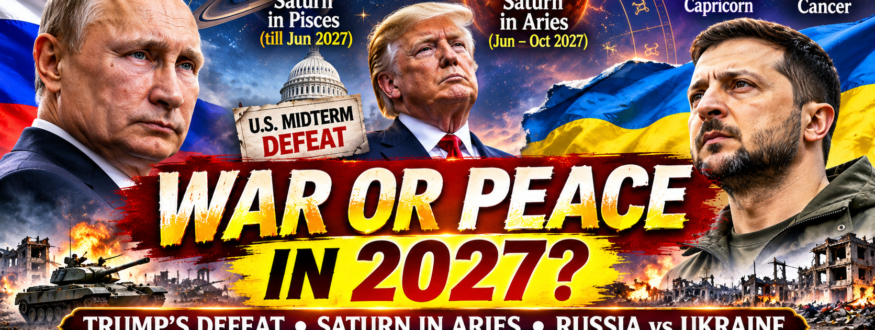
Russia vs Ukraine: Could 2027 Become the Year That Changes the War?
Nearly five years after Russia launched its full-scale invasion of Ukraine on February 24, 2022, Europe continues to confront its most devastating interstate war in generations.
Hundreds of thousands of soldiers have been killed. Millions of Ukrainians have been displaced. Cities, energy infrastructure and communities have suffered enormous destruction.
Yet despite the extraordinary human cost, neither Russia nor Ukraine has secured a decisive military outcome.
Now, as 2026 approaches its conclusion, three developments are converging.
First, President Donald Trump’s Republican Party has suffered a major defeat in the November 2026 US midterm elections, with Democrats projected to control both chambers of Congress.
Second, Washington has renewed diplomatic efforts to negotiate an end to the Russia–Ukraine war, although major disagreements concerning territory and security guarantees remain unresolved.
Third, 2027 introduces a remarkable series of planetary transitions in the Lahiri sidereal zodiac: Saturn temporarily leaves Pisces for Aries, Jupiter moves through Cancer, Leo and Virgo, and Rahu–Ketu occupy the Capricorn–Cancer axis.
The Hindu New Year beginning in April 2027 also introduces Plavanga Samvatsara in the commonly used southern sixty-year cycle.
Could these events represent a geopolitical turning point?
More importantly, can classical Vedic Mundane Astrology offer a symbolic framework for understanding the tension between military confrontation, diplomatic compromise and changing political authority?
To explore this question, we must first examine the facts.
1. The Russia–Ukraine War: What Has Happened Since February 2022?
Russia’s full-scale invasion began on February 24, 2022, following years of conflict dating back to Russia’s annexation of Crimea in 2014 and the fighting in eastern Ukraine.
Moscow justified its military actions through claims concerning Russian security, NATO expansion and the political status of Ukraine.
Ukraine and most Western governments rejected those justifications, describing the invasion as a violation of Ukrainian sovereignty and international law.
What Russia initially appeared to anticipate as a relatively rapid military campaign developed into a prolonged war of attrition.
Ukraine resisted the initial assault on Kyiv, while subsequent fighting increasingly concentrated on eastern and southern territories.
By November 2026, Russian forces controlled approximately one-fifth of Ukrainian territory, including Crimea and other occupied regions.
However, the battlefield situation had become extraordinarily costly for both countries.
Rather than decisive territorial breakthroughs, the war increasingly revolved around artillery, drones, missiles, electronic warfare, defensive fortifications and attacks on military infrastructure.
The fundamental strategic problem remained unchanged.
Russia sought territorial and security concessions that Ukraine considered unacceptable.
Ukraine demanded sovereignty, security guarantees and protection against future aggression.
Neither side had demonstrated a willingness to accept the other’s central conditions.
2. The Human Cost: More Than Two Million Military Casualties
The scale of the conflict is difficult to comprehend.
According to a July 2026 assessment by the Center for Strategic and International Studies (CSIS), Russian military casualties between February 2022 and June 2026 were estimated at approximately 1.4 million.
This figure included personnel killed, wounded or missing.
CSIS estimated that Russian military fatalities alone had reached approximately 400,000–450,000.
For Ukraine, the same assessment estimated approximately 525,000–625,000 military casualties, including 125,000–150,000 deaths.
Together, these estimates suggest that combined military casualties had exceeded two million by mid-2026.
These are independent analytical estimates rather than universally verified totals. Wartime casualty reporting remains incomplete, politically contested and subject to revision.
Civilian Deaths and Displacement
The civilian consequences have been equally devastating.
A November 2026 Russia Matters assessment, drawing on United Nations reporting, stated that more than 17,000 civilians had been killed and almost 54,000 injured in Ukraine.
Approximately 9.6 million Ukrainians were displaced, including internally displaced people and refugees abroad.
The true civilian toll may be higher because independent verification remains difficult in occupied and heavily contested areas.
Beyond the statistics lie destroyed homes, separated families, disrupted education and the psychological consequences of prolonged warfare.
This humanitarian dimension must remain central to any geopolitical or astrological discussion.
War is not merely a contest between governments. Its consequences are borne by ordinary human beings.
3. Has Russia’s Military Advance Stalled?
One of the most important developments of 2026 has been the changing assessment of Russia’s battlefield momentum.
CSIS reported that Russian territorial gains had slowed considerably, while Ukrainian forces had achieved limited territorial recoveries during parts of the year.
Its July 2026 analysis described Russian advances in several contested areas as exceptionally slow relative to the enormous casualties sustained.
The study also highlighted Ukraine’s growing use of drones, long-range strikes and technological adaptation.
This does not mean Russia has lost the war.
Russia continues to possess significant military resources, manpower and the capacity to inflict severe damage on Ukraine.
Nevertheless, the relationship between territorial gains and battlefield losses raises a fundamental strategic question.
How much longer can either country sustain the human and economic costs of continued warfare?
This question increasingly shapes diplomatic calculations in Washington, Moscow, Kyiv and European capitals.
4. Donald Trump’s 2026 Midterm Defeat: A Political Earthquake in Washington
The November 3, 2026 US midterm elections produced a decisive setback for President Donald Trump and the Republican Party.
Democrats won control of the House of Representatives and secured a Senate majority, according to major election projections.
The Council on Foreign Relations described the Democratic victory as one of the largest midterm performances in modern American political history.
By November 11, Democrats had secured 54 Senate seats, with additional races still unresolved.
The election results represented a substantial rejection of the governing party.
Why Did Republicans Lose?
Political analysts have highlighted several contributing factors, including dissatisfaction with the economy, cost-of-living pressures and opposition to aspects of the administration’s domestic policies.
Brookings Institution analysis also emphasised voter reactions to immigration policies and broader social issues.
The election cannot be reduced to one explanation, and it should not be presented as a referendum exclusively on Ukraine.
Nevertheless, the political consequences for Trump’s foreign-policy agenda could be significant.
What Does This Mean for the Russia–Ukraine War?
Trump remains president following the midterm elections.
However, Democratic control of Congress changes the political environment in which his administration must operate.
Congress can influence foreign-policy outcomes through appropriations, oversight, legislation and scrutiny of executive decisions.
A more confrontational Congress may complicate efforts to reshape American commitments to Ukraine or negotiate arrangements that require legislative cooperation.
At the same time, congressional control does not eliminate the president’s diplomatic authority.
Trump can continue negotiations, appoint envoys and pursue foreign-policy initiatives within constitutional and statutory limits.
The result is a potentially more complicated balance of power.
Trump may still seek a historic peace agreement, but the political conditions surrounding that effort have changed dramatically.
5. November 2026: Are Russia and Ukraine Finally Moving Toward Peace?
The most important diplomatic development occurred during November 10–11, when Russian and Ukrainian representatives participated in renewed US-brokered negotiations in Abu Dhabi.
The meetings represented the first such direct talks in approximately nine months.
American envoys Steve Witkoff and Jared Kushner participated in the renewed diplomatic initiative.
The discussions focused on possible pathways toward a ceasefire, prisoner exchanges and longer-term security arrangements.
The Prisoner Exchange Breakthrough
Negotiators reached an agreement in principle concerning a potentially substantial prisoner exchange.
Kushner subsequently suggested that the initiative could become the largest prisoner exchange of the war.
However, the precise scale and implementation had not been finalised as of November 13.
This development offered a limited but meaningful humanitarian opportunity.
The Fundamental Disagreement: Donbas
Despite diplomatic progress, the central territorial dispute remained unresolved.
Russia continued to demand Ukrainian concessions involving the Donbas region.
Ukraine rejected demands that it surrender territory not controlled by Russian forces.
Moscow also sought broader negotiations concerning European security arrangements.
Ukraine and European governments emphasised the need for credible security guarantees and protection against future Russian attacks.
These differences remain substantial.
A prisoner exchange is not equivalent to a ceasefire.
A ceasefire is not equivalent to a comprehensive peace settlement.
And a peace agreement on paper does not necessarily guarantee long-term security.
6. Europe’s New Role: Britain, France, Germany, Italy and Poland
On November 13, 2026, European leaders agreed on a more coordinated representation for future Ukraine peace discussions.
The proposed European negotiating group included Britain, France, Germany, Italy, Poland and European Union institutions.
NATO representation was also expected in future discussions.
The decision reflected a growing European determination to participate directly in negotiations affecting the continent’s security.
German Chancellor Friedrich Merz rejected Russia’s attempt to make a broad restructuring of European security arrangements a prerequisite for resolving the Ukraine conflict.
European leaders argued that Ukraine’s sovereignty and the continent’s security could not be decided without meaningful European participation.
This development introduces another important geopolitical dimension.
The conflict is no longer simply a question of Russia and Ukraine reaching an agreement.
It also concerns the future balance of power between Russia, the United States, NATO and the European Union.
The negotiating table may be expanding even as the battlefield remains dangerous.
PART II: THE VEDIC ASTROLOGY OF WAR, AUTHORITY AND DIPLOMACY
7. Saturn in Pisces: The Karma of a Prolonged War
In the Lahiri sidereal zodiac, Saturn entered Pisces on March 29, 2025.
Saturn is traditionally associated with time, suffering, responsibility, restrictions, labour, endurance and the consequences of accumulated actions.
Pisces, ruled by Jupiter, represents collective ideals, compassion, faith, sacrifice and the dissolution of boundaries.
In Mundane Astrology, the combination offers a powerful symbolic framework for examining prolonged humanitarian crises.
Saturn represents the burden of war.
Pisces symbolises the suffering that transcends national boundaries.
The conflict in Ukraine has affected not only soldiers and governments but also refugees, families, food supplies, energy systems and European security.
From a Jyotish perspective, Saturn in Pisces can be interpreted as a period when political decisions confront their accumulated humanitarian consequences.
The transit does not establish that Saturn caused the war or its casualties.
Rather, its symbolism provides a traditional language for examining responsibility, suffering and the limitations of military power.
8. Saturn Enters Aries in June 2027: A New Phase of Confrontation?
One of the most significant sidereal planetary transitions of 2027 occurs when Saturn enters Aries on approximately June 2–3, depending on time zone.
Aries is ruled by Mars, the planet traditionally associated with warfare, initiative, aggression, military action and confrontation.
Saturn, meanwhile, represents restraint, delay, responsibility and structural limitations.
Saturn is also traditionally debilitated in Aries.
What Does Saturn’s Debilitation Symbolise?
In classical Jyotish, Saturn’s debilitation in Aries reflects tension between Saturnian patience and Martian urgency.
Mars seeks immediate action.
Saturn demands endurance and restraint.
Mars represents confrontation.
Saturn represents consequences.
From a mundane-astrology perspective, this combination may symbolise conflict between aggressive political objectives and the practical limitations of military or institutional power.
Three Possible Geopolitical Expressions
Scenario One: Increased Military Pressure
Negotiations could be accompanied by intensified military activity as either side attempts to improve its bargaining position.
Scenario Two: Confrontation Produces Compromise
The accumulated costs of warfare could increase pressure for a ceasefire or limited settlement.
Scenario Three: Diplomatic Breakdown
Unresolved territorial and security disputes could undermine negotiations, leading to renewed confrontation.
These scenarios are not predictions established by astrology. They are geopolitical possibilities examined through the symbolic tension between Saturn and Mars.
The Most Important Detail: Saturn Returns to Pisces
Saturn’s movement into Aries is temporary in 2027.
Around October 20, Saturn retrogrades back into Pisces.
This creates an interesting symbolic sequence:
Pisces → Aries → Pisces
The transition can be interpreted as:
Accumulated consequences → Confrontation and decisions → Reassessment of unfinished obligations.
In the context of the Russia–Ukraine conflict, the symbolism raises an intriguing question.
Could 2027 witness a major diplomatic or military initiative that subsequently requires reconsideration?
The transit alone cannot answer that question, but it offers a coherent theme for a mundane-astrology discussion.
9. Rahu in Capricorn and Ketu in Cancer: Governments Versus Public Security
In early December 2026, Rahu and Ketu shift into the Capricorn–Cancer axis in commonly used Lahiri sidereal calculations.
This axis remains active throughout 2027.
Capricorn is ruled by Saturn and is traditionally associated with institutions, administration, hierarchy, governance and established structures.
Cancer is ruled by the Moon and is associated with homeland, emotional security, families and the public.
Rahu symbolises ambition, unconventional strategies, disruption and the amplification of desire.
Ketu symbolises detachment, separation, disillusionment and the questioning of established attachments.
Rahu in Capricorn: The Restructuring of Political Power
Rahu’s transit through Capricorn can be interpreted symbolically as increased attention to institutional authority, administrative systems and strategic political objectives.
For the Russia–Ukraine conflict, this symbolism may be applied to negotiations involving territorial control, security institutions, sanctions and the architecture of European defence.
Ketu in Cancer: The Emotional Cost of War
Cancer represents home, family and collective security.
Ketu’s passage through Cancer may symbolically draw attention to displacement, emotional exhaustion, fractured communities and the consequences of prolonged insecurity.
This is particularly relevant to millions of Ukrainians who have been forced to leave their homes.
The Capricorn–Cancer Axis
The central tension becomes:
Institutional power versus human security.
Governments may negotiate borders, military commitments and political arrangements.
Families, meanwhile, seek safety, stability and the possibility of returning home.
This is perhaps the most meaningful humanitarian interpretation of the nodal shift.
10. Jupiter’s Three Major Sign Transitions in 2027
Jupiter, or Brihaspati, represents wisdom, law, diplomacy, ethics, guidance and the principles underlying justice.
Its movement through three sidereal signs during 2027 provides another layer of interpretation.
January 24, 2027: Jupiter Returns to Cancer
Jupiter retrogrades back into Cancer, its sign of exaltation.
Cancer is associated with homeland, protection, security and emotional well-being.
From a mundane-astrology perspective, this may symbolise renewed attention to humanitarian needs, national security and the protection of civilian populations.
In geopolitical terms, the corresponding themes include refugee protection, reconstruction, security guarantees and humanitarian negotiations.
June 25–26, 2027: Jupiter Enters Leo
Jupiter subsequently enters Leo, the sign ruled by the Sun.
Leo represents sovereignty, political authority, leadership and national prestige.
Jupiter in Leo may symbolically emphasise negotiations involving heads of state, national legitimacy and political leadership.
This transit overlaps closely with Saturn’s initial movement into Aries.
Both signs belong to the fire element in traditional Jyotish.
The combination may be interpreted as highlighting political decisions, leadership ambitions and questions of sovereignty.
However, a fiery astrological configuration should not automatically be interpreted as a prediction of military escalation.
November 26, 2027: Jupiter Enters Virgo
Jupiter enters Virgo toward the end of November.
Virgo, ruled by Mercury, is associated with analysis, administration, practical detail and problem-solving.
In a diplomatic interpretation, this transition may symbolise greater attention to technical arrangements.
Such matters could include ceasefire monitoring, reconstruction planning, humanitarian logistics, sanctions compliance and the implementation of negotiated agreements.
The symbolic progression is particularly interesting:
Cancer: Protection and security.
Leo: Sovereignty and leadership.
Virgo: Implementation and practical arrangements.
This sequence provides a useful narrative framework, although it cannot establish that the war will follow these stages.
11. Plavanga Samvatsara 2027: What Does the Hindu Panchang Indicate?
The Hindu New Year beginning on Chaitra Shukla Pratipada, April 7, 2027, introduces Vikram Samvat 2084.
In the commonly used southern Prabhavadi sixty-year cycle, the year is named Plavanga Samvatsara, following Parabhava.
Regional Panchang traditions differ in how Samvatsara names are assigned, particularly between northern Barhaspatya reckoning and southern conventions. Therefore, the Samvatsara designation should be identified with the system being used.
The Symbolism of Plavanga
Plavanga is associated linguistically with leaping or crossing, and the word is also used in Sanskrit for creatures such as monkeys.
A contemporary symbolic interpretation might associate the name with movement, transition and crossing obstacles.
However, the literal meaning of a Samvatsara name should not be mistaken for a verified classical prediction about warfare.
Why the Samvatsara Chart Matters
Traditional annual mundane astrology may examine the Chaitra Shukla Pratipada chart, planetary dignities, the year’s Raja and Mantri, and other Panchang-based indications.
The roles of Raja, Mantri and Senadhipati are determined through specific calendrical rules and may vary by regional tradition.
A rigorous forecast requires calculating the relevant annual chart for the chosen location and Panchang system.
It would therefore be premature to claim that Plavanga Samvatsara guarantees either war or peace.
Nevertheless, its arrival provides a meaningful framework for discussing the political transition from 2026 into 2027.
PART III: WHAT COULD HAPPEN IN 2027?
12. Three Possible Outcomes for the Russia–Ukraine War
Scenario One: A Negotiated Ceasefire
Diplomatic negotiations could produce a ceasefire or a limited agreement addressing immediate military and humanitarian concerns.
Such an outcome would require mechanisms for monitoring compliance and resolving disputes.
A ceasefire could reduce casualties without resolving the underlying territorial conflict.
Scenario Two: A Frozen Conflict
The fighting could diminish without a comprehensive political settlement.
Territorial disagreements might remain unresolved, with both sides maintaining military positions and preparing for future contingencies.
This would reduce some immediate dangers but leave substantial uncertainty.
Scenario Three: Continued War of Attrition
Negotiations could fail to bridge the differences between Moscow and Kyiv.
The conflict might continue through 2027, with both sides attempting to improve their strategic positions while sustaining further casualties and economic costs.
None of these outcomes can be established from planetary transits alone.
13. What Do Geopolitical Experts Suggest?
Military and policy analysts have repeatedly emphasised the importance of battlefield realities, political incentives and credible security guarantees.
CSIS has highlighted the extraordinary Russian casualties and the slowing pace of territorial advances.
The Congressional Research Service has described a conflict in which neither side appears positioned for an easy decisive military victory.
Reuters reporting from the November 2026 negotiations indicates that prisoner exchanges and renewed diplomatic engagement have created limited opportunities, but territorial disputes remain deeply entrenched.
These assessments suggest that negotiations may be necessary without necessarily being sufficient.
A sustainable settlement would require addressing the reasons both sides fear that a ceasefire could be exploited by the other.
For Ukraine, the central concern is future security and sovereignty.
For Russia, the leadership continues to emphasise territorial demands and its preferred European security arrangements.
For the United States and Europe, the challenge is finding a settlement that reduces the danger of renewed warfare without undermining broader security commitments.
14. Could Trump’s Midterm Loss Change the Course of the War?
Trump’s political setback introduces another source of uncertainty.
A Democratic Congress could increase scrutiny of the administration’s negotiations and influence the resources available for Ukraine-related policies.
However, it would be misleading to conclude that the midterm results automatically make peace more or less likely.
Some lawmakers may support stronger assistance to Ukraine.
Others may emphasise diplomatic compromise or domestic spending priorities.
The administration may seek a rapid agreement, while congressional leaders demand greater scrutiny of its terms.
The resulting political environment could produce greater pressure for accountability or complicate negotiations.
From a symbolic Jyotish perspective, this reflects the tension between the Sun and Saturn.
The Sun represents executive authority and leadership.
Saturn represents institutional constraints, accountability and the consequences of political decisions.
The analogy is especially relevant after an election that significantly changed the balance of power in Washington.
Yet the outcome depends on constitutional institutions and political decisions, not planetary symbolism.
15. The Most Important Astrological Window: June to October 2027
If one period deserves particular attention in a symbolic mundane-astrology study, it is June through October 2027.
During this interval:
- Saturn initially occupies Aries, its sign of debilitation.
- Jupiter moves from Cancer into Leo.
- Rahu remains in Capricorn.
- Ketu remains in Cancer.
- Saturn eventually retrogrades back into Pisces.
This combination brings together several traditional themes:
Military initiative and restraint.
Political authority and national sovereignty.
Institutional restructuring.
Humanitarian insecurity.
The reconsideration of unfinished obligations.
For astrologers studying world events, the period may be worth examining through national horoscopes, ingress charts, eclipses and relevant planetary periods.
However, it would be irresponsible to declare this a guaranteed period of peace, territorial collapse or military escalation.
A genuine classical Mundane Astrology study would require considerably more than a comparison of transiting signs.
16. Will 2027 Bring Peace or Another Dangerous Chapter?
The most important question is not whether Saturn enters Aries.
It is whether the political and military leadership of Russia, Ukraine, the United States and Europe can find terms that reduce violence while addressing their fundamental security concerns.
The November 2026 negotiations demonstrate that diplomatic channels remain open.
The possibility of a substantial prisoner exchange offers hope to families separated by war.
European participation may help address security questions that extend beyond Ukraine’s borders.
Yet territorial disputes, distrust and continuing military attacks remain formidable obstacles.
From a traditional Jyotish perspective, 2027 offers a striking symbolic sequence:
Saturn in Aries: Confrontation between ambition and limitation.
Rahu in Capricorn: Institutional power and strategic restructuring.
Ketu in Cancer: Homeland, displacement and emotional insecurity.
Jupiter in Cancer: Protection and humanitarian concerns.
Jupiter in Leo: Sovereignty and political leadership.
Jupiter in Virgo: Practical implementation and detailed agreements.
Plavanga Samvatsara: A new annual cycle that invites examination of transition and political change.
These are interpretive associations, not evidence that celestial movements determine geopolitical events.
Conclusion: The Real Test of 2027 Is Not Victory, but Lasting Security
The Russia–Ukraine war has entered a critical period.
After nearly five years of devastation, the human and economic costs continue to grow.
Donald Trump’s midterm setback has changed the American political landscape.
Renewed negotiations have reopened diplomatic possibilities.
European governments are seeking a more direct role in shaping the continent’s security future.
And the major sidereal planetary movements of 2027 provide a compelling symbolic framework for examining the tension between military confrontation and diplomatic responsibility.
Saturn’s temporary movement into Aries may represent, in astrological language, the struggle between urgency and restraint.
Jupiter’s progression through Cancer, Leo and Virgo offers a symbolic movement from protection toward leadership and practical arrangements.
The Rahu–Ketu axis highlights the contrast between institutional power and the human need for safety.
But history will not be decided by planetary transits.
It will be shaped by decisions made in Moscow, Kyiv, Washington and European capitals.
A ceasefire can stop the shooting. A sustainable peace must also address the conditions that could cause the fighting to resume.
For millions of people whose lives have been transformed by this conflict, that distinction matters far more than political prestige.
Perhaps the most meaningful question for 2027 is therefore not which leader can claim victory.
It is whether the world’s political leaders can create a future in which another generation does not inherit the same war.
Frequently Asked Questions
Will the Russia–Ukraine war end in 2027?
As of November 13, 2026, there is no confirmed comprehensive peace agreement. Renewed negotiations offer possibilities, but major territorial and security disagreements remain unresolved.
Did Donald Trump lose the 2026 midterm elections?
Trump was not personally a candidate. His Republican Party suffered major congressional losses, with Democrats projected to control both the House and Senate.
When does Saturn enter Aries in 2027?
In the Lahiri sidereal zodiac, Saturn enters Aries around June 2–3, 2027, before retrograding into Pisces around October 20.
What is the Rahu–Ketu transit in 2027?
Rahu occupies Capricorn and Ketu occupies Cancer throughout 2027 under the commonly used Lahiri sidereal framework.
Which signs will Jupiter transit in 2027?
Jupiter moves through Cancer, Leo and Virgo during 2027, with ingress dates depending slightly on time zone and ephemeris conventions.
What is the Hindu Samvatsara for 2027?
Plavanga Samvatsara begins in April 2027 under the commonly used southern sixty-year cycle. Northern naming conventions may differ.
Can Vedic Astrology predict war or peace?
Vedic Mundane Astrology provides traditional symbolic interpretations of political and collective events. There is no reliable scientific evidence that planetary movements can predict the outbreak, escalation or conclusion of wars.
Disclaimer: This article combines geopolitical reporting, military estimates and traditional Vedic Mundane Astrology. Casualty figures are estimates and may change. Astrological interpretations are symbolic and should not be presented as established causes or reliable predictions of military or political events. The article does not endorse either side’s military actions.
References and Further Reading
- Reuters — Russia–Ukraine peace negotiations, November 10–13, 2026.
- Reuters — European participation in Ukraine peace discussions, November 13, 2026.
- Center for Strategic and International Studies — Russian Blood and Treasure: The Ballooning Costs of Putin’s War, July 2026.
- Congressional Research Service — Russia’s War Against Ukraine: Diplomatic Talks and U.S. Policy, May 2026.
- Council on Foreign Relations — The 2026 Election by the Numbers, November 2026.
- Brookings Institution — Historic Wins Show the 2026 Vote Was About More Than Prices, November 2026.
- Russia Matters — Russia–Ukraine War Report Card, November 12, 2026.
- Drik Panchang — Hindu New Year and Samvatsara calculations for 2027.
- Brihat Parashara Hora Shastra — Classical planetary significations and Graha Drishti.
- Traditional Jyotish principles concerning Saturn, Jupiter, Rahu, Ketu and Mundane Astrology.
