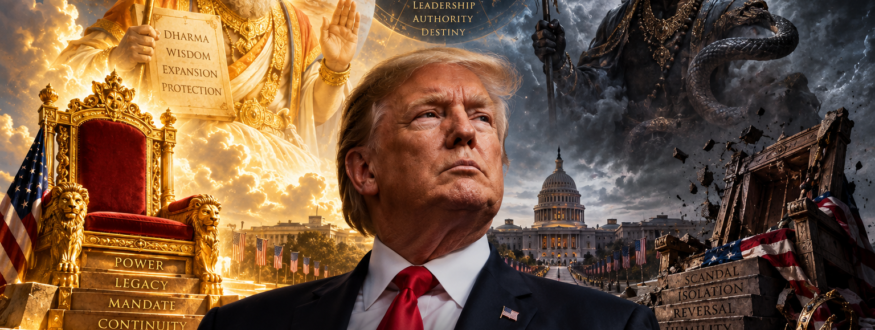
2026 Midterm Elections: Is Donald Trump Approaching Another Political Turning Point?
The 2026 United States midterm elections are rapidly developing into one of the most closely watched political events of Donald Trump’s second presidency.
And the timing is extraordinary from a Vedic astrology perspective.
The elections arrive after a turbulent period involving the continuing conflict with Iran, economic and cost-of-living concerns, major developments involving Venezuela, and another confrontation between the Trump administration and prominent American media organizations.
Meanwhile, barely days before Election Day, Jupiter enters sidereal Leo on October 31, 2026, joining Ketu in the royal sign associated in Jyotish with rulers, sovereignty, authority and political leadership.
For Donald Trump, this becomes especially interesting because his widely used Vedic horoscope has Leo Ascendant.
So the question astrologers naturally encounter is:
Does Jupiter arriving over Trump’s Lagna provide protection at the crucial moment—or does Jupiter joining Ketu force a karmic reckoning with power itself?
Before examining the horoscope, we need to understand the political environment in which this unusual transit is occurring.
Why the 2026 Midterms Matter
Midterm elections take place halfway through a president’s four-year term. All 435 seats in the House of Representatives are contested, while roughly one-third of the Senate is elected. The 2026 elections take place in November.
Consequently, this is not simply another election for Donald Trump.
His own name is not on the congressional ballot, but voters’ attitudes toward the sitting president can become an important part of the political environment surrounding congressional races.
And in September 2026, that environment is unusually volatile.
Trump’s Political Journey: From Venezuela to the Iran Problem
Trump’s second presidency has produced dramatic foreign-policy developments.
Venezuela represents one of the developments his administration can present as a success. Following the removal and arrest of Nicolás Maduro earlier in 2026, the administration has pointed to increasing cooperation with Venezuela’s interim authorities. In September, the United States removed Venezuela from its list of countries deemed to be failing in their efforts against illegal drug trafficking.
The White House has also strongly promoted its Venezuela energy agreement as a major achievement of Trump’s foreign policy. That description, however, represents the administration’s own characterization of the agreement rather than a neutral assessment of its long-term results.
Iran presents a very different political problem.
The conflict has continued for months, and Congress has repeatedly debated attempts to restrict continued military operations. On September 15, the House passed another war-powers resolution aimed at ending U.S. military involvement, with Democrats and seven Republicans supporting it.
Yet diplomacy has not disappeared.
On September 22, Trump said negotiations with Iran were continuing and expressed confidence that an eventual settlement could be reached, while maintaining that Iran could not be permitted to acquire nuclear weapons.
Therefore, the political situation remains fluid rather than resolved.
And public opinion reflects that uncertainty.
Trump’s Approval Rating Becomes a Midterm Issue
A Reuters/Ipsos poll published September 21 reported Trump’s presidential approval at 32% among U.S. adults, with particularly weak ratings on the cost of living and significant dissatisfaction surrounding Iran. The poll surveyed 1,277 adults and carried a margin of error of about three percentage points.
The same poll found Democrats ahead of Republicans by eight percentage points on the congressional ballot among respondents at that moment. That is a snapshot rather than an election forecast: national polling does not translate mechanically into individual House and Senate contests, and opinion can change before voting.
This distinction is extremely important.
The midterms are not one national presidential contest. They consist of hundreds of individual races, with candidate quality, district composition, turnout and local issues all affecting the final results.
Nevertheless, presidential approval provides an important piece of the political background.
And another controversy has now added to that environment.
Trump vs. CNN, Politico and MS NOW
In September, Trump announced that CNN, Politico and MS NOW would be barred from the White House, accusing them of publishing false reporting.
The restriction was subsequently enforced, with journalists from the organizations denied access and credentials confiscated. The organizations challenged the action, arguing that it violated First Amendment protections.
The controversy escalated further when other major television networks temporarily suspended White House pool coverage in response.
For Trump’s supporters, his confrontation with mainstream media fits his longstanding argument that major news organizations treat him unfairly.
Critics, including press-freedom organizations and the affected outlets, argue that excluding journalists because of unfavorable reporting threatens constitutional press protections. The dispute is now also a legal question rather than merely a political argument.
Whatever one’s political interpretation, the timing is striking for an astrologer:
authority, media, institutions, conflict and public perception are simultaneously becoming major themes just before Jupiter enters Leo.
Now Enter Vedic Astrology
Astrology should be treated here as a traditional interpretive framework rather than an empirically established method of predicting election results.
But Trump’s horoscope provides a fascinating case study.
The commonly cited birth information for Donald Trump is:
June 14, 1946
10:54 AM
Queens, New York
Astro-Databank rates this birth information AA, its highest category, indicating birth-record documentation.
Using the Lahiri sidereal system, this produces a Leo (Simha) Ascendant. One Vedic calculation using these birth details places his Moon in Scorpio, Mars in Leo, Mercury in Gemini, Jupiter in Virgo, Saturn and Venus in Cancer, and the Rahu-Sun combination in Taurus.
That Leo Ascendant becomes central to November 2026.
Donald Trump: The Leo Ascendant Archetype
Leo is ruled by the Sun.
In mundane and political astrology, the symbolism of Leo naturally resonates with:
- rulers and heads of state,
- authority,
- visibility,
- leadership,
- prestige,
- personal command,
- spectacle,
- recognition,
- and the relationship between an individual leader and the collective.
Trump’s chart contains another important feature.
Mars occupies Leo itself.
This gives the Ascendant a strongly Martian quality: confrontation, competition, aggression, rapid reaction and willingness to enter battles.
His horoscope therefore contains a powerful mixture of Surya and Mangala symbolism — authority combined with combativeness.
But perhaps the most remarkable combination appears in the tenth house.
Sun + Rahu in Trump’s 10th House
For Leo Ascendant, Taurus becomes the tenth house of career, authority, reputation and public status.
Trump’s sidereal chart places both the Sun and Rahu in Taurus, with the two positioned very close together.
This is extraordinarily symbolic considering his public career.
The Sun represents authority, government, status and the ruler.
Rahu amplifies, disrupts and crosses conventional boundaries.
Put them together in the karma-sthana—the tenth house—and public life rarely remains ordinary.
The same combination can be interpreted as creating enormous visibility while simultaneously generating controversy around authority.
Trump’s political career has repeatedly displayed both sides of that symbolism:
extraordinary political visibility and extraordinary political polarization.
And then we arrive at 2026.
Trump Is Running Jupiter Mahadasha
Vimshottari calculations based on the commonly used birth data place Trump in Jupiter Mahadasha, approximately 2016–2032.
The symbolism is remarkable.
His Jupiter period began around the same broad historical chapter in which he entered the presidency.
But natal Jupiter occupies Virgo, the second house from Leo Ascendant.
The second house concerns wealth, speech, values, accumulated resources and the continuity of one’s established position.
Jupiter additionally governs the fifth and eighth houses for Leo Ascendant.
Therefore Jupiter carries two dramatically different currents:
5th house: intelligence, strategy, political counsel, merit and purva punya.
8th house: upheaval, crisis, reversals, secrets and sudden transformation.
This makes Jupiter Mahadasha capable of producing expansion through periods of enormous disruption.
That description fits Trump’s political trajectory surprisingly well.
But the most fascinating development occurs immediately before the midterms.
October 31, 2026: Jupiter Enters Leo
According to Lahiri sidereal transit calculations, Jupiter leaves Cancer and enters Leo on October 31, 2026.
This places Jupiter directly into Trump’s Ascendant sign.
Normally, Jupiter transiting the Lagna is considered a significant period.
Guru brings expansion.
Guru brings advisers.
Guru brings legitimacy.
Guru can bring protection.
And Jupiter’s aspects from Leo fall upon the fifth, seventh and ninth houses—three extremely significant areas of a horoscope.
But there is a complication.
Ketu is already moving through Leo.
And therefore the political story isn’t simply:
“Jupiter enters Trump’s Lagna, therefore Trump wins.”
Jyotish is considerably subtler than that.
Jupiter Meets Ketu: Guru Meets the Headless Graha
Ketu is among the most misunderstood forces in Vedic astrology.
Ketu represents separation, detachment, previous karmic residue, dissolution of ego and the removal of attachment to worldly identity.
Jupiter represents wisdom, law, counsel, dharma and expansion.
When Jupiter and Ketu meet, worldly expansion and spiritual detachment occupy the same territory.
This is why Guru-Ketu combinations can be paradoxical.
Something may expand while something else is being removed.
A person may receive protection while simultaneously being forced to surrender control.
Truth can become more important than image.
And the ego can encounter circumstances it cannot completely command.
For a Leo Ascendant individual—particularly someone whose identity is inseparable from leadership—the symbolism becomes unusually powerful.
The Magha Connection: Throne, Ancestors and Karmic Authority
Jupiter’s October 31 ingress takes it into the beginning of Leo and therefore into Magha Nakshatra.
Magha is associated traditionally with the Pitris—the ancestral powers.
Its symbolism concerns lineage, inheritance, throne, authority and the burden accompanying status.
Magha asks a fascinating question:
What have you inherited, and what will you do with the authority that inheritance gives you?
For an ordinary horoscope, this can concern family lineage.
For the horoscope of a president, the symbolism can be read more broadly: political inheritance, institutional authority and the legacy attached to holding office.
And Jupiter’s arrival amplifies those questions.
Does Jupiter Protect Trump?
This is where simplistic election astrology becomes dangerous.
Jupiter transiting Trump’s Lagna can certainly be interpreted as supportive.
It can correspond astrologically with:
- renewed confidence,
- influential advisers,
- opportunities to recover political momentum,
- greater ideological clarity,
- legal or institutional developments,
- international diplomacy,
- and attempts to reframe the narrative surrounding his presidency.
A diplomatic settlement involving Iran, for example, would fit Jupiterian symbolism far more naturally than endless confrontation.
But Jupiter does not arrive alone.
Ketu changes the equation.
Ketu says:
Power cannot remain entirely under personal control.
The combination therefore resembles protection accompanied by detachment rather than uncomplicated victory.
Could Ketu Work Against Him?
Potentially—but not necessarily in the simplistic sense of political defeat.
Ketu moving across the Lagna can challenge identity itself.
For a political leader, that can manifest symbolically through questions such as:
Who actually controls the political narrative?
Does personal popularity remain transferable to congressional candidates?
Can foreign-policy achievements outweigh domestic dissatisfaction?
Can confrontation continue mobilizing supporters without simultaneously energizing opponents?
Does institutional conflict strengthen the leader’s image—or begin exhausting the broader electorate?
These are exactly the types of contradictions surrounding Trump in late 2026.
And Jupiter joining Ketu magnifies them.
The Iran Question May Be More Important Than It Appears
Astrologically, Iran may become one of the most consequential themes surrounding the final weeks before the election—not because astrology proves how voters will respond, but because the political issue overlaps strikingly with the symbolism of Jupiter and Ketu.
Jupiter represents diplomacy, judgment and settlement.
Ketu represents cutting, separation and ending attachments.
If negotiations move meaningfully toward settlement, the symbolism could manifest through de-escalation and a shift from Mars-like confrontation toward Jupiterian negotiation.
If the conflict remains unresolved, however, the same transit could emphasize the political cost of a situation that voters perceive as lacking a clear conclusion.
Trump said on September 22 that talks were continuing and that he believed a settlement would ultimately be reached.
That makes the weeks immediately ahead especially interesting from both political and astrological perspectives.
What About America’s Horoscope?
Here we need to correct one common misconception.
There is no universally authenticated Leo Ascendant horoscope for the United States.
Astrologers agree on July 4, 1776 as the symbolic national birth date, but the precise time remains disputed.
Astro-Databank explicitly notes that the U.S. chart’s time has been debated since the nineteenth century. One famous version uses approximately 5:10 PM and Sagittarius rising, while alternative historical charts produce other Ascendants.
Therefore, rather than pretending that one American Lagna has been historically proven, a responsible mundane analysis should place greater weight on planetary cycles whose interpretation does not depend entirely upon a disputed birth time.
And that brings us back to Leo.
Jupiter-Ketu in Leo: The Mundane Political Message
Leo is the natural sign of kingship.
In mundane Jyotish, its symbolism encompasses leadership, government prestige, heads of state and the performance of political authority.
Jupiter entering Leo expands the question of leadership.
Ketu in Leo strips leadership of certainty.
Together they create an unusual collective message:
The institution of leadership becomes larger—but the leader’s ability to completely control its meaning becomes smaller.
This is why the 2026 midterms may be remembered astrologically less as a straightforward referendum and more as a recalibration of political authority.
The electorate decides Congress.
Congress determines how easily the executive can legislate.
Foreign policy intersects with domestic economics.
Media institutions confront presidential authority.
And Jupiter and Ketu meet inside the zodiac’s royal sign.
The symbolism is difficult to ignore.
So What Does Vedic Astrology Suggest About the 2026 Midterms?
The astrological picture does not justify a confident prediction that either Republicans or Democrats will control Congress.
Nor does the current polling provide certainty about individual races.
Instead, the combination points toward an unusually consequential and contested political environment.
Trump’s Jupiter Mahadasha remains active.
Jupiter enters his Ascendant sign only days before Election Day.
That can symbolize protection, strategic opportunities and an ability to regain momentum.
But Ketu occupying the same sign introduces unpredictability, detachment and the possibility that political power behaves differently from what either side expects.
Therefore the most interesting astrological question is not simply:
“Will Jupiter save Trump?”
It is:
“What will Jupiter protect—and what will Ketu force him to surrender?”
That distinction could define the entire political symbolism of November 2026.
Final Astrological Perspective: A Battle for the Meaning of Power
Donald Trump’s horoscope has always contained extraordinary contradictions.
A Leo Ascendant seeks visibility.
Mars in Leo fights.
Sun-Rahu in the tenth house magnifies political ambition and public controversy.
Jupiter Mahadasha expands his historical significance.
And now Jupiter approaches Leo while Ketu is already occupying the sign of kingship.
From a Jyotish perspective, that is not a quiet transit.
It suggests a period in which leadership, legacy, authority and detachment collide simultaneously.
The political evidence available in September also points toward a competitive environment: Trump’s approval has weakened in recent polling, Iran remains politically contentious, the administration is promoting its Venezuela policy as a success, and the White House’s conflict with major media organizations has opened another institutional confrontation.
None of those facts predetermines the election.
And astrology should not be used to manufacture certainty where none exists.
But symbolically, November 2026 arrives at a remarkable moment.
Jupiter may provide the shield.
Ketu may remove the illusion of control.
And the American electorate—not the planets—will determine who controls Congress.
Perhaps that is the deeper message of Guru-Ketu in Leo:
The throne may remain powerful, while the person sitting upon it discovers that power itself has limits.
Disclaimer: Political developments and polling cited in this article reflect information available as of September 22, 2026. Polling is a snapshot of public opinion, not a prediction of election results. Astrological interpretations are based on traditional Vedic astrology and are presented for educational and cultural interest rather than as scientifically established election forecasts.
