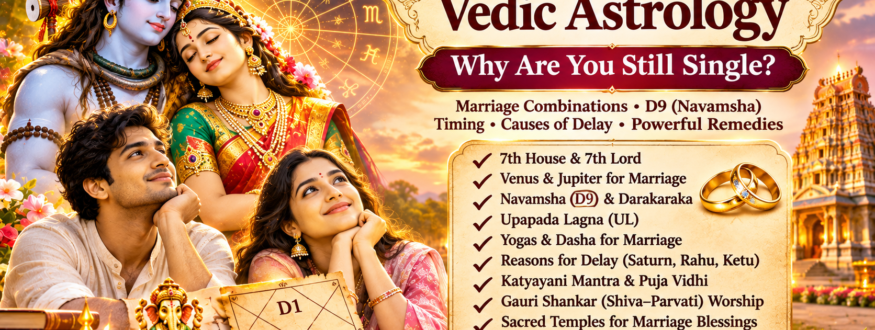
Marriage in Vedic Astrology: Why Do Some People Find Their Partner Early While Others Remain Single?
Why do some individuals meet their life partners effortlessly while others remain single well into their thirties or forties?
Is delayed marriage a result of Saturn, an afflicted 7th House, challenging planetary Dashas, or simply the circumstances of modern life?
Can Vedic Astrology distinguish between meeting a potential partner, developing a committed relationship and actually getting married?
In Sanatan Dharma, marriage is traditionally regarded as one of the important Samskaras, representing companionship, shared responsibilities, family life and the pursuit of Dharma.
Classical Jyotish examines marriage through several interconnected factors, particularly the 7th House, its lord, Venus, Jupiter, the Navamsha (D9) chart, Jaimini Darakaraka, Upapada Lagna and relevant planetary periods.
However, one fundamental principle deserves emphasis:
Delay in marriage does not necessarily indicate denial of marriage.
Furthermore, remaining unmarried is not inherently a defect, misfortune or indication of negative karma. Marriage is a personal choice, and a horoscope cannot scientifically establish whether or when someone will marry.
Let us examine the traditional astrological combinations associated with marriage before exploring a consolidated Sanatan Dharma remedy package for unmarried individuals seeking a suitable life partner.
1. The 7th House: The Primary House of Marriage
The 7th House is the principal house associated with marriage, committed partnerships, contractual relationships and the spouse.
Its lord, planetary occupants, aspects and relationship with other houses are examined to understand the traditional indications concerning partnership.
Auspicious Marriage Combinations
The following configurations are traditionally considered supportive of marriage:
- A strong 7th Lord placed in a Kendra or Trikona, particularly when receiving benefic support.
- A favourable relationship between the 1st Lord and 7th Lord.
- Venus influencing the 7th House or its lord in a supportive manner.
- Jupiter’s benefic influence on the 7th House or 7th Lord.
- A relationship between the 5th and 7th Lords, sometimes interpreted as supportive of romance developing into marriage.
- Connections between the 7th and 11th Houses, traditionally associated with fulfilment of relationship aspirations.
- Supportive combinations repeated in the Navamsha (D9) chart.
These factors are considered collectively rather than individually.
A strong 7th House alone does not guarantee marriage, just as an afflicted 7th House does not establish permanent denial.
2. The 2nd, 5th, 8th, 9th and 11th Houses in Marriage Analysis
Although the 7th House is central, a complete traditional assessment also considers several supporting houses.
2nd House: Family Formation
The 2nd House represents family, lineage, accumulated resources and the development of household responsibilities.
Its relationship with the 7th Lord may be interpreted as relevant to establishing a family after marriage.
5th House: Romance and Emotional Attachment
The 5th House represents affection, romance, attraction and emotional expression.
Connections between the 5th and 7th Lords are frequently examined when assessing traditional indications of love marriage.
8th House: Shared Resources and Marital Vulnerabilities
The 8th House is associated with shared resources, intimacy, vulnerability and transformative experiences.
Traditional astrologers examine its condition in relation to the broader stability and complexities of married life.
9th House: Dharma and Blessings
The 9th House represents Dharma, fortune, teachers and guiding values.
Its favourable relationship with marriage-related houses may be interpreted as supportive of shared beliefs and family blessings.
11th House: Fulfilment of Desires
The 11th House represents gains, social connections and fulfilment of aspirations.
Connections involving the 7th and 11th Lords may be considered relevant to the realisation of marriage-related goals.
3. Venus and Jupiter: Important Planetary Significators of Marriage
Venus: Relationships, Affection and Partnership
Venus, or Shukra, is the principal natural significator of marriage, romantic attraction, harmony and sensual enjoyment in many Parashari interpretations.
A strong Venus may traditionally be associated with relationship opportunities, affection and the capacity to appreciate companionship.
Its placement, dignity, conjunctions, aspects and condition in Navamsha are important considerations.
However, an afflicted Venus does not automatically indicate unsuccessful relationships or lifelong bachelorhood.
Jupiter: Wisdom, Commitment and Marital Guidance
Jupiter represents wisdom, ethics, guidance, blessings and the principles supporting family life.
Traditional Jyotish also assigns Jupiter particular significance in certain spouse-related interpretations, especially in older gender-specific conventions.
Modern readings should avoid assuming that a person’s gender alone determines the nature of their marriage.
Jupiter’s relationship with the 7th House, 7th Lord and Navamsha may be examined as part of the broader marriage analysis.
4. Navamsha (D9): The Divisional Chart of Marriage
The Navamsha, or D9 chart, is one of the most important divisional charts in classical Jyotish.
Each zodiac sign is divided into nine portions to construct the chart.
Navamsha is used to refine the assessment of planetary strength, Dharma and marriage-related matters.
Important factors include:
- D9 Ascendant and its Lord.
- D9 7th House and 7th Lord.
- Venus and Jupiter in Navamsha.
- The dignity of the natal 7th Lord in D9.
- Benefic and challenging influences on marriage-related houses.
- Correlation between D1 and D9 configurations.
For example, a 7th Lord appearing challenged in the birth chart but receiving substantial support in Navamsha may invite a more nuanced traditional interpretation.
The D1 chart establishes the broader framework, while D9 refines the assessment.
Navamsha should not be interpreted in isolation or used to guarantee marriage outcomes.
5. Jaimini Darakaraka: The Chara Karaka of Spouse
Jaimini Astrology introduces the concept of Chara Karakas, where planets receive particular significations based on their degrees within their respective signs.
In the commonly used seven-Chara-Karaka system, the planet with the lowest longitude within its sign becomes Darakaraka.
Darakaraka is associated with the spouse and committed partnerships.
Its placement, dignity, associations, Jaimini aspects and relevant divisional-chart positions may be examined.
In the eight-karaka system, the calculation differs because Rahu is included.
Darakaraka may offer additional symbolic insight into relationship themes, but it cannot reliably identify a future spouse or predict their personality with certainty.
6. Upapada Lagna (UL): Marriage and Family Life in Jaimini Astrology
Upapada Lagna is an important Arudha-based indicator traditionally used in Jaimini marriage analysis.
It is calculated from the 12th House using the Arudha Pada method, subject to the relevant calculation rules and exceptions.
Traditional astrologers examine:
- The placement and strength of Upapada Lagna.
- The Lord of Upapada Lagna.
- Planets influencing UL.
- The 2nd House from UL, traditionally examined for marital sustenance.
- Relationships between UL, Darakaraka and the natal 7th House.
Upapada Lagna provides another interpretive layer concerning marriage and family circumstances.
It should not be treated as an independent or infallible marriage prediction technique.
7. Important Marriage Yogas in Vedic Astrology
1st and 7th Lord Connection
A relationship between the Ascendant Lord and 7th Lord is traditionally interpreted as connecting the individual with partnership matters.
Its significance depends on planetary strength, dignity, house placement and other influences.
5th and 7th Lord Connection
A relationship between the 5th and 7th Lords is frequently considered in interpretations concerning romance developing into marriage.
However, it cannot determine whether a person will have a love marriage.
7th and 11th Lord Connection
A favourable relationship between the 7th and 11th Lords may be interpreted as supportive of the fulfilment of partnership aspirations.
Strong Venus in Kendra or Trikona
A well-supported Venus in a favourable house may be considered beneficial for relationship harmony and attraction.
Jupiter’s Influence on the 7th House
Jupiter’s favourable influence on the 7th House or its lord is traditionally regarded as supportive of marriage-related matters.
Supportive Navamsha Combinations
When favourable natal marriage indicators receive reinforcement in D9, astrologers may interpret the combined configuration more positively.
None of these Yogas independently guarantees marriage or a particular marital experience.
8. Why Is Marriage Delayed? Saturn, Rahu, Ketu and the 7th House
Delayed marriage is one of the most frequently discussed subjects in contemporary Jyotish.
Traditional astrologers may examine:
- Saturn’s influence on the 7th House or 7th Lord.
- Challenging relationships involving the 6th, 8th or 12th Houses.
- Afflictions involving Venus or the 7th Lord.
- Rahu or Ketu influencing marriage-related houses.
- Difficult configurations repeated in D1 and D9.
- Planetary periods not strongly connected with marriage-related significators.
Saturn and Delayed Marriage
Saturn is traditionally associated with time, responsibility, maturity and sustained commitments.
Its influence on the 7th House may be interpreted as indicating caution, delayed commitment or a more serious approach to partnership.
However, Saturn does not automatically deny marriage.
Rahu and Ketu in Marriage Analysis
Rahu and Ketu may be interpreted as introducing unconventional circumstances, detachment, uncertainty or changes in relationship expectations.
Their influence should always be evaluated within the entire horoscope.
Rahu or Ketu in the 7th House does not automatically mean divorce, failed marriage or lifelong bachelorhood.
Modern relationship circumstances, personal preferences, financial responsibilities and opportunities to meet compatible partners remain important real-world considerations.
9. Marriage Timing Through Mahadasha, Antardasha and Transits
In traditional Vimshottari Dasha analysis, marriage timing is examined through planetary periods associated with marriage-related houses and significators.
Commonly examined periods include:
- The Mahadasha or Antardasha of the 7th Lord.
- Venus periods when Venus is meaningfully connected with marriage indicators.
- Periods involving planets occupying or influencing the 7th House.
- Planetary periods connected with the 2nd or 11th Houses.
- Relevant D9 combinations and their planetary rulers.
Jupiter and Saturn transits are also frequently examined in relation to the natal Ascendant, Moon, 7th House and marriage-related planets.
However, no Dasha or transit can reliably establish an exact wedding date.
Meeting someone, developing a relationship, becoming engaged and getting married are distinct events.
Traditional astrologers should avoid presenting one planetary transit as a guarantee that all these events will occur.
10. Katyayani Mantra: A Sacred Prayer for Marriage
Among the most recognised Hindu devotional practices associated with seeking a suitable husband is the worship of Goddess Katyayani.
The Bhagavata Purana describes the unmarried Gopis of Vraja undertaking Katyayani worship with the desire to have Lord Krishna as their husband.
Katyayani Mantra in Sanskrit
कात्यायनि महामाये महायोगिन्यधीश्वरि।
नन्दगोपसुतं देवि पतिं मे कुरु ते नमः॥
English Transliteration
Katyayani Mahamaye Mahayoginyadhishvari,
Nandagopa-sutam Devi Patim Me Kuru Te Namah.
Meaning
“O Goddess Katyayani, great divine power and supreme Yogini, I bow to you. Please grant that the son of Nanda may become my husband.”
This mantra appears in the Bhagavata Purana, Canto 10, Chapter 22, Verse 4.
The original prayer specifically refers to Krishna as the desired husband. Devotees today may draw broader spiritual inspiration from the story when praying for a compatible partner.
Katyayani Mantra Puja Vidhi
Step 1: Choose an Auspicious Beginning
Friday is commonly associated with Goddess worship.
Some devotees prefer beginning during Shukla Paksha, the waxing phase of the Moon.
However, the Bhagavata Purana’s Katyayani-vrata narrative describes the Gopis undertaking their observance during the first month of Hemanta, traditionally associated with Margashirsha.
Therefore, a Friday during Shukla Paksha is a contemporary devotional preference, not the specific universal rule established by that narrative.
Step 2: Prepare the Altar
Place an image of Goddess Katyayani or Durga in a clean prayer area.
Offer flowers, water, a lamp and suitable devotional offerings according to family tradition.
Step 3: Take a Sankalpa
Pray for a compatible, respectful and loving life partner.
The Sankalpa may emphasise mutual understanding, emotional maturity and a harmonious married life.
Step 4: Recite the Mantra
Recite the Katyayani Mantra 108 times daily if convenient.
Step 5: Continue the Observance
A 40- or 41-day devotional commitment may be adopted according to personal preference.
This duration is not a universal scriptural requirement for the mantra.
The practice is spiritual and has not been scientifically demonstrated to produce marriage opportunities.
11. The Pauranic Story of Katyayani Vrata and the Gopis
The Bhagavata Purana recounts that the unmarried Gopis of Vraja worshipped Goddess Katyayani while desiring Lord Krishna as their husband.
They observed a devotional discipline, worshipped the Goddess and recited their prayer with sincerity.
This narrative is one of the clearest scriptural connections between Goddess worship and a prayer concerning marriage.
Its spiritual significance extends beyond a literal marriage request.
The story emphasises devotion, dedication and the desire for divine companionship.
It should not be interpreted as a guarantee that reciting the mantra will result in marriage within a particular number of days.
12. Gauri Shankar Worship: Seeking the Blessings of Shiva and Parvati
Lord Shiva and Goddess Parvati are revered as divine embodiments of spiritual partnership, devotion and complementary energies.
Their union occupies an important place in Hindu religious literature.
The story of Parvati’s devotion and austerities before her marriage to Shiva is narrated in several Hindu traditions, including the Shiva Purana.
For unmarried individuals seeking a compatible partner, Shiva-Parvati worship is a widely recognised devotional practice.
Suggested Gauri Shankar Puja
- Begin on a convenient Monday or during Shukla Paksha.
- Offer clean water and Bilva leaves to Lord Shiva where customary.
- Offer flowers and prayers to Goddess Parvati.
- Recite Om Namah Shivaya 108 times.
- Pray for a relationship founded on mutual respect, affection and responsibility.
Shiva Mantra:
ॐ नमः शिवाय॥
Om Namah Shivaya.
The practice may be performed by unmarried men or women.
There is no need for elaborate or expensive arrangements.
13. Swayamvara Parvati Mantra and Marriage Remedies
Swayamvara Parvati worship is another devotional tradition associated with seeking a suitable spouse.
Different lineages preserve different mantras and ritual procedures under this name.
Some versions involve formal initiation, prescribed Nyasa, specific Japa counts or priest-guided ceremonies.
For this reason, individuals wishing to undertake a formal Swayamvara Parvati Mantra Anushthana should obtain the exact mantra and procedure from a qualified teacher or priest within their tradition.
For a simple household practice, Shiva-Parvati worship and Om Namah Shivaya offer a more accessible alternative.
A specific marriage date or guaranteed result should never be promised on the basis of mantra recitation.
14. Sacred Temples Traditionally Associated With Marriage Blessings
Kalyana Sundareswarar Temple, Thirumanancheri, Tamil Nadu
Thirumanancheri is widely associated with prayers for marriage.
The temple is dedicated to Lord Shiva and Goddess Parvati and is especially known for traditions connected with their divine wedding.
Devotees seeking marriage blessings visit the temple and participate in the prescribed worship according to temple customs.
The pilgrimage is particularly meaningful for those devoted to Shiva-Parvati.
Meenakshi Amman Temple, Madurai, Tamil Nadu
Meenakshi Amman Temple celebrates the divine relationship between Goddess Meenakshi and Lord Sundareswarar.
The sacred wedding of Meenakshi and Sundareswarar is a central element of the temple’s religious tradition.
Devotees may seek blessings for marriage, family harmony and companionship.
Mangadu Kamakshi Amman Temple, Chennai, Tamil Nadu
Mangadu Kamakshi Amman Temple is associated with Goddess Parvati’s penance and devotion to Lord Shiva.
The temple is an important destination for devotees seeking blessings concerning marriage and family life.
Temple-specific rituals should be confirmed directly with the relevant temple authorities.
Pilgrimages should remain voluntary expressions of faith rather than financial obligations or guaranteed solutions to delayed marriage.
15. Consolidated Sanatan Dharma Remedy Package for Unmarried Men and Women
For unmarried individuals seeking a compatible life partner, a balanced spiritual routine may combine devotion, prayer, charitable service and practical efforts to build meaningful relationships.
Remedy 1: Katyayani Mantra
Recite the Katyayani Mantra 108 times daily if it aligns with your devotional tradition.
Friday or a convenient Shukla Paksha day may be chosen as the beginning.
Remedy 2: Shiva-Parvati Worship
Offer prayers to Lord Shiva and Goddess Parvati on Mondays.
Recite Om Namah Shivaya 108 times.
Remedy 3: Ganesha Worship
Lord Ganesha is traditionally invoked before beginning important undertakings.
Ganesha Mantra:
ॐ गं गणपतये नमः॥
Om Gam Ganapataye Namah.
Recite 21 or 108 times according to personal preference.
Remedy 4: Venus-Related Devotional Practice
Venus is traditionally associated with relationships, affection and harmony.
Friday worship of Goddess Lakshmi or another deity according to family tradition may be incorporated into the routine.
Expensive gemstones or planetary rituals are not necessary.
Remedy 5: Guru Brihaspati Worship
Jupiter represents wisdom, guidance and ethical principles.
Thursday prayers may focus on developing sound judgment, patience and responsibility in relationships.
Remedy 6: Charity and Seva
Offer food, support families in need or assist community initiatives.
Charitable service may be undertaken as an expression of compassion rather than as a transaction intended to secure marriage.
Remedy 7: Sacred Temple Pilgrimage
Visit a temple associated with Shiva-Parvati, Goddess Katyayani or marriage blessings if practical.
The journey should not interfere with financial responsibilities or create pressure to obtain a particular result.
16. A Simple 41-Day Marriage Remedy Routine for Singles and Bachelors
Individuals seeking a manageable spiritual programme may adopt the following optional 41-day routine.
Daily Morning Routine
Step 1: Begin with a short prayer to Lord Ganesha.
Step 2: Recite Om Namah Shivaya 108 times.
Step 3: Recite the Katyayani Mantra if it is appropriate to your devotional practice.
Step 4: Offer a Sankalpa for a compatible, loving and respectful partnership.
Weekly Routine
Monday: Shiva-Parvati worship.
Tuesday: Hanuman Chalisa or another preferred devotional practice.
Wednesday: Ganesha worship.
Thursday: Guru Brihaspati or Vishnu worship.
Friday: Katyayani, Gauri or Lakshmi worship according to personal tradition.
Saturday: Charitable service or quiet spiritual reflection.
Sunday: Gratitude, self-reflection and preparation for the coming week.
Day 41: Completion of the Sankalpa
Conclude the observance with gratitude.
Offer food or charitable support if feasible.
The 41-day duration is a personal devotional commitment rather than a scripturally guaranteed period for finding a spouse.
17. Practical Steps That Should Accompany Marriage Remedies
Spiritual practice may provide personal meaning and emotional strength, but meeting a compatible partner also requires practical effort.
Unmarried individuals may benefit from:
- Developing clarity about relationship expectations and long-term goals.
- Participating in social, cultural or community activities.
- Exploring reputable matrimonial platforms when appropriate.
- Communicating openly about marriage, children, finances and family responsibilities.
- Avoiding relationships driven solely by pressure, fear or age-related anxiety.
- Seeking counselling or relationship guidance when helpful.
- Respecting consent, compatibility and personal boundaries.
A meaningful marriage requires more than a favourable horoscope.
It requires mutual willingness, trust, communication and sustained commitment.
Frequently Asked Questions About Marriage in Vedic Astrology
Which planet is responsible for marriage?
Venus is the principal natural significator of marriage and relationships in many Parashari interpretations. Jupiter also holds important significance, while the 7th House and its lord remain central.
Can Saturn delay marriage?
Traditional Jyotish sometimes associates Saturn with delay, maturity and responsibility. However, Saturn’s placement cannot reliably predict whether or when someone will marry.
Does Rahu in the 7th House deny marriage?
No. Rahu in the 7th House does not automatically indicate denial of marriage, divorce or an unsuccessful partnership.
Which divisional chart is used for marriage?
The Navamsha (D9) chart is the principal divisional chart traditionally examined for marriage-related matters, alongside the natal D1 chart.
What is Darakaraka in Jaimini Astrology?
Darakaraka is a Chara Karaka associated with the spouse. In the commonly used seven-karaka system, it is the planet holding the lowest longitude within its sign.
Which mantra is best for delayed marriage?
Katyayani Mantra, Shiva-Parvati worship and Om Namah Shivaya are commonly practised devotional options. The choice depends on personal faith and religious tradition.
Which day is best to begin marriage remedies?
Monday is commonly associated with Shiva worship, while Friday is often associated with Goddess worship. Shukla Paksha may be preferred in some traditions, but no particular day guarantees marriage.
Can someone marry after 40 according to Vedic Astrology?
Traditional Jyotish does not establish a universal age after which marriage becomes impossible. People may form meaningful partnerships and marry at many different stages of life.
Conclusion: Marriage, Destiny and the Importance of Conscious Choice
In Vedic Astrology, marriage is traditionally examined through the 7th House, Venus, Jupiter, Navamsha (D9), Darakaraka, Upapada Lagna and relevant planetary Dashas.
Certain combinations may be interpreted as supportive of partnership, while others may symbolically suggest delays, caution or complex relationship experiences.
However, no planetary combination can guarantee marriage, identify a future spouse with certainty or establish an exact wedding date.
Sanatan Dharma offers meaningful devotional practices through Katyayani Mantra, Shiva-Parvati worship, Ganesha prayers, charitable service and sacred temple pilgrimages.
These traditions may provide spiritual comfort and personal reflection for those seeking a life partner.
Yet the most meaningful foundation of marriage remains mutual respect, emotional maturity, compatibility and the willingness of two people to build a shared life.
Being single is not a spiritual failure, and delayed marriage should never be treated as punishment for past-life actions.
May Lord Shiva and Goddess Parvati bless every sincere seeker with wisdom, companionship and the freedom to choose a relationship grounded in love, dignity and Dharma.
Om Namah Shivaya!
Disclaimer: This article discusses traditional Vedic Astrology, Hindu religious narratives and devotional practices for educational and spiritual purposes. Astrology and religious rituals are not scientifically validated methods of predicting or guaranteeing marriage. Individual relationship decisions should be based on compatibility, mutual consent, personal circumstances and sound judgment.
References and Further Reading:
- Brihat Parashara Hora Shastra — Traditional principles concerning marriage, the 7th House and Navamsha.
- Jaimini Sutras — Chara Karaka and Arudha-related principles.
- Srimad Bhagavatam, Canto 10, Chapter 22, Verse 4 — Katyayani Mantra and the Gopis’ observance.
- Shiva Purana — Traditional narratives concerning Shiva and Parvati.
- Phaladeepika — Classical interpretations of marriage-related planetary configurations.
- Kalyana Sundareswarar Temple, Thirumanancheri — Traditional marriage-related pilgrimage practices.
- Meenakshi Amman Temple, Madurai — Divine marriage traditions of Meenakshi and Sundareswarar.
