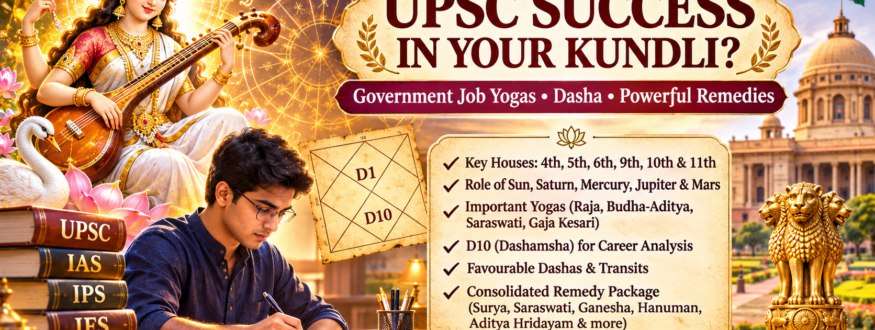
Government Jobs in Vedic Astrology: Can Your Kundli Indicate UPSC, IAS, IPS or Civil Services Success?
Every year, millions of aspirants in India prepare for prestigious government examinations such as the UPSC Civil Services Examination, State Public Service Commission examinations, SSC, banking recruitment, railway examinations and other competitive selection processes.
For many students, clearing UPSC and entering the Indian Administrative Service (IAS), Indian Police Service (IPS), Indian Foreign Service (IFS) or another government institution represents much more than securing employment.
It signifies responsibility, public service, professional stability, administrative authority and the opportunity to contribute to society.
But an interesting question arises from the perspective of Vedic Astrology:
Are there particular planetary combinations that traditionally indicate success in competitive examinations, government service and administrative authority?
Classical Jyotish examines professional success through the relationship between the 6th House, 10th House, Sun, Saturn, Mercury, Jupiter, Mars and the operating planetary Dashas.
For competitive examinations, the 4th, 5th, 6th, 9th, 10th and 11th Houses are especially relevant.
However, a distinction must be established at the outset.
A horoscope cannot scientifically predict whether a candidate will clear UPSC, obtain a particular rank or receive appointment to a specific government service.
Astrological combinations may be studied as traditional symbolic indicators, while actual examination success depends on eligibility, preparation, performance, available vacancies and the official selection process.
Let us explore the important Jyotish principles before consolidating a practical Sanatan Dharma remedy package for students preparing for government examinations.
1. Important Houses for Government Jobs and Competitive Examinations
4th House: Foundational Education and Academic Discipline
The 4th House represents foundational education, learning environment, mental comfort and the support system available to a student.
A strong 4th Lord, particularly when connected with Mercury, Jupiter or the 5th House, is traditionally considered supportive of educational pursuits.
For UPSC aspirants, this house may symbolically reflect the environment needed for sustained preparation.
5th House: Intelligence, Memory and Examination Performance
The 5th House governs intelligence, analytical ability, memory, discrimination and the application of knowledge.
A strong 5th Lord associated with Mercury or Jupiter is traditionally considered favourable for intellectual development.
This becomes particularly relevant for examinations requiring comprehension, reasoning, essay writing and conceptual clarity.
6th House: Competition, Service and Defeating Opposition
The 6th House is one of the most important houses examined in traditional competitive-examination astrology.
It represents competition, opponents, challenges, disciplined effort and service.
A strong 6th Lord or supportive relationship between the 6th and 10th Houses may be interpreted as an ability to confront competition and pursue service-oriented employment.
However, the 6th House alone cannot determine success in UPSC or any other examination.
9th House: Higher Knowledge, Guidance and Fortune
The 9th House represents higher learning, teachers, Dharma, fortune and the guidance of mentors.
A relationship between the 5th and 9th Lords is traditionally considered auspicious for intellectual and educational development.
10th House: Career, Government Authority and Professional Status
The 10th House is the principal house of Karma, profession, authority and public responsibilities.
A strong 10th Lord, particularly when connected with the Sun, Saturn, Jupiter or auspicious Raja Yoga combinations, is traditionally associated with professional recognition and responsibility.
For government-service aspirations, astrologers examine the 10th House together with the 6th House and relevant planetary significators.
11th House: Achievement and Fulfilment of Ambitions
The 11th House represents gains, achievements, networks and fulfilment of desires.
A favourable relationship between the 10th and 11th Lords may be interpreted as professional accomplishments and recognition.
2. The Sun: The Primary Significator of Government Authority
In classical Jyotish, the Sun represents sovereignty, authority, administration, leadership and recognition.
Historically, the Sun was associated with kings, rulers and positions of power.
In contemporary interpretation, astrologers frequently examine the Sun when evaluating aspirations involving public administration, leadership or government institutions.
Traditionally supportive configurations include:
- The Sun strongly placed in its own sign Leo or exaltation sign Aries.
- The Sun influencing the 10th House or 10th Lord.
- A relationship between the Sun and the 9th or 10th Lord.
- A strong Sun associated with relevant Raja Yoga combinations.
- A well-supported Sun in the Dashamsha (D10) chart.
However, a powerful Sun does not automatically indicate IAS, IPS or another specific government appointment.
The overall horoscope and professional context must be considered.
3. Saturn: Government Service, Discipline and Institutional Responsibility
Saturn represents duty, discipline, persistence, hierarchy, labour and institutional structures.
While the Sun symbolises authority, Saturn is traditionally associated with sustained service and responsibility.
A supportive relationship between Saturn and the 6th or 10th House may be interpreted as favourable for structured employment and long-term professional development.
For candidates preparing for demanding examinations, Saturn also symbolises qualities essential for success:
Consistency, patience, repetition and the willingness to work through prolonged challenges.
A challenging Saturn configuration should not automatically be interpreted as failure.
In traditional Jyotish, Saturn can also represent achievement through sustained effort.
4. Mercury and Jupiter: Intelligence, Knowledge and Examination Preparation
Mercury: Reasoning, Communication and Analytical Ability
Mercury represents intellect, logic, calculation, communication, interpretation and information processing.
A strong Mercury is traditionally associated with analytical abilities useful in examinations involving quantitative aptitude, comprehension, reasoning and written communication.
Connections between Mercury and the 5th or 10th Lord may be examined for intellectual and professional development.
Jupiter: Higher Knowledge, Ethics and Wisdom
Jupiter represents knowledge, teachers, judgment, ethics, law and philosophical understanding.
Its influence is particularly relevant in traditional interpretations concerning higher education, administration, law and advisory responsibilities.
A favourable connection between Mercury and Jupiter may be interpreted as combining analytical intelligence with sound judgment.
For UPSC aspirants, these qualities correspond symbolically to the knowledge, reasoning and ethical understanding required in public-service examinations.
5. Mars: Courage, Leadership and Police or Defence Services
Mars represents courage, initiative, physical energy, discipline and the capacity to act decisively.
Traditional astrologers frequently examine Mars when considering professions involving defence, policing, engineering, emergency response or operational leadership.
For an aspirant interested in IPS, military service or other uniformed government professions, Mars may receive additional interpretive attention.
However, Mars alone cannot establish that a person will become an IPS officer or enter the armed forces.
Professional selection depends on the relevant examination, medical standards, physical requirements and recruitment procedures.
6. Important Yogas Traditionally Associated With Government Service and Competitive Success
Dharma-Karmadhipati Raja Yoga
A relationship between the 9th Lord and 10th Lord is traditionally regarded as an important Raja Yoga.
The 9th House represents Dharma and fortune, while the 10th represents Karma, profession and public responsibility.
Their association may symbolise the integration of purpose, responsibility and professional achievement.
This Yoga is often considered relevant when examining careers involving authority and leadership.
Budha-Aditya Yoga
Budha-Aditya Yoga is generally formed through the conjunction of the Sun and Mercury.
Traditional interpretations associate this combination, when sufficiently strong and supported, with intelligence, communication and administrative abilities.
Its actual assessment requires consideration of planetary dignity, house placement, combustion and the broader horoscope.
The mere conjunction of the Sun and Mercury should not automatically be interpreted as an exceptional Yoga.
Saraswati Yoga
Saraswati Yoga is traditionally associated with favourable configurations involving Mercury, Jupiter and Venus, subject to specific conditions of placement and strength.
It is associated with learning, knowledge, eloquence and intellectual accomplishment.
For students, this Yoga is symbolically relevant to educational pursuits.
Gaja Kesari Yoga
Gaja Kesari Yoga is commonly associated with Jupiter occupying a Kendra from the Moon, with classical interpretations also considering planetary strength and afflictions.
It is traditionally connected with wisdom, reputation and social recognition.
However, its presence alone does not guarantee academic or competitive examination success.
Raja Yoga Through Kendra and Trikona Lords
Favourable associations between Kendra and Trikona Lords are traditionally regarded as important Raja Yoga combinations.
When connected with the 10th House, such Yogas may be interpreted as supportive of professional recognition and authority.
Viparita Raja Yoga
Certain classical combinations involving the Lords of the 6th, 8th and 12th Houses are associated with Viparita Raja Yoga.
These are traditionally interpreted as circumstances in which difficulties may eventually contribute to achievement.
For competitive-examination aspirants, such combinations are sometimes discussed in relation to overcoming obstacles.
However, their interpretation is highly dependent on the specific configuration and should not be simplified into a promise of success after repeated failures.
7. Important Planetary Combinations for UPSC and Government Jobs
Rather than relying on one isolated Yoga, a traditional Jyotish assessment may examine the following combinations collectively.
Combination 1: Strong Sun and 10th House
A well-supported Sun associated with a strong 10th Lord may be interpreted as favourable for leadership and administrative responsibilities.
Combination 2: Relationship Between the 6th and 10th Lords
A constructive relationship between the houses of competition and profession may be interpreted as supportive of service-oriented career ambitions.
Combination 3: Strong Mercury and 5th Lord
This combination is traditionally associated with intellectual ability, analytical thinking and learning.
Combination 4: Relationship Between the 9th and 10th Lords
Dharma-Karmadhipati connections may be interpreted as supportive of professional recognition and responsible authority.
Combination 5: Strong Saturn Associated With Career Houses
A favourable Saturn may symbolise discipline, institutional responsibility and long-term career development.
Combination 6: Strong Mars in Relevant Professional Configurations
Mars may receive greater emphasis when evaluating traditional indications associated with policing, defence or operational services.
Combination 7: Supportive 11th House Connections
Relationships involving the 10th and 11th Lords may be interpreted as favourable for achievement and professional gains.
These combinations should be considered collectively and cannot be used as a reliable selection or rank-prediction method.
8. Dashamsha (D10): The Divisional Chart of Career and Professional Authority
The Dashamsha, or D10 chart, is traditionally used for a deeper examination of profession, career responsibilities and public recognition.
For government-service aspirations, the D10 chart may be examined alongside the natal D1 chart.
Important factors include:
- D10 Ascendant and its Lord.
- D10 10th House and 10th Lord.
- Strength and placement of the Sun.
- Saturn’s association with service and institutional responsibility.
- Connections involving Mercury, Jupiter and Mars.
- Correlation between D1 and D10 planetary strengths.
A strong professional combination in D1 supported by D10 may be interpreted as reinforcing the broader career indication.
Nevertheless, D10 cannot determine whether a candidate will clear UPSC or obtain a particular government appointment.
9. Dasha and Antardasha: Traditional Timing of Government Job Opportunities
In Vimshottari Dasha analysis, astrologers examine the operating Mahadasha and Antardasha in relation to professional houses and planetary significators.
Periods involving the following planets may receive attention:
- The 10th Lord, representing professional activity.
- The 6th Lord, associated with competition and service.
- The 9th Lord, associated with fortune and higher learning.
- The 11th Lord, associated with achievements and gains.
- The Sun, associated with authority.
- Mercury and Jupiter, associated with intellectual and educational development.
For example, a favourable relationship between the 6th and 10th Lords, activated during their planetary periods, may be interpreted as a professionally significant phase.
Jupiter and Saturn transits may also be examined for their traditional association with career development and responsibility.
However, planetary periods cannot reliably predict examination results or replace realistic preparation planning.
10. Powerful Sanatan Dharma Remedies for UPSC and Competitive Examination Aspirants
Students seeking spiritual support may adopt a simple devotional routine rather than pursuing numerous expensive rituals or gemstones.
The following practices are widely recognised within Hindu devotional traditions.
Remedy 1: Surya Arghya for Confidence and Authority
The Sun represents authority, confidence, discipline and leadership in traditional Jyotish.
Offering Arghya to Surya is a longstanding Hindu devotional practice.
Suggested Procedure:
- Wake early and bathe or wash before prayer.
- Offer clean water to the rising Sun from a suitable vessel.
- Recite the Surya Mantra 11 times.
- Offer a prayer for clarity, discipline and righteous action.
Surya Mantra:
ॐ घृणिः सूर्याय नमः॥
Om Ghrinih Suryaya Namah.
Sunday is traditionally associated with Surya, although devotees may perform a simple daily observance.
Never look directly at the Sun, and avoid unsafe practices involving intense sunlight.
Remedy 2: Saraswati Mantra for Knowledge and Learning
Goddess Saraswati represents wisdom, learning, speech, music and intellectual refinement.
Students traditionally seek her blessings before beginning educational pursuits.
Saraswati Mantra:
ॐ ऐं सरस्वत्यै नमः॥
Om Aim Saraswatyai Namah.
Suggested Procedure:
Begin on a convenient Wednesday or Thursday, or on Vasant Panchami according to family tradition.
Recite the mantra 108 times before beginning the day’s study session.
Place books and study materials in a clean environment and begin preparation with a focused intention.
This is a devotional practice, not a scientifically demonstrated method of improving examination scores.
Remedy 3: Lord Ganesha Worship for Removing Obstacles
Lord Ganesha is traditionally worshipped as Vighnaharta, the remover of obstacles.
Students may offer a brief prayer before beginning a demanding study session.
Ganesha Mantra:
ॐ गं गणपतये नमः॥
Om Gam Ganapataye Namah.
Suggested Procedure:
Recite the mantra 21 or 108 times according to personal preference.
Wednesday is a commonly chosen day for Ganesha worship, but daily prayer is also appropriate.
Remedy 4: Hanuman Chalisa for Courage and Perseverance
Lord Hanuman represents devotion, courage, strength, humility and unwavering commitment.
Hanuman Chalisa is among the most widely practised Hindu devotional recitations.
Suggested Procedure:
Recite Hanuman Chalisa on Tuesdays or Saturdays, or daily if desired.
Students may use this practice as an opportunity to cultivate emotional steadiness and determination.
It should not replace adequate sleep, exercise or evidence-based support for anxiety and stress.
Remedy 5: Aditya Hridayam for Strength and Determination
Aditya Hridayam is a sacred hymn appearing in the Yuddha Kanda of the Valmiki Ramayana.
In the narrative, Sage Agastya teaches the hymn to Lord Rama before his confrontation with Ravana.
The hymn praises Surya and is traditionally associated with courage, clarity and strength.
Suggested Procedure:
Read or listen to Aditya Hridayam on Sundays or during morning prayer.
Students may incorporate it into their routine as a devotional practice before beginning preparation.
The Ramayana narrative provides religious inspiration rather than evidence that recitation guarantees examination success.
Remedy 6: Guru Brihaspati Worship for Wisdom and Guidance
Jupiter represents knowledge, teachers, wisdom and ethical judgment.
Thursday is traditionally associated with Guru Brihaspati.
Guru Mantra:
ॐ बृं बृहस्पतये नमः॥
Om Brim Brihaspataye Namah.
Suggested Procedure:
Recite the mantra 108 times on Thursdays if convenient.
Express gratitude toward teachers, mentors and those who support your education.
Helping another student understand a difficult topic may also be a meaningful expression of Guru Seva.
Remedy 7: Shani Worship for Discipline and Persistence
Saturn represents responsibility, patience, sustained effort and service.
Students who associate their spiritual practice with Shani may offer prayers on Saturdays.
Shani Mantra:
ॐ शं शनैश्चराय नमः॥
Om Sham Shanaishcharaya Namah.
A simple observance may include mantra recitation, charitable service or helping individuals facing hardship.
There is no need to undertake expensive rituals or wear gemstones solely because Saturn is believed to influence examination prospects.
11. Sacred Temples Associated With Knowledge, Wisdom and Blessings
Saraswati Temple, Basar, Telangana
Sri Gnana Saraswati Temple at Basar is an important pilgrimage destination dedicated to Goddess Saraswati.
Families traditionally visit the temple for Aksharabhyasam, a ceremony associated with introducing children to education.
Students may seek the Goddess’s blessings for knowledge and learning.
Saraswati Temple, Koothanur, Tamil Nadu
Koothanur Saraswati Temple is dedicated to Goddess Saraswati and is associated with prayers for education, knowledge and artistic pursuits.
It is particularly relevant for devotees who wish to honour Saraswati before beginning important educational endeavours.
Sankat Mochan Hanuman Temple, Varanasi
Sankat Mochan Hanuman Temple is a well-known centre of devotion to Lord Hanuman.
Students seeking courage, perseverance and spiritual strength may consider visiting according to their personal beliefs.
Temple pilgrimages are optional acts of faith and should not interfere with preparation schedules or create financial pressure.
12. Consolidated 41-Day Jyotish Remedy Package for Government Job Aspirants
Rather than recommending numerous unrelated rituals, students may adopt a focused 41-day devotional routine.
The duration is a personal spiritual commitment, not a universally prescribed scriptural requirement.
Daily Morning Routine
Step 1: Offer Surya Arghya at sunrise if practical.
Step 2: Recite the Ganesha Mantra 21 times.
Step 3: Recite the Saraswati Mantra 108 times.
Step 4: Begin the first study session with a clear academic target.
Weekly Spiritual Routine
Sunday: Aditya Hridayam or Surya worship.
Monday: Brief prayer to Lord Shiva, according to personal tradition.
Tuesday: Hanuman Chalisa for courage and perseverance.
Wednesday: Saraswati or Ganesha worship.
Thursday: Guru Brihaspati Mantra and gratitude toward teachers.
Friday: Saraswati worship or quiet devotional reflection.
Saturday: Shani Mantra, Hanuman Chalisa or an act of charitable service.
Day 41: Completion of the Sankalpa
Conclude the devotional observance with gratitude.
Students may donate educational materials, support a disadvantaged learner or offer food according to their means.
There is no requirement for expensive Homas, elaborate ceremonies or compulsory donations.
The most important practical discipline remains regular study, revision and examination practice.
13. The Real-World Success Formula: Spiritual Discipline and Smart Preparation
Aspirants should treat Jyotish and devotional practices as optional spiritual support rather than substitutes for preparation.
A balanced approach includes:
- Understanding the official UPSC or relevant examination syllabus.
- Building a realistic daily and weekly study schedule.
- Revising foundational concepts regularly.
- Practising previous-year examination papers.
- Taking mock tests and reviewing mistakes.
- Improving answer-writing and time-management skills.
- Maintaining adequate sleep, physical activity and emotional well-being.
- Following official examination notifications and eligibility requirements.
For UPSC Civil Services aspirants, preparation should address the distinct requirements of Prelims, Mains and the Personality Test.
Spiritual practices may help provide personal meaning and structure, but examination performance must be developed through sustained preparation.
Frequently Asked Questions
Which planet gives a government job in Vedic Astrology?
The Sun is traditionally associated with government authority, while Saturn represents service and institutional responsibility. The 6th and 10th Houses and their lords are also examined.
Which house is important for UPSC success?
The 6th House represents competition, the 5th intelligence, the 9th higher learning and the 10th profession. No single house can reliably predict UPSC selection.
Does Budha-Aditya Yoga guarantee an IAS job?
No. Budha-Aditya Yoga is traditionally associated with intellectual and administrative qualities under favourable conditions, but it does not guarantee appointment to the IAS or any other government service.
Which mantra is best for competitive examinations?
Saraswati Mantra, Ganesha Mantra and prayers to Surya are commonly used devotional practices. Their selection depends on personal faith and family tradition.
Which day is best to begin remedies for government job success?
Thursday or Wednesday may be chosen for Saraswati or Guru-related worship, while Sunday is associated with Surya. No particular day is required for sincere prayer.
Can an unfavourable Dasha prevent someone from clearing UPSC?
Astrological Dashas are not scientifically validated predictors of examination outcomes. Candidates should base decisions about attempts, preparation and career alternatives on practical circumstances and official eligibility criteria.
Should students wear gemstones for government job success?
Gemstones are not proven to improve examination results. Traditional gemstone prescriptions are chart-dependent, and students should avoid expensive purchases or fear-based recommendations.
Conclusion: Government Job Success Requires Karma, Knowledge and Discipline
In Vedic Astrology, government service and professional authority are traditionally examined through the Sun, Saturn, Mercury, Jupiter, Mars, the 6th House, 10th House, Dashamsha chart and relevant planetary periods.
Combinations such as Dharma-Karmadhipati Raja Yoga, Budha-Aditya Yoga, Saraswati Yoga and favourable career-house connections may be interpreted as symbolic indicators of professional potential.
However, no planetary Yoga can guarantee selection in UPSC, IAS, IPS, SSC or another competitive government examination.
Sanatan Dharma offers meaningful devotional practices through Surya Arghya, Saraswati Mantra, Ganesha worship, Hanuman Chalisa, Aditya Hridayam and Guru Brihaspati prayers.
These practices may be incorporated into a balanced spiritual routine without replacing disciplined preparation.
The Bhagavad Gita reminds us of the importance of performing our duties without becoming consumed by attachment to the results.
For every aspirant preparing for a demanding government examination, this remains a valuable guiding principle.
Let knowledge guide your preparation, discipline sustain your efforts, and faith provide strength through uncertainty.
May Goddess Saraswati bless every sincere student with wisdom, and may Lord Ganesha guide them toward clarity, courage and perseverance.
Om Aim Saraswatyai Namah!
Disclaimer: This article discusses traditional Vedic Astrology and Sanatan Dharma devotional practices for educational and spiritual purposes. Astrology and religious rituals are not scientifically validated methods of predicting competitive examination results or guaranteeing government employment. Aspirants should rely on official recruitment notifications, eligibility criteria, examination preparation and qualified educational guidance.
References and Further Reading:
- Brihat Parashara Hora Shastra — Traditional principles of planetary strength, houses, Yogas and divisional charts.
- Phaladeepika — Classical interpretations of planetary placements and professional significations.
- Saravali — Traditional discussions of planetary combinations and career indications.
- Valmiki Ramayana, Yuddha Kanda — Aditya Hridayam narrative.
- Bhagavad Gita, Chapter 2, Verse 47 — Karma Yoga and the performance of duty.
- Union Public Service Commission — Official examination notices and syllabi: https://upsc.gov.in/
- Staff Selection Commission — Official recruitment information: https://ssc.gov.in/
