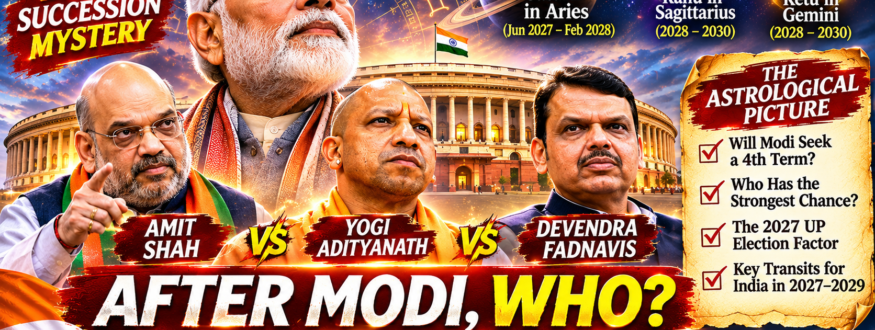
After Modi, Who? The Question That Could Redefine Indian Politics
For more than twelve years, one individual has dominated India’s national political landscape.
Narendra Damodardas Modi.
From the Bharatiya Janata Party’s historic parliamentary victory in 2014 to his re-election in 2019 and the formation of a third government in 2024, Modi has become the defining political figure of contemporary India.
Yet every long political era eventually produces one unavoidable question.
Who comes next?
Will Union Home Minister Amit Shah inherit the political machinery he helped build?
Will Uttar Pradesh Chief Minister Yogi Adityanath emerge as the next national face of the BJP?
Could Maharashtra Chief Minister Devendra Fadnavis become a consensus candidate acceptable to different sections of the party and its ideological ecosystem?
Or is the entire succession debate premature because Modi could seek a fourth term in 2029?
The speculation has intensified as Modi, who turned 76 in September 2026, approaches the midpoint of his third term.
But the most fascinating development is not merely the number of potential successors.
It is the growing intersection of electoral politics, organisational influence, ideological expectations and the BJP’s relationship with the Rashtriya Swayamsevak Sangh.
A November 2026 report has even suggested that Amit Shah and Yogi Adityanath, frequently portrayed as potential succession rivals, are now cooperating ahead of the crucial Uttar Pradesh Assembly election.
This creates an extraordinary political paradox.
Two leaders who may eventually compete for India’s highest political office currently need each other to win one of the country’s most important state elections.
From the perspective of Vedic Mundane Astrology, the coming years introduce another fascinating dimension.
Saturn moves from Pisces into Aries in 2027, before returning to Pisces and subsequently re-entering Aries in 2028.
Rahu and Ketu shift onto the Capricorn–Cancer axis.
Jupiter moves through Cancer, Leo and Virgo.
Could these transitions symbolically reflect a period of political restructuring, leadership tests and changing national priorities?
Let us examine the political evidence before turning to the Jyotish interpretation.
PART I: THE POLITICAL REALITY BEHIND THE BJP SUCCESSION DEBATE
1. Is Narendra Modi Actually Retiring?
This is the most important question to answer before discussing potential successors.
There is no confirmed announcement that Narendra Modi intends to retire before the 2029 general election.
India’s Constitution does not impose a maximum age for serving as prime minister.
Nor does it impose a limit on the number of terms a person may serve.
The frequently discussed age of 75 has sometimes been associated with internal BJP conventions and decisions involving senior political figures.
However, it is not a constitutional retirement requirement.
Political speculation intensified around Modi’s 75th birthday in September 2025.
Opposition politicians suggested that the BJP or RSS might be preparing for a leadership transition.
BJP leaders rejected those suggestions.
Devendra Fadnavis publicly defended Modi’s continuing leadership and dismissed the idea that a successor needed to be selected immediately.
Therefore, the central premise must remain clear.
The BJP succession race is a discussion about possible future leadership, not an officially announced transition.
2. Why Did the 2024 Lok Sabha Election Change the Succession Conversation?
The BJP won 303 Lok Sabha seats in 2019.
In 2024, its tally fell to 240.
Although the BJP-led National Democratic Alliance retained sufficient parliamentary support to form a government, the BJP no longer possessed an outright majority on its own.
This was a significant political development.
The government became more dependent on coalition partners, including the Telugu Desam Party and Janata Dal (United).
The result demonstrated that Modi’s political popularity remained considerable but was not sufficient to reproduce the BJP’s earlier parliamentary dominance.
It also raised a strategic question.
Could another BJP leader reproduce Modi’s electoral appeal across India’s diverse regions, communities and political constituencies?
Political scientist Suhas Palshikar, cited in Reuters Breakingviews, has examined how Modi’s appeal combines economic narratives, political organisation and Hindu nationalist mobilisation.
Replacing such a leader involves more than choosing a new face.
It requires constructing a durable national electoral coalition.
3. Amit Shah: The Organisational Powerhouse
<text>The strongest argument for Amit Shah: His proximity to Modi, experience in national government and extensive knowledge of the BJP’s electoral organisation.</text>
<AsyncImage query=”Amit Shah Indian Union Home Minister official portrait speaking at political event” aspectRatio=”16:9″/>
Amit Shah has been one of the most influential figures in Indian politics throughout the Modi era.
Born on October 22, 1964, Shah rose through the BJP’s organisational structure and became one of Modi’s closest political associates.
He served as BJP president from 2014 to 2020 and became Union Home Minister in 2019.
His political reputation is closely associated with election strategy, organisational discipline and the management of complex political campaigns.
Why Amit Shah Is Considered a Serious Successor
Shah possesses several advantages.
He has extensive experience in national governance.
He understands the BJP’s organisational structure and its relationships with state-level leadership.
He has longstanding ties with Modi.
He has played a central role in shaping important national policy decisions.
And he is widely regarded as one of the party’s most formidable political strategists.
Reuters Breakingviews identified Shah in December 2025 as one of the plausible successors should Modi eventually leave office.
What Could Work Against Amit Shah?
Shah’s strength as an organiser does not automatically establish that he would enjoy Modi’s nationwide electoral popularity.
The ability to manage elections and the ability to become the principal public face of a national campaign are related but distinct political skills.
His leadership would also be evaluated against the BJP’s performance in major state elections, its coalition relationships and public perceptions of government policy.
The November 2026 Development
A November 9 report in The Telegraph described Shah as preparing to play a leading strategic role in the 2027 Uttar Pradesh election.
The report cited party insiders who portrayed Shah and Yogi Adityanath as potential succession rivals who were now working toward a common electoral objective.
This cooperation could strengthen both leaders if the BJP performs well.
But a disappointing result could also complicate their future ambitions.
Amit Shah may possess the strongest organisational credentials, but the succession question ultimately concerns electoral leadership as much as internal influence.
4. Yogi Adityanath: The Mass Leader With a National Following
<text>The strongest argument for Yogi Adityanath: His public visibility, ideological appeal and experience governing India’s most populous state.</text>
<AsyncImage query=”Yogi Adityanath Uttar Pradesh chief minister speaking at public rally saffron robes” aspectRatio=”16:9″/>
Yogi Adityanath, born Ajay Mohan Singh Bisht on June 5, 1972, has served as Chief Minister of Uttar Pradesh since 2017.
Before becoming chief minister, he represented Gorakhpur in the Lok Sabha for several terms.
His political identity combines religious leadership, Hindu nationalist politics and a governance record emphasising law enforcement, infrastructure and investment.
Supporters credit his administration with improving infrastructure and strengthening law and order.
Critics have raised concerns about policing practices, communal polarisation, civil liberties and the use of demolitions against alleged offenders.
These competing assessments form part of his national political profile.
Why Yogi Is Considered a Potential Prime Minister
Uttar Pradesh is India’s most populous state and sends 80 elected representatives to the Lok Sabha.
A leader who can sustain electoral success in Uttar Pradesh possesses an important political advantage.
Yogi also has an established public following extending beyond his state.
His supporters view him as a leader with a distinctive political identity and strong executive experience.
The National Bureau of Asian Research identified him in March 2026 as one of the significant figures representing the BJP’s next generation of leadership.
The 2027 Uttar Pradesh Election: Yogi’s Biggest Test
The next Uttar Pradesh Assembly election is expected in 2027.
It could become one of the most consequential events in the succession discussion.
In the 2024 Lok Sabha election, the BJP won only 33 of Uttar Pradesh’s 80 seats, compared with 62 in 2019.
That decline raised questions about electoral organisation, social coalitions and the party’s state-level performance.
A strong Assembly election victory in 2027 would reinforce Yogi’s political standing.
A defeat could weaken his claim to national leadership.
Why Amit Shah and Yogi Need Each Other
Recent reporting suggests that the two leaders are attempting to coordinate more closely.
Shah brings national organisational experience.
Yogi brings state-level executive authority and a substantial public following.
Their cooperation could strengthen the BJP’s electoral machinery.
But the political implications of the result could be very different for each leader.
If the BJP wins convincingly, Yogi could claim a renewed mandate while Shah could claim organisational success.
That is precisely why Uttar Pradesh may become a crucial stepping stone in the broader post-Modi conversation.
5. Devendra Fadnavis: The Consensus Candidate Who Could Surprise Everyone
<text>The strongest argument for Devendra Fadnavis: Administrative experience, a relatively younger political profile and reported goodwill within sections of the RSS.</text>
<AsyncImage query=”Devendra Fadnavis Maharashtra chief minister formal portrait political event” aspectRatio=”16:9″/>
Devendra Fadnavis, born on July 22, 1970, has established himself as one of the BJP’s most prominent leaders in Maharashtra.
He first became Maharashtra Chief Minister in 2014 and returned to the position in December 2024.
His political profile emphasises administration, infrastructure, investment and party organisation.
Unlike Shah, whose influence is closely associated with the central government, or Yogi, whose appeal is strongly associated with Uttar Pradesh, Fadnavis represents a different leadership possibility.
He could be viewed as a candidate combining state-level governance experience with the ability to operate within the BJP’s wider organisational ecosystem.
Why Is His Name Suddenly More Prominent?
Reuters Breakingviews identified Fadnavis as a plausible successor in its December 2025 assessment.
In August 2026, The New Indian Express reported speculation that he could be considered for a position on the BJP’s powerful Parliamentary Board.
The report cited party sources suggesting that elements within the RSS were favourable toward his elevation.
However, the report also made clear that no final decision had been taken.
The Importance of the Parliamentary Board
The BJP Parliamentary Board is one of the party’s most important decision-making bodies.
A place on the board could increase a leader’s influence over national political strategy and candidate selection.
But membership would not automatically make Fadnavis the next prime minister.
Fadnavis’s Political Challenge
His principal challenge is national recognition.
He possesses substantial political experience in Maharashtra, but a prime ministerial candidate must build credibility across India.
That includes Hindi-speaking states, southern India, eastern India and coalition partners.
His future may therefore depend on whether he can move from state leadership into a broader national role.
Fadnavis could become particularly relevant if the BJP eventually seeks a candidate capable of balancing organisational continuity, administrative experience and coalition acceptability.
PART II: WHAT TRUSTED POLITICAL ANALYSTS ARE SAYING
6. Reuters Breakingviews: Shah and Fadnavis Are Plausible Successors
In December 2025, Reuters Breakingviews published an assessment titled India Begins to Ponder Life After Narendra Modi.
The analysis argued that succession questions would become increasingly relevant as Modi progressed through his third term.
It identified Amit Shah and Devendra Fadnavis as possible successors from within the BJP.
The commentary also discussed alternative scenarios involving coalition partners or the opposition.
Importantly, this was an analytical forecast, not a report of an official succession decision.
Its value lies in identifying the political options and institutional constraints facing the BJP.
7. Carnegie Endowment: The BJP’s Succession Is Still Unclear
Research published by the Carnegie Endowment for International Peace examined the resilience of India’s party system after the 2024 election.
The analysis highlighted Modi’s unusually strong personal political appeal.
It also identified Amit Shah and Yogi Adityanath as widely discussed possible successors.
Carnegie emphasised that the succession process would likely be influenced by internal BJP calculations and the views of organisations associated with the broader Hindu nationalist movement.
This provides an important corrective to simplified media narratives.
The next BJP leader will not necessarily be selected solely on the basis of public popularity.
Organisational legitimacy, political relationships and electoral strategy will also matter.
8. National Bureau of Asian Research: Yogi Represents the Next Generation
A March 2026 study by the National Bureau of Asian Research examined India’s next generation of political leadership.
It identified Yogi Adityanath and opposition leader Rahul Gandhi as significant figures in the country’s future political landscape.
The study noted that both leaders are considerably younger than Modi and possess extensive political experience.
It also emphasised that a post-Modi BJP could face electoral challenges without the prime minister’s personal appeal.
This is particularly relevant to the 2029 election.
A successor must not only inherit the BJP’s leadership.
He must also persuade voters that the party can remain effective under a different national figure.
9. What Role Could the RSS Play?
The Rashtriya Swayamsevak Sangh is an influential ideological organisation with longstanding historical connections to the BJP.
Many senior BJP leaders have backgrounds in the RSS or associated organisations.
The RSS is not a constitutional body responsible for selecting India’s prime minister.
Nevertheless, its influence within the broader political movement makes its preferences an important subject of political analysis.
Commentary concerning Fadnavis frequently references his RSS connections.
Shah and Modi have longstanding organisational relationships within the BJP’s political ecosystem.
Yogi possesses a distinct religious and political base.
The eventual leadership decision could therefore involve several competing considerations.
These include ideological continuity, organisational acceptability, national electability, coalition management and the preferences of senior party figures.
Claims that the RSS has already secretly chosen a successor should be treated cautiously unless supported by verifiable evidence.
PART III: THE VEDIC ASTROLOGY OF POLITICAL SUCCESSION
10. Can Vedic Astrology Identify India’s Next Prime Minister?
Classical Jyotish contains extensive discussions of political authority, kingship, status and the rise of influential individuals.
However, it does not provide a scientifically validated method for predicting the winner of a modern democratic election.
A traditional astrologer might examine:
- The Sun, representing authority and executive power.
- The tenth house, representing public office and professional responsibility.
- The ninth house, associated with Dharma, fortune and guiding principles.
- The Ascendant and its lord, representing the individual.
- Raja Yogas involving Kendra and Trikona lords.
- The Dashamsha (D10) chart for career-related indications.
- Vimshottari Mahadasha and Antardasha periods.
- Jaimini Chara Karakas and relevant Dasha systems.
- National mundane charts and major planetary ingress charts.
But the personal horoscopes of political leaders should not be treated as reliable unless their birth times have been authenticated.
A chart calculated from an uncertain birth time can produce incorrect house positions, divisional charts and Dasha interpretations.
Therefore, this article focuses primarily on the broader sidereal planetary movements of 2027–2029 rather than inventing precise Raja Yogas for individual politicians.
11. Saturn in Pisces: The Final Phase of an Established Political Era?
Saturn entered sidereal Pisces in March 2025.
Saturn represents institutions, responsibility, restrictions, labour, public accountability and the consequences of accumulated decisions.
Pisces, ruled by Jupiter, represents ideals, faith, collective concerns and the dissolution of boundaries.
In mundane astrology, Saturn’s passage through Pisces can be interpreted symbolically as a period when established institutions confront questions about their long-term purpose and responsibilities.
For Indian politics, the relevant themes include coalition governance, institutional accountability, public expectations and the sustainability of established leadership arrangements.
However, the transit does not establish that Modi’s political era must end.
The more useful question is whether the BJP can preserve its organisational strength while preparing for eventual generational change.
The Saturnian Principle
Saturn does not merely signify endings.
It also represents continuity, discipline and the construction of durable institutions.
A strong political organisation may survive a leadership transition precisely because it has developed systems that extend beyond one individual.
The BJP’s future therefore depends partly on whether its institutional strength can support a successor.
12. Saturn Enters Aries in 2027: A New Leadership Test
Saturn temporarily enters sidereal Aries around June 2–3, 2027.
Aries is ruled by Mars and represents initiative, confrontation and assertive leadership.
Saturn is traditionally debilitated in Aries.
The combination symbolically creates tension between Saturnian restraint and Martian ambition.
What Could This Mean for Indian Politics?
A modern mundane-astrology interpretation might associate the transit with increased debate concerning political authority, executive decision-making and institutional constraints.
The timing overlaps with the period in which the BJP will be evaluating major state election results and preparing for the 2029 national election.
The symbolism is particularly interesting because the possible successors represent different leadership styles.
Amit Shah is associated with organisational strategy.
Yogi Adityanath is associated with assertive executive leadership and mass political appeal.
Devendra Fadnavis is associated with administration and institutional relationships.
Saturn in Aries may be interpreted as highlighting the tension between decisive leadership and organisational responsibility.
But it cannot identify which of these individuals will succeed Modi.
Saturn Returns to Pisces in October 2027
Around October 20, Saturn retrogrades back into Pisces.
This produces a symbolic sequence:
Pisces → Aries → Pisces
Institutional reflection → Leadership confrontation → Reassessment of unfinished responsibilities.
In political terms, the sequence provides a useful framework for examining how the BJP responds to the 2027 electoral cycle.
13. Rahu in Capricorn: The Politics of Institutional Power
In early December 2026, Rahu moves into sidereal Capricorn while Ketu enters Cancer.
Capricorn is ruled by Saturn and is traditionally associated with governance, hierarchy, administration and established structures.
Rahu represents ambition, unconventional strategies, amplification and challenges to existing boundaries.
A modern mundane interpretation of Rahu in Capricorn may therefore emphasise competition for institutional influence.
This symbolism can be connected with questions concerning the BJP’s Parliamentary Board, organisational appointments and the distribution of political authority.
Ketu in Cancer: The Public and Emotional Loyalty
Cancer is ruled by the Moon and is associated with homeland, emotional attachment, collective security and public sentiment.
Ketu represents detachment, separation and the reconsideration of established attachments.
The Capricorn–Cancer axis can therefore be interpreted as a tension between institutional authority and emotional political loyalty.
This is relevant to the succession discussion because Modi’s appeal is not simply organisational.
It also involves a substantial personal connection with voters.
A successor would need to build a relationship with the electorate while maintaining institutional support.
The challenge is not merely transferring political power. It is transferring political confidence.
14. Jupiter’s 2027 Transits: Alliances, Leadership and Administration
Jupiter represents wisdom, law, ethics, diplomacy, guidance and political judgment.
Its movements through Cancer, Leo and Virgo in 2027 offer an interesting symbolic progression.
Jupiter in Cancer: Coalition and Political Protection
Jupiter returns to Cancer, its sign of exaltation, in January 2027.
Cancer represents security, homeland and collective well-being.
In mundane interpretation, the transit may symbolically emphasise public welfare, political alliances and the importance of social confidence.
For the BJP, the relevant questions concern coalition relationships, voter expectations and state-level electoral performance.
Jupiter in Leo: The Question of Political Leadership
Jupiter enters sidereal Leo in late June 2027.
Leo is ruled by the Sun and represents sovereignty, authority, prestige and leadership.
This transit is particularly interesting because it occurs near Saturn’s initial movement into Aries.
Both signs belong to the fire element.
In symbolic terms, the period may highlight leadership ambitions, public visibility and political authority.
Yet Jupiter in Leo does not establish that a new prime minister will emerge.
Jupiter in Virgo: Administrative Competence
Jupiter enters Virgo in late November 2027.
Virgo, ruled by Mercury, represents analysis, administration, practical judgment and attention to detail.
This may symbolically shift the focus from leadership personalities toward governance performance.
The relevant political questions become:
Who can manage a large national administration?
Who can maintain coalition relationships?
Who can deliver economic and infrastructure policies?
Who can communicate effectively with India’s diverse electorate?
These questions may ultimately prove more important than personal popularity alone.
PART IV: THE 2027 UTTAR PRADESH ELECTION — THE REAL POLITICAL TEST
15. Why Uttar Pradesh Could Shape the BJP’s Future
The 2027 Uttar Pradesh Assembly election may be the most important near-term political event in the succession discussion.
Uttar Pradesh is central to the BJP’s national electoral strategy.
It has the largest number of Lok Sabha seats of any Indian state.
It is also the political base of Yogi Adityanath.
A third consecutive BJP-led Assembly victory under Yogi would reinforce his position as a major national leader.
A weaker result could raise questions about his electoral appeal and administrative record.
Amit Shah’s Stake in the Result
If Shah assumes a major strategic role in the campaign, the election will also test his organisational influence.
A strong victory could strengthen his reputation.
A defeat could intensify scrutiny of the party’s electoral strategy.
The Fadnavis Factor
Fadnavis is not directly competing in the Uttar Pradesh election.
However, his national prospects could be affected by the broader BJP leadership environment.
If the party seeks to elevate a leader associated with administrative experience and organisational consensus, Fadnavis may attract greater attention.
If the BJP instead prioritises a leader with a powerful mass political base, Yogi may remain central to the discussion.
If continuity with the existing national leadership is prioritised, Shah could be especially relevant.
These are scenarios, not evidence of an agreed succession plan.
16. Three Possible Succession Scenarios
Scenario One: Narendra Modi Seeks a Fourth Term
Modi could choose to lead the BJP into the 2029 general election.
There is no constitutional prohibition against a fourth term.
This would postpone the immediate need for a new national leader.
The BJP would still need to prepare for eventual succession, but the decision might not arise in 2029.
Scenario Two: Amit Shah Becomes the Continuity Candidate
If Modi decides not to seek another term, Shah could emerge as a candidate representing organisational continuity.
His principal strengths would include experience, internal relationships and strategic influence.
His challenge would be demonstrating broad national electoral appeal.
Scenario Three: Yogi or Fadnavis Emerges as the Next-Generation Leader
Yogi could strengthen his position through a decisive Uttar Pradesh victory.
Fadnavis could become more prominent through national organisational appointments and wider political responsibilities.
Either could be considered if the BJP seeks a leader with a distinct political profile.
However, other leaders could also emerge, and coalition dynamics might influence the final choice.
17. Could the Next Prime Minister Come From Outside the BJP?
The succession debate often assumes that the next prime minister will necessarily come from the BJP.
That assumption should not go unquestioned.
India is a parliamentary democracy.
The next prime minister will depend on the composition of the Lok Sabha and the ability of a leader to command parliamentary confidence.
The 2024 election demonstrated that coalition politics remains important.
Opposition parties could strengthen their position before 2029.
Regional parties could become decisive.
A coalition arrangement could produce outcomes that differ substantially from today’s succession speculation.
Therefore, the question of who succeeds Modi is not exclusively an internal BJP matter.
The ultimate decision belongs to India’s electoral and parliamentary process.
PART V: THE 2028–2029 ASTROLOGICAL TRANSITION
18. Saturn Re-Enters Aries in 2028
Saturn returns to sidereal Aries in February 2028.
This is important because the transit begins a more sustained period of Saturn in the sign ruled by Mars.
In mundane astrology, the combination may symbolically emphasise institutional discipline, executive authority and the tension between political ambition and practical limitations.
The BJP will be moving closer to the 2029 national election.
Political parties may begin consolidating leadership arrangements, electoral alliances and campaign strategies.
However, Saturn’s position cannot determine whether Modi retires or which politician receives the party’s support.
19. Rahu–Ketu Shift Toward Sagittarius and Gemini
During 2028, Rahu moves into Sagittarius and Ketu into Gemini, with precise ingress dates depending on mean-node or true-node calculations.
Sagittarius represents ideology, law, philosophy and guiding beliefs.
Gemini represents communication, information, debate and political messaging.
The axis may symbolically highlight ideological competition and the importance of political narratives.
This could be relevant to India’s 2029 campaign, which may involve competing visions of economic development, social policy, national identity and governance.
A leadership transition would add another dimension.
The BJP would need to explain how a new leader would preserve continuity while offering a distinctive political identity.
20. Jupiter and the 2029 Election
Jupiter’s movement during 2029 would need to be examined using a verified Lahiri sidereal ephemeris and the precise election schedule.
A complete mundane analysis should also include:
- The Indian national horoscope selected for the study.
- The annual solar ingress chart.
- Relevant eclipses.
- Jupiter and Saturn’s relationships to the national chart.
- Planetary periods where a suitable national Dasha framework is used.
- The horoscopes of the principal candidates, provided reliable birth data are available.
Without these elements, declaring a specific 2029 election winner would be speculative.
PART VI: WHO IS BEST POSITIONED TO SUCCEED MODI?
21. A Comparative Political Assessment
| Political Factor | Amit Shah | Yogi Adityanath | Devendra Fadnavis |
|---|---|---|---|
| National government experience | Extensive | Primarily state-level | Primarily state-level |
| BJP organisational influence | Major strength | Significant state influence | Established party connections |
| State executive experience | Limited compared with the two CMs | Uttar Pradesh since 2017 | Maharashtra, multiple terms |
| Mass political identity | Nationally recognised | Strong independent following | More state-centred |
| Reported RSS relationships | Longstanding political ecosystem | Distinct religious-political base | Frequently highlighted |
| Immediate political test | UP 2027 campaign strategy | UP 2027 election | Potential national elevation |
| Principal challenge | Building Modi-level electoral appeal | Broadening national coalition | Expanding national recognition |
Amit Shah: Strongest Organisational Position
Shah appears especially well positioned in terms of proximity to Modi and experience within the BJP’s national political machinery.
Yogi Adityanath: Strongest Distinctive Mass-Leadership Profile
Yogi has a substantial independent public following and the advantage of governing India’s most populous state.
The 2027 election will be particularly important to his future.
Devendra Fadnavis: A Potential Consensus Alternative
Fadnavis could become more relevant if the party seeks a leader with administrative experience and reported organisational goodwill.
His principal challenge is building a stronger nationwide profile.
These assessments are qualitative. They are not probabilities of becoming prime minister.
22. The Most Important Question: Can Anyone Reproduce Modi’s Electoral Appeal?
Perhaps the central challenge is not selecting a successor.
It is replacing a political brand that has become deeply intertwined with the BJP’s national identity.
Modi’s leadership has been associated with a distinctive combination of political communication, organisational strategy, economic policy, national-security messaging and cultural identity.
A successor would inherit the benefits of the party’s established organisation.
But he would also inherit political expectations and unresolved challenges.
These include economic opportunity, employment, public services, social cohesion, regional inequalities and coalition management.
The next BJP leader would need to demonstrate both continuity and independence.
Too much continuity could make the successor appear dependent on Modi’s legacy.
Too much departure could unsettle the party’s established political coalition.
The next leader’s greatest test may be proving that the BJP can remain electorally competitive without relying on one dominant personality.
23. The Deeper Jyotish Interpretation: The Sun, Saturn and the Transfer of Authority
Classical Jyotish associates the Sun with kingship, sovereignty and executive authority.
Saturn represents institutions, responsibility, the masses and the consequences of accumulated actions.
Jupiter represents guidance, wisdom, law and ethical principles.
Mars represents initiative, assertiveness and the ability to act decisively.
These planetary significations provide a useful philosophical framework for examining political succession.
The Sun asks who possesses authority.
Saturn asks whether that authority is supported by durable institutions.
Jupiter asks whether leadership is guided by sound judgment.
Mars asks whether a leader can act effectively when confronted with challenges.
The BJP’s succession question involves all four themes.
A successor must command political authority.
He must maintain organisational stability.
He must exercise judgment in governing a complex democracy.
And he must demonstrate the capacity to lead during difficult circumstances.
No single planet can determine which candidate possesses these qualities.
But the traditional symbolism offers a meaningful way to discuss the demands of leadership.
Frequently Asked Questions
Who will become the next prime minister after Narendra Modi?
No successor has been officially named. Amit Shah, Yogi Adityanath and Devendra Fadnavis are among the politicians discussed by analysts and media commentators.
Is Narendra Modi retiring in 2029?
Modi has not announced retirement. He could seek another term if he chooses and if the BJP selects him as its leader.
Is Amit Shah the official BJP successor?
No. Shah is a senior BJP leader and a frequently discussed potential successor, but there has been no official announcement naming him as the next prime minister.
Could Yogi Adityanath become prime minister?
Yes, he is constitutionally eligible and politically prominent. However, his future depends on party decisions, elections and parliamentary support.
Why is the 2027 Uttar Pradesh election important?
It will test Yogi Adityanath’s electoral standing and the BJP’s organisational strength in India’s most populous state.
Why is Devendra Fadnavis being discussed?
Political reporting has highlighted his administrative experience, party connections and reported goodwill within sections of the RSS.
Does the BJP have a compulsory retirement age of 75?
There is no constitutional retirement age for prime ministers. The BJP’s past age-related practices should not be confused with a binding constitutional rule.
When is India’s next Lok Sabha election?
The next regular general election is expected in 2029, unless the Lok Sabha is dissolved earlier.
Can Vedic Astrology predict the next prime minister?
Vedic Astrology offers traditional symbolic interpretations of leadership and political cycles, but it cannot reliably establish who will become prime minister.
Conclusion: The BJP’s Greatest Political Mystery May Not Be Solved Until 2029
India’s post-Modi political future remains one of the most fascinating questions in contemporary national politics.
Amit Shah possesses extensive organisational influence and experience in national government.
Yogi Adityanath has an established public following and a crucial electoral test approaching in Uttar Pradesh.
Devendra Fadnavis represents a possible alternative associated with administrative experience and organisational relationships.
But Narendra Modi remains firmly in office, and there is no official succession process underway.
The 2027 Uttar Pradesh election could significantly reshape perceptions of the potential contenders.
The 2028–2029 period will bring further political decisions concerning leadership, alliances and the next general election.
From the perspective of Vedic Mundane Astrology, Saturn’s movement from Pisces into Aries provides a compelling symbolic theme of institutional responsibility and leadership challenges.
Rahu’s passage through Capricorn highlights political ambition and organisational power.
Jupiter’s movements through Cancer, Leo and Virgo offer symbolic themes of alliances, authority and administrative competence.
Yet these planetary movements cannot determine the identity of India’s next prime minister.
The real answer will emerge through political organisation, electoral performance, coalition negotiations and the democratic process.
Amit Shah may possess the machinery.
Yogi Adityanath may possess a distinctive mass following.
Devendra Fadnavis may possess the potential to emerge as a consensus candidate.
But Narendra Modi still holds the office — and the decision to seek another term remains his to make.
The most important question may therefore not be simply:
“After Modi, who?”
It may be:
“Can the BJP produce another leader capable of uniting the party, its allies and a diverse national electorate?”
That question could shape Indian politics for the next decade.
Disclaimer: This article combines verified political reporting, attributed commentary and traditional Vedic Mundane Astrology. Succession scenarios are speculative and should not be interpreted as official BJP decisions. Astrological interpretations are symbolic and are not scientifically established methods for predicting political leadership or election results. The article does not endorse any political party or candidate.
References and Further Reading
- Reuters Breakingviews — India Begins to Ponder Life After Narendra Modi, December 24, 2025.
- Carnegie Endowment for International Peace — The Resilience of India’s Fourth Party System, September 2024.
- National Bureau of Asian Research — After Modi: Political Leadership and the Future of Indian Foreign Policy, March 26, 2026.
- The Telegraph India — High-Stakes UP Poll ‘Unifier’ for Amit Shah and Yogi Adityanath in Succession Race, November 9, 2026.
- The New Indian Express — BJP Parliamentary Board Rejig Likely; At Least Four CMs May Figure in Powerful Body, August 26, 2026.
- Eastern Eye — The Million-Dollar Question: Who Will Succeed Modi?, April 10, 2025.
- Election Commission of India — Official 2024 Lok Sabha election results.
- Constitution of India — Articles 74 and 75 concerning the Union Council of Ministers and appointment of the Prime Minister.
- Brihat Parashara Hora Shastra — Traditional principles concerning planetary significations, Raja Yogas and Graha Drishti.
- Phaladeepika — Classical principles concerning professional authority and planetary combinations.
