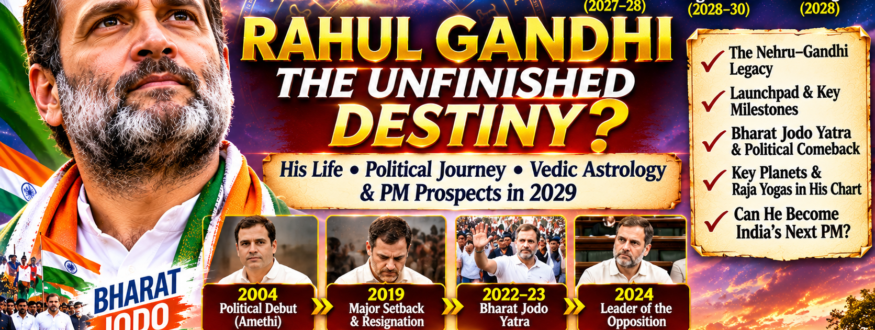
Rahul Gandhi: The Man Behind the Political Narrative
For more than two decades, Rahul Gandhi has occupied an unusual position in Indian politics.
Born into one of India’s most influential political families, he inherited a surname associated with the country’s independence-era leadership and several generations of national government.
But political inheritance has never guaranteed political success.
Rahul Gandhi entered public life carrying extraordinary expectations. He subsequently experienced electoral defeats, internal party criticism, personal attacks and prolonged scrutiny of his leadership.
Yet his career did not end with those setbacks.
He remained active in Parliament, travelled across India through extensive political marches, rebuilt his public profile and became Leader of the Opposition in the Lok Sabha following the 2024 general election.
By November 2026, he was leading a renewed campaign concerning electoral accountability and voter-list revisions.
His political opponents continue to question his leadership and the Congress party’s record. His supporters see his persistence, public engagement and emphasis on constitutional institutions as evidence of political maturation.
Both perspectives form part of the story.
But there is another question that makes Rahul Gandhi particularly interesting to students of Vedic Astrology.
Does his birth horoscope contain the classical indications of political authority, endurance and the possibility of attaining India’s highest executive office?
To examine that question, we must begin with his life.
PART I: THE NEHRU–GANDHI LEGACY
1. Born Into India’s Most Recognisable Political Family
Rahul Gandhi was born on June 19, 1970, in New Delhi.
His father, Rajiv Gandhi, became Prime Minister of India in 1984.
His mother, Sonia Gandhi, later served as President of the Indian National Congress.
His grandmother, Indira Gandhi, served as Prime Minister during two separate periods.
His great-grandfather, Jawaharlal Nehru, was independent India’s first Prime Minister.
The Nehru–Gandhi family’s political history stretches across generations.
Yet it would be inaccurate to describe this inheritance as exclusively advantageous.
Rahul’s childhood and early adulthood were also shaped by political violence.
The Assassination of Indira Gandhi
On October 31, 1984, Indira Gandhi was assassinated by two of her bodyguards.
Rahul was fourteen years old.
Her assassination was followed by horrific anti-Sikh violence, a deeply troubling chapter in India’s history that remains central to assessments of the Congress party’s legacy.
Rajiv Gandhi subsequently became Prime Minister.
The Assassination of Rajiv Gandhi
On May 21, 1991, Rajiv Gandhi was assassinated during an election campaign in Tamil Nadu.
Rahul was twenty years old.
The killing transformed the family’s circumstances and contributed to extensive security concerns.
For Rahul Gandhi, politics was therefore never simply an inherited profession.
It was also associated with profound personal loss.
This background helps explain why his eventual entry into politics attracted intense public interest.
2. Education and Professional Life Before Politics
Rahul Gandhi studied at St. Columba’s School in Delhi and later at the Doon School.
Security concerns contributed to changes in his education.
He attended St. Stephen’s College and Harvard University before moving to Rollins College in Florida, where he completed his undergraduate degree.
He subsequently earned an M.Phil. from Trinity College, Cambridge, in 1995.
Before entering Indian politics, he worked in management consulting in London.
He later became involved in a technology outsourcing business in Mumbai.
These details matter because public portrayals sometimes overlook the period of his life before electoral politics.
However, educational qualifications alone do not establish political competence. His subsequent record must be judged through public responsibilities and outcomes.
PART II: THE POLITICAL LAUNCHPAD
3. The Amethi Election of 2004: Rahul Gandhi Enters Politics
Rahul Gandhi formally entered electoral politics in 2004.
He contested the Lok Sabha election from Amethi in Uttar Pradesh, a constituency with longstanding connections to his family.
He won by a substantial margin.
The election coincided with the Congress-led United Progressive Alliance coming to power under Prime Minister Manmohan Singh.
Rahul’s entry created immediate expectations that he would eventually occupy a senior national leadership position.
But he did not immediately become a minister.
Instead, his early political career developed through parliamentary work and party organisation.
Why 2004 Was His Political Launchpad
Amethi gave Rahul Gandhi a parliamentary constituency, a direct electoral mandate and an opportunity to build relationships with voters.
It also placed him within a national government led by his own party.
From a political perspective, he had access to an unusually powerful launchpad.
The more difficult question was whether he could develop an independent political identity beyond his family name.
4. Youth Congress and NSUI: His First Major Organisational Responsibilities
In September 2007, Rahul Gandhi became General Secretary of the All India Congress Committee.
He was assigned responsibility for the Indian Youth Congress and the National Students’ Union of India.
He advocated greater youth participation and changes to internal organisational processes.
The Congress party credits his tenure with significant membership expansion.
The extent to which those organisational initiatives produced lasting electoral benefits remains a matter for political evaluation.
Nevertheless, this period is important because it demonstrated his early interest in party organisation rather than only parliamentary visibility.
5. The 2013 Vice-Presidency: From Emerging Leader to National Responsibility
In January 2013, Rahul Gandhi became Vice-President of the Indian National Congress.
The appointment placed him near the centre of the party’s national decision-making.
By this stage, the UPA government faced growing criticism concerning corruption allegations, inflation and governance.
Rahul’s leadership responsibilities increased as the Congress approached a difficult national election.
The 2014 general election would become one of the defining setbacks of his career.
PART III: DEFEATS, RESPONSIBILITY AND POLITICAL REINVENTION
6. The 2014 Election: The Congress Suffers a Historic Defeat
The BJP, led by Narendra Modi, won a decisive victory in 2014.
The Congress secured only 44 Lok Sabha seats.
The result represented a historic low for the party.
It also raised questions about Rahul Gandhi’s political communication, organisational effectiveness and ability to challenge Modi.
For a leader who had entered politics with substantial expectations, the defeat was a major setback.
Yet the Congress’s decline had multiple causes, including anti-incumbency, organisational weaknesses and dissatisfaction with the UPA government’s performance.
Attributing the entire result to one individual would oversimplify a complex election.
7. Congress President, 2017–2019
Rahul Gandhi became President of the Indian National Congress in December 2017.
His tenure included the party’s victories in the 2018 Assembly elections in Madhya Pradesh, Rajasthan and Chhattisgarh.
These results demonstrated that Congress remained capable of defeating the BJP in significant state contests.
However, the 2019 general election produced another major national defeat.
The Congress won 52 Lok Sabha seats.
Rahul also lost the Amethi constituency to BJP candidate Smriti Irani, although he won from Wayanad in Kerala.
He subsequently resigned as Congress president.
Why His Resignation Matters
Political leadership is often judged by how individuals respond to failure.
Rahul’s resignation was presented as an acceptance of responsibility for the election result.
Critics questioned the party’s leadership structure and the continuing influence of the Gandhi family.
Supporters regarded the decision as evidence that he was willing to acknowledge defeat.
Both interpretations deserve consideration.
What followed, however, was a significant change in his public political strategy.
8. Bharat Jodo Yatra: The Defining Turning Point of His Public Image
On September 7, 2022, Rahul Gandhi began the Bharat Jodo Yatra from Kanyakumari.
The journey concluded in Kashmir in January 2023.
The Congress describes the march as covering approximately 4,080 kilometres.
It became one of the most prominent political initiatives of his career.
Rather than relying exclusively on parliamentary speeches or election rallies, Rahul travelled on foot through numerous communities.
The march created opportunities for conversations with farmers, students, workers, entrepreneurs and civil-society representatives.
Why the Yatra Was Politically Important
The Yatra allowed Rahul Gandhi to communicate directly with the public over an extended period.
It also changed the visual narrative surrounding his political career.
Instead of being seen primarily through election campaigns and parliamentary confrontations, he appeared in a sustained programme of public engagement.
The Congress framed the journey around social harmony and opposition to polarisation.
Critics questioned its electoral effectiveness and argued that symbolic outreach needed to be accompanied by stronger party organisation.
Both points matter.
The Yatra strengthened Rahul’s public visibility, but it did not automatically solve Congress’s electoral difficulties.
Bharat Jodo Nyay Yatra, 2024
In January 2024, Rahul launched the Bharat Jodo Nyay Yatra from Manipur.
The journey concluded in Mumbai in March.
Its central themes included social justice, economic opportunity, youth employment, farmers’ concerns and representation.
Together, the two yatras became central to his political identity.
They marked a shift toward sustained public mobilisation.
PART IV: THE 2024 COMEBACK AND THE ROLE OF THE OPPOSITION
9. The 2024 Lok Sabha Election: Congress Recovers Ground
The 2024 general election produced a different political landscape from 2014 and 2019.
The Congress increased its Lok Sabha tally from 52 to 99 seats.
The BJP declined from 303 seats in 2019 to 240 in 2024.
The BJP-led National Democratic Alliance retained power, allowing Narendra Modi to begin a third term.
However, the BJP now depended more directly on its coalition partners.
For Rahul Gandhi, the result represented a substantial improvement in the Congress party’s parliamentary position.
He won both Rae Bareli and Wayanad before retaining Rae Bareli.
The result did not amount to a Congress victory.
But it demonstrated that the opposition had recovered some of its electoral strength.
10. Rahul Gandhi Becomes Leader of the Opposition
In June 2024, Rahul Gandhi became Leader of the Opposition in the Lok Sabha.
This was a significant institutional milestone.
The position gave him a formal parliamentary responsibility beyond his role as a senior Congress politician.
As Leader of the Opposition, his responsibilities include scrutinising government decisions, raising policy questions and participating in parliamentary processes.
His speeches have addressed constitutional institutions, social justice, economic inequality, employment and national security.
The government and BJP have frequently challenged his arguments.
That disagreement is a normal feature of parliamentary politics.
Why This Role Matters for His Political Future
Serving as Leader of the Opposition provides experience in national policy debates and parliamentary leadership.
It also increases public scrutiny.
Rahul Gandhi must demonstrate that he can do more than criticise the government.
He must help articulate a credible alternative programme and contribute to building an electoral coalition capable of governing.
That remains one of his most important political challenges.
PART V: RAHUL GANDHI IN NOVEMBER 2026
11. The Electoral-Roll Controversy
In November 2026, Rahul Gandhi led a major opposition demonstration in New Delhi concerning revisions to electoral rolls.
Opposition parties alleged that the changes risked excluding eligible voters, particularly members of vulnerable communities.
The Election Commission rejected allegations of partisan bias and maintained that eligible voters could pursue the relevant registration procedures.
The BJP also challenged the opposition’s claims.
The controversy has become an important political issue ahead of future state and national elections.
The allegations should not be presented as established findings without independent verification.
However, the protests demonstrate Rahul Gandhi’s continued prominence in opposition mobilisation.
12. A Wider International Political Profile
Rahul Gandhi is also expected to address the Bharat Summit in Hyderabad on November 14, 2026.
The gathering is scheduled to discuss economic policy, technology, democratic institutions, climate change and international cooperation.
His planned remarks concern India’s place in the world and an alternative foreign-policy approach emphasising multilateralism and strategic autonomy.
This is relevant to his national ambitions because a prospective prime minister must eventually demonstrate a coherent approach to foreign affairs, security and international economic relationships.
PART VI: THE VEDIC ASTROLOGY OF RAHUL GANDHI
13. The Most Important Question: What Is His Reliable Birth Chart?
Rahul Gandhi’s officially documented birth details establish:
Date of birth: June 19, 1970
Place of birth: Delhi, India
However, a reliably authenticated birth time is essential before making confident claims about his Ascendant, house lords, Navamsha, Dashamsha and precise Vimshottari Dasha periods.
Different birth times circulating in astrology discussions should not automatically be treated as verified.
This distinction is particularly important when discussing the possibility of becoming prime minister.
An incorrect Ascendant can change the interpretation of the ninth and tenth houses.
An incorrect birth time can also affect divisional charts and timing calculations.
Therefore, the following analysis distinguishes general planetary symbolism from combinations that require a verified horoscope.
14. The Sun in Sidereal Gemini: Communication and Political Debate
Rahul Gandhi’s birth date places the Sun in sidereal Gemini under the commonly used Lahiri zodiac.
Gemini is ruled by Mercury.
Traditional Jyotish associates Mercury with communication, analysis, learning, negotiation and intellectual adaptability.
The Sun represents authority, leadership, public recognition and executive responsibility.
What Can Sun in Gemini Symbolise?
The combination may be interpreted as an emphasis on leadership through communication, debate and engagement with differing perspectives.
In Rahul Gandhi’s political career, communication has become increasingly important.
His parliamentary speeches, public marches and engagement with students and other communities are central to his political identity.
However, Sun in Gemini is not a Raja Yoga by itself.
Nor does it establish that a person will become prime minister.
Its strength depends on the complete horoscope, including the Sun’s house position, lordship, associations, aspects and relevant divisional charts.
15. Mercury: The Planet of Political Communication
Mercury is especially important when examining politicians whose careers depend on public communication and negotiation.
In classical Jyotish, Mercury represents intellect, speech, reasoning, commerce and adaptability.
A strong Mercury may traditionally be interpreted as supportive of analytical ability and communication.
An afflicted Mercury may be interpreted differently depending on the broader chart.
For Rahul Gandhi, a complete Mercury analysis would require verifying its exact natal longitude, house position, dignity and relationships with other planets.
It would be inappropriate to infer Mercury’s actual strength merely from his public speaking style.
Nevertheless, Mercury’s symbolism offers a useful framework for examining how political communication has shaped his career.
16. Saturn: The Planet of Endurance, Responsibility and Delayed Recognition
Saturn is traditionally associated with perseverance, delay, hardship, discipline, responsibility and institutional life.
These themes provide an interesting symbolic lens through which to examine Rahul Gandhi’s political journey.
His career has involved extended periods of opposition, repeated electoral setbacks and gradual changes in public perception.
From a Saturnian perspective, the relevant question is not whether he experienced difficulty.
It is whether he developed political capacity through prolonged responsibility.
Does Saturn Promise Success After Struggle?
Classical Jyotish does not support a universal rule that every individual who experiences delayed recognition will eventually attain high office.
Saturn’s results depend on its lordship, dignity, associations, aspects, divisional strength and Dasha periods.
Therefore, Rahul Gandhi’s political endurance can be discussed through Saturnian symbolism without claiming that Saturn guarantees him the premiership.
17. Jupiter: Political Philosophy, Guidance and Dharma
Jupiter represents wisdom, law, ethics, guidance and philosophical judgment.
In political astrology, Jupiter may symbolise a leader’s relationship with constitutional principles, education, public policy and moral reasoning.
Rahul Gandhi has increasingly emphasised constitutional institutions, social justice and representation.
These are observable themes in his political messaging.
However, their presence does not establish that Jupiter is powerful in his horoscope.
A proper astrological judgment would require examining Jupiter’s natal placement and its relationships with the relevant houses.
The distinction between a person’s political message and the actual strength of a natal planet is essential.
PART VII: THE CLASSICAL RAJA YOGAS REQUIRED FOR HIGH POLITICAL OFFICE
18. The Ninth and Tenth Houses: Dharma and Karma
In traditional Jyotish, the ninth house represents Dharma, fortune, guidance and higher principles.
The tenth house represents Karma, profession, public responsibility and authority.
A favourable association between the ninth and tenth lords is commonly discussed as a Dharma-Karmadhipati Raja Yoga.
Such a combination may be interpreted as supportive of status or professional achievement.
But it cannot be confirmed in Rahul Gandhi’s chart without establishing his Ascendant.
Even when present, a Raja Yoga does not guarantee that a person will become prime minister.
Its results depend on the strength of the planets, the overall chart and relevant Dasha periods.
19. The Sun and the Tenth House: Political Authority
The Sun is the principal natural significator of kingship and executive authority.
The tenth house is particularly important in evaluating professional and public responsibilities.
For a political leader, an astrologer may examine:
- The tenth house and tenth lord.
- The Sun’s dignity and associations.
- The ninth and fifth houses.
- The Ascendant and Ascendant lord.
- Relevant Raja Yogas.
- The Dashamsha chart.
- Dasha and Antardasha periods.
These factors must be interpreted together.
One strong planet cannot independently establish a person’s political destiny.
20. The Dashamsha D10: The Most Important Divisional Chart for Career
The Dashamsha, or D10, is traditionally used to refine interpretations concerning professional life, authority and public responsibility.
For a politician, it may be examined alongside the natal D1 chart.
A serious study would consider the D10 Ascendant, tenth house, planetary dignity and relevant Dasha lords.
However, the D10 is highly sensitive to birth-time accuracy.
A speculative birth time can produce a misleading divisional chart.
Therefore, no confident claim concerning Rahul Gandhi’s D10 Raja Yogas should be made without reliable birth data.
21. Jaimini Astrology: Atmakaraka, Amatyakaraka and Rajya
Jaimini astrology offers additional methods for evaluating status, responsibility and professional achievement.
The Atmakaraka is commonly identified through planetary longitude under a specified Chara Karaka scheme.
The Amatyakaraka is associated with professional responsibility and the execution of duties.
Jaimini practitioners may examine relationships between these Karakas, relevant Arudha positions and applicable Dasha systems.
But exact planetary longitudes and a clearly stated calculation method are necessary.
Without those calculations, identifying a particular planet as Rahul Gandhi’s Atmakaraka or Amatyakaraka would be premature.
PART VIII: THE 2027–2029 TRANSITS AND RAHUL GANDHI’S POLITICAL FUTURE
22. Saturn’s Transition From Pisces to Aries
Saturn temporarily enters sidereal Aries in June 2027, returns to Pisces in October and re-enters Aries in February 2028.
Aries is ruled by Mars, and Saturn is traditionally debilitated there.
This creates a symbolic tension between assertive leadership and institutional restraint.
For Indian politics, the transit may provide a framework for discussing political authority, accountability and the challenges facing established institutions.
For Rahul Gandhi personally, however, the transit cannot be assigned to a definite natal house without a verified Ascendant.
It would therefore be misleading to declare that Saturn is activating his tenth house or producing a specific Raja Yoga.
23. Rahu–Ketu: Political Narratives and Institutional Change
In early December 2026, Rahu and Ketu move into the Capricorn–Cancer axis under commonly used Lahiri calculations.
Capricorn is associated with institutions, hierarchy and governance.
Cancer represents collective security, homeland and public sentiment.
The symbolic tension between these signs can be interpreted as a debate between institutional power and public expectations.
During 2028, the nodal axis shifts toward Sagittarius and Gemini.
Sagittarius represents ideology and guiding beliefs.
Gemini represents communication and public debate.
These themes are relevant to India’s political environment approaching the 2029 general election.
They do not determine which party or leader will win.
24. Jupiter’s 2027 Movements
Jupiter moves through Cancer, Leo and Virgo during 2027.
In a mundane-astrology interpretation, the progression may symbolically emphasise public welfare, political leadership and administrative competence.
These themes correspond to issues that all major Indian parties must address.
For Rahul Gandhi, the relevant political questions include whether Congress can strengthen its organisation, maintain alliances and communicate a credible governing programme.
A precise personal transit interpretation would require a verified natal chart.
25. Could Rahul Gandhi Become Prime Minister in 2029?
Constitutionally, Rahul Gandhi is eligible to become Prime Minister of India.
He has substantial parliamentary experience and currently holds the office of Leader of the Opposition.
He also possesses national recognition and an established political organisation.
However, becoming prime minister requires more than personal eligibility or prominence.
Congress and its allies would need to secure sufficient parliamentary support.
A prospective governing coalition would also need to agree on leadership.
Factors That Could Strengthen His Prospects
Congress would need to improve its electoral organisation, broaden its voter coalition and maintain effective cooperation with regional parties.
Rahul Gandhi would also need to translate public mobilisation into sustained electoral gains.
Factors That Could Limit His Prospects
Congress has continued to experience significant setbacks in state elections.
The BJP retains a powerful national organisation.
Opposition parties have differing regional interests and political priorities.
And Rahul Gandhi’s public profile, although more prominent, does not automatically translate into nationwide majority support.
The Astrological Verdict
There is no defensible basis for declaring that Rahul Gandhi is destined to become prime minister in 2029 solely from his birth date or the major planetary transits.
A serious Jyotish assessment would require a verified birth time, accurately calculated D1 and D10 charts, Raja Yoga analysis and the relevant Dasha periods.
Even then, the result would remain an astrological interpretation rather than a reliable electoral forecast.
PART IX: THE DEEPER STORY OF RAHUL GANDHI
26. Political Inheritance Versus Political Identity
Rahul Gandhi’s surname opened doors that would have been unavailable to most aspiring politicians.
That is an important reality.
It is equally true that inherited political visibility did not protect him from electoral defeat, public criticism or the consequences of his party’s decline.
His career has therefore involved two competing forces.
The advantages of political inheritance.
And the challenge of developing an independent political identity.
His Bharat Jodo initiatives and role as Leader of the Opposition have become central to that second process.
27. Why His Political Journey Cannot Be Reduced to Internet Memes
Social-media content often reduces politicians to isolated moments, edited clips or simplified characterisations.
Such material may generate attention without providing a reliable assessment of public leadership.
Rahul Gandhi’s career should instead be evaluated through documented events.
These include his parliamentary service, party responsibilities, election results, public campaigns, policy positions and leadership decisions.
This approach does not require overlooking his mistakes.
It requires judging him through evidence rather than caricature.
The same standard should apply to Narendra Modi, Amit Shah, Yogi Adityanath and every other political leader.
28. What Would Rahul Gandhi Need to Demonstrate as a Future Prime Minister?
The premiership requires far more than political visibility.
A prospective prime minister must demonstrate the ability to govern a complex country with competing economic, social and regional priorities.
For Rahul Gandhi, the most important areas of evaluation would include economic policy, employment, national security, foreign relations, coalition management, institutional accountability and the capacity to deliver public services.
His political career has provided extensive experience in opposition and party leadership.
Whether that experience can translate into effective executive governance remains an open question.
PART X: THE PHILOSOPHICAL JYOTISH INTERPRETATION
29. The Sun, Saturn and Jupiter: Three Tests of Leadership
Classical Jyotish offers a meaningful philosophical framework for discussing political responsibility.
The Sun asks: Can a leader exercise authority?
Saturn asks: Can that leader endure responsibility, criticism and the consequences of decisions?
Jupiter asks: Can authority be guided by wisdom, ethical judgment and concern for the wider community?
Rahul Gandhi’s public career invites examination through all three questions.
He has inherited political visibility.
He has experienced prolonged setbacks.
He has developed a more prominent parliamentary role.
But the ultimate test of executive leadership would come only if he were entrusted with governing.
30. The Difference Between Political Recognition and Rajya
In traditional astrology, Rajya refers broadly to authority, rule or positions of influence.
Modern interpretations sometimes equate strong Raja Yogas with becoming a prime minister, president or chief minister.
That interpretation can be too narrow.
A person may achieve substantial public authority without becoming head of government.
Leader of the Opposition is itself a significant constitutional-parliamentary position.
Therefore, Rahul Gandhi’s attainment of this office should not be dismissed simply because he has not become prime minister.
At the same time, his present position does not prove that a future premiership is astrologically promised.
Frequently Asked Questions
What is Rahul Gandhi’s date of birth?
Rahul Gandhi was born on June 19, 1970, in Delhi, India.
What is Rahul Gandhi’s political background?
He belongs to the Nehru–Gandhi family and entered electoral politics in 2004, winning the Amethi Lok Sabha constituency.
When did Rahul Gandhi become Congress President?
He became President of the Indian National Congress in December 2017 and resigned following the party’s 2019 general-election defeat.
What was the Bharat Jodo Yatra?
It was a major political march led by Rahul Gandhi from September 2022 to January 2023, travelling from Kanyakumari to Kashmir.
When did Rahul Gandhi become Leader of the Opposition?
He assumed the role in June 2024 following the general election.
What is Rahul Gandhi’s Vedic Sun sign?
His Sun is in sidereal Gemini under the Lahiri zodiac.
Does Rahul Gandhi have Raja Yogas?
A reliable assessment requires an authenticated birth time and a complete horoscope. Specific Raja Yogas cannot be established confidently from his date of birth alone.
Can Rahul Gandhi become Prime Minister in 2029?
He is constitutionally eligible, but the outcome depends on election results, parliamentary support and political decisions.
Can Vedic Astrology predict his premiership?
Traditional Jyotish offers symbolic interpretations of authority and timing, but there is no scientifically validated method for predicting election outcomes through planetary placements.
Conclusion: Rahul Gandhi’s Political Story Is Still Unfinished
Rahul Gandhi’s career cannot be understood through political inheritance alone.
He entered public life with enormous advantages and expectations.
He subsequently experienced major defeats, party criticism and repeated challenges to his leadership.
Yet he continued to participate in electoral politics, developed extensive public campaigns and became Leader of the Opposition in India’s Parliament.
His political transformation is a legitimate subject of historical and contemporary analysis.
It does not require exaggeration.
Nor does it require overlooking the challenges facing the Congress party.
From the perspective of Vedic Astrology, his life offers an interesting opportunity to examine the traditional symbolism of the Sun, Mercury, Saturn and Jupiter.
But a definitive assessment of his Raja Yogas, Dasha periods and prospects of becoming prime minister requires reliable birth data and careful calculations.
The 2029 election remains an open political contest.
Rahul Gandhi’s past has been shaped by inheritance, loss, setbacks and persistence. His future will depend on whether he can translate political recognition into a viable governing coalition.
That is the question which will determine the next chapter of his public life.
Editorial Disclaimer: This article is an evidence-based political biography combined with traditional Vedic Astrology interpretation. It does not endorse Rahul Gandhi or any political party. Astrological concepts are presented as cultural and symbolic interpretations, not scientifically established methods of predicting political office or election results.
References and Further Reading
- Parliament of India, Digital Sansad — Official biography and parliamentary record of Rahul Gandhi.
- Indian National Congress — Rahul Gandhi’s official party biography and political career.
- The Indian Express — Cranking Up Congress Machinery: Rahul Gandhi’s Task Cut Out as He Steps Up for 2029, June 28, 2026.
- Reuters and Associated Press reporting — November 1, 2026 opposition demonstrations concerning electoral-roll revisions.
- The New Indian Express — Bharat Summit: Stage Set for Progressive Thoughts & Ideas, November 13, 2026.
- Election Commission of India — Official Lok Sabha election results, 2014, 2019 and 2024.
- Brihat Parashara Hora Shastra — Classical principles concerning Graha significations, Raja Yogas and Dasha interpretation.
- Phaladeepika — Classical principles concerning planetary strength, status and professional achievement.
- Jaimini Sutras — Traditional Chara Karaka and related interpretive principles.
