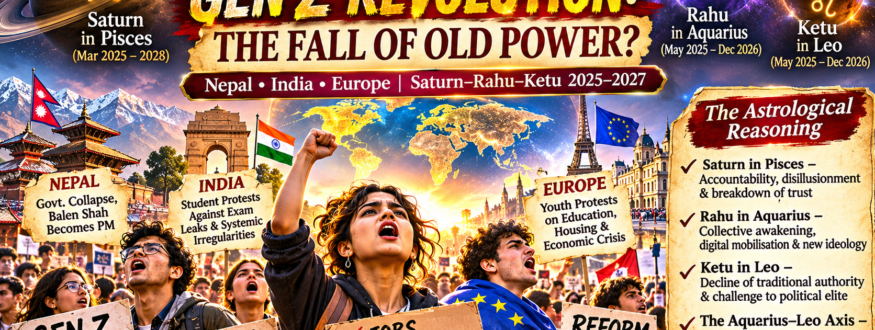
The Generation That Refused to Remain Silent: A Global Political Awakening
Something extraordinary is unfolding across the world.
From the streets of Kathmandu to the examination centres of India, from Serbia’s student demonstrations to youth-led protests across Germany and France, a new generation is challenging political authority.
These protests are not identical. Their political demands, economic circumstances and outcomes differ considerably.
Yet beneath these differences lies a remarkable common thread.
Young people increasingly believe that the institutions promising them a better future are failing to deliver it.
In Nepal, anger over corruption and censorship eventually contributed to the collapse of a government.
In India, students have protested examination irregularities, paper leaks and the perceived erosion of meritocracy.
Across Europe, younger generations have questioned rising living costs, deteriorating public services, housing affordability and the priorities of ageing political establishments.
The Council on Foreign Relations and the international civil society organisation CIVICUS have documented the international spread of youth-led movements, identifying corruption, inequality and lack of opportunity among their recurring grievances.
But from the perspective of Vedic Astrology, another question emerges:
Could the simultaneous rise of these movements symbolically reflect the planetary transition of Saturn through Pisces and Rahu through Aquarius?
To understand the astrological symbolism, we must first examine what actually happened on the ground.
1. Nepal’s Gen Z Revolution: When a Rapper Became Prime Minister
Perhaps the most dramatic example of the recent youth-led political transformation comes from Nepal.
In September 2025, thousands of young Nepalese citizens took to the streets in demonstrations that would fundamentally reshape their country’s political landscape.
The Backstory: Corruption, Nepotism and the Social Media Ban
For years, Nepal’s younger population had faced frustration over unemployment, limited economic opportunities, political instability and the need to seek employment abroad.
At the same time, social media increasingly exposed the luxurious lifestyles of individuals connected to political families.
The phrase “Nepo Kids” became a symbol of public resentment toward perceived privilege and political nepotism.
The immediate flashpoint came when Nepal’s government blocked 26 social media platforms in September 2025.
Although the government cited regulatory requirements, many young citizens interpreted the restrictions as an attempt to silence criticism.
What began as anger over digital censorship rapidly became a broader movement against corruption and political privilege.
The Demands
Protesters sought an end to the social media restrictions, accountability for corruption, meaningful political reform and greater opportunities for young citizens.
Following the violent crackdown, demands for justice and accountability intensified.
The Outcome: The Fall of an Establishment
The protests escalated dramatically.
Security forces used lethal force, and approximately 76 people died during the unrest and its aftermath.
Prime Minister K. P. Sharma Oli resigned on September 9, 2025.
Former Chief Justice Sushila Karki subsequently became interim prime minister, and early parliamentary elections were scheduled.
In March 2026, the Rastriya Swatantra Party achieved a decisive electoral victory.
On March 27, 2026, Balendra Shah, popularly known as Balen Shah, a former rapper, engineer and Kathmandu mayor, became Nepal’s youngest-ever elected prime minister.
Shah had not been the principal organiser of the street protests, but he successfully channelled widespread anti-establishment sentiment into an electoral mandate.
The transformation was extraordinary.
A figure whose public identity had once been associated with rap music and criticism of the establishment now occupied the country’s highest executive office.
The Jyotish Connection
In traditional mundane astrology, the Sun represents kingship, political authority and established leadership.
Saturn represents the masses, labour, hardship and accountability.
Rahu is associated with disruption, unconventional movements, outsiders and the crossing of established boundaries.
Nepal’s political transformation offers a striking symbolic illustration of these principles.
The authority of established political families was challenged by digitally connected young citizens, while an unconventional public figure emerged as the new face of political leadership.
The deeper question is whether the new leadership can deliver the institutional reforms that protesters demanded.
Replacing a government is one achievement. Rebuilding public trust is another.
2. India: When the Dream of Meritocracy Becomes a Protest Movement
India’s youth protests have followed a different trajectory.
Unlike Nepal, India has not experienced a single nationwide Gen Z uprising resulting in the overthrow of its central government.
Instead, recurring student demonstrations have focused on examination integrity, recruitment procedures, unemployment and educational opportunities.
The Backstory: Paper Leaks and Broken Expectations
For millions of Indian students, competitive examinations represent a pathway toward social mobility.
Families invest years of savings in education, coaching and preparation for medical, engineering and government recruitment examinations.
However, repeated allegations and incidents of examination irregularities have generated intense frustration.
During 2026, the youth-led movement associated with the satirical online identity Cockroach Janta Party drew attention to examination leaks and systemic educational grievances.
The movement developed from online satire into street demonstrations.
Its underlying message was simple: if students are expected to compete fairly, the institutions conducting examinations must also be accountable.
The Demands
Students have called for transparent examinations, investigations into paper leaks, fair recruitment processes, accountability for irregularities and reforms that protect candidates from losing years of preparation.
The Outcome
The demonstrations forced authorities into discussions and brought renewed attention to examination governance.
However, there has been no comparable nationwide change of government.
The longer-term question remains whether institutional reforms will restore students’ confidence.
The Jyotish Connection
In classical Jyotish, Mercury represents learning, reasoning, communication and analytical intelligence.
Jupiter represents higher knowledge, teachers, ethics and the principles of justice.
Saturn represents disciplined effort, delayed rewards and institutional accountability.
Rahu represents unconventional mobilisation and the rapid circulation of information.
The Indian examination protests can therefore be interpreted symbolically as a confrontation between Mercury’s promise of merit, Jupiter’s principles of fairness and Saturn’s demand for institutional responsibility.
When students devote years to preparation but lose faith in the fairness of the system, frustration becomes political.
The issue is no longer merely an examination.
It becomes a question of whether society rewards effort honestly.
3. Serbia: When a Railway Station Tragedy Became a Movement Against Corruption
In Europe, Serbia offers one of the clearest examples of student-led mobilisation against institutional failures.
The Backstory
In November 2024, a concrete canopy collapsed at the renovated railway station in Novi Sad, ultimately killing 16 people.
The disaster generated widespread public anger.
Many demonstrators questioned whether corruption, inadequate oversight or negligence had contributed to the tragedy.
Students became central participants in the ensuing protest movement.
The Demands
Protesters demanded transparency concerning the renovation project, accountability for those responsible, disclosure of relevant documents and stronger institutional safeguards.
The Outcome
The demonstrations sustained pressure on the Serbian government and contributed to the resignation of Prime Minister Miloš Vučević in January 2025.
However, the wider struggle over political accountability and institutional reform continued.
The Jyotish Connection
Saturn is traditionally associated with physical structures, public works, labour, responsibility and consequences.
Its symbolism is particularly relevant when discussing public infrastructure and institutional accountability.
Pisces, a water sign ruled by Jupiter, is associated in traditional astrological interpretation with collective ideals, compassion, faith and the dissolution of boundaries.
From a symbolic perspective, Serbia’s movement reflects a confrontation between institutional responsibility and public disillusionment.
A tragedy involving concrete and steel became a national debate about trust, justice and political accountability.
4. Germany: Why Is Gen Z Challenging Europe’s Economic Priorities?
By late October 2026, Germany had become another prominent centre of youth-led demonstrations.
The movement known as GenZ regelt, meaning “Gen Z has got this,” organised protests across more than 30 German cities.
Organisers reported approximately 120,000 participants.
The Backstory
Germany’s younger generation has faced growing concerns over sluggish economic growth, educational infrastructure, housing affordability and the future of social protection.
Students have complained about deteriorating school facilities, insufficient investment and shortages of teachers.
Meanwhile, debates over compulsory military service have added another dimension to generational dissatisfaction.
The Demands
Protesters have called for greater investment in education, healthcare, social security, climate protection and affordable living.
They have also opposed a return to compulsory military service.
The Outcome
The demonstrations brought these issues into public debate and increased pressure on policymakers.
As of November 2026, the movement had not produced a Nepal-style change of government.
The Jyotish Connection
Germany illustrates the Saturnian theme of generational responsibility.
Saturn symbolises institutions, obligations, ageing populations and the distribution of burdens across society.
The younger generation is questioning whether it will inherit a system in which it must contribute more while receiving fewer opportunities.
Rahu in Aquarius adds a compelling symbolic dimension: digitally connected citizens coordinating collective action outside conventional political structures.
The central conflict is not simply between young and old.
It is between the expectations of a social contract and the economic realities facing those who must sustain it.
5. France: From Classroom Protests to a National Political Crisis
France experienced another dramatic wave of student-led demonstrations during September and October 2026.
The Backstory: A Crisis in Education
The movement began on September 17, when teachers at a high school in Créteil protested staff shortages.
Students and parents joined them, and videos circulated rapidly on social media.
Within weeks, demonstrations had spread across France, affecting more than 1,000 high schools.
The grievances expanded beyond education to include living costs, housing affordability and dissatisfaction with the political establishment.
The Demands
Students demanded better school infrastructure, more teachers, smaller classes, fairer university admissions and greater public investment.
Many also criticised the Parcoursup university admissions system for its perceived complexity and lack of transparency.
The Outcome
Following major demonstrations and episodes of serious violence, the French government announced education concessions, including plans to reform university admissions, increase higher-education places and improve school funding.
Nevertheless, the movement continued to challenge the government’s broader economic and political priorities.
With France approaching its 2027 presidential election, youth dissatisfaction may become an important electoral factor.
The Jyotish Connection
France illustrates a powerful symbolic combination of Jupiter and Saturn.
Jupiter signifies education, wisdom, ethical principles and teachers.
Saturn represents public institutions, austerity, structural limitations and the consequences of neglect.
When educational institutions fail to meet the expectations of younger generations, the resulting conflict becomes more than an administrative problem.
It becomes a struggle over the future of society itself.
6. Beyond Europe: Indonesia, Madagascar and Morocco
The Gen Z protest phenomenon has extended well beyond South Asia and Europe.
In Indonesia, demonstrations intensified in 2025 over generous benefits for lawmakers amid wider economic frustration. Authorities subsequently withdrew controversial allowances, although demands for accountability continued.
In Madagascar, protests initially centred on electricity and water shortages, before developing into a broader political uprising. President Andry Rajoelina ultimately lost power after the military shifted its position.
In Morocco, the Gen Z 212 movement challenged deficiencies in healthcare, education and economic opportunity. The government responded with commitments to increase health and education spending, but the underlying grievances remained significant.
These cases reveal that Gen Z mobilisation is not a single international organisation pursuing one political ideology.
Rather, separate movements are responding to different local failures while borrowing tactics, language and inspiration from one another.
And this brings us to the most fascinating part of the analysis.
7. The Vedic Astrology Behind the Global Gen Z Uprising
Saturn in Pisces: When the Masses Question the System
In the Lahiri sidereal zodiac, Saturn entered Pisces on March 29, 2025, remaining there throughout 2026.
Saturn is traditionally associated with the masses, labour, suffering, accountability, restrictions and the consequences of accumulated actions.
Pisces, ruled by Jupiter, represents ideals, compassion, faith, collective concerns and the dissolution of boundaries.
The combination offers an interesting mundane-astrology interpretation.
Saturn in Pisces symbolically confronts institutions with the difference between their stated ideals and the lived experiences of ordinary people.
A government may promise prosperity, but citizens experience unemployment.
An educational system may promise meritocracy, but students encounter examination irregularities.
A political establishment may promise equality, while young people perceive privilege and corruption.
In Jyotish symbolism, Saturn demands accountability for the gap between promises and outcomes.
This does not mean Saturn caused these protests. It means the transit provides a traditional astrological lens through which their shared themes can be interpreted.
Rahu in Aquarius: The Digital Generation Becomes a Political Force
Perhaps the most striking symbolic correspondence is Rahu’s transit through Aquarius.
Rahu entered sidereal Aquarius in May 2025 and remains there until early December 2026, depending on the calculation method.
Aquarius, or Kumbha, is traditionally associated with collective networks, social groups and broader societal concerns.
Rahu represents unconventional behaviour, amplification, disruption, dissatisfaction and challenges to established boundaries.
Modern mundane astrologers often extend these symbols to digital networks, viral communication and technology-driven social movements.
Consider what happened across the world:
- In Nepal, social media restrictions helped ignite a national uprising.
- In India, online satire developed into organised student activism.
- In France, digital platforms helped demonstrations spread rapidly between schools.
- In Germany, youth groups coordinated protests across dozens of cities.
- In Indonesia and Morocco, online networks helped protesters mobilise around shared grievances.
The common element is not simply youthful anger.
It is the ability to organise without depending entirely on traditional political parties, trade unions or established leadership structures.
Rahu in Aquarius symbolically represents the moment when a digitally connected generation discovers its collective political power.
Ketu in Leo: The Declining Authority of Traditional Leaders
The other half of this astrological configuration is equally important.
While Rahu transits Aquarius, Ketu occupies the opposite sign, Leo.
Leo is ruled by the Sun, the natural significator of kingship, sovereignty and authority.
Ketu is traditionally associated with detachment, separation, disillusionment and the questioning of worldly attachments.
In mundane interpretation, Ketu in Leo may symbolise a period when the public becomes less emotionally attached to established leaders and traditional forms of prestige.
Nepal offers a particularly compelling example.
An older political establishment lost its authority, and an unconventional younger leader emerged through an electoral process.
But the symbolism is not restricted to Nepal.
Across different countries, younger citizens have increasingly questioned whether established political figures deserve automatic loyalty.
Ketu in Leo asks a provocative question: What happens when the public stops believing that political authority deserves respect simply because it exists?
The Aquarius–Leo Axis: The People Versus the Throne
This is arguably the most important astrological theme of the entire period.
Aquarius represents the collective.
Leo represents individual sovereignty and leadership.
Rahu in Aquarius amplifies the collective voice, while Ketu in Leo symbolically weakens unquestioned attachment to personal authority.
In a geopolitical reading, this axis can be interpreted as a confrontation between the demands of the public and the legitimacy of those governing them.
However, it is important to distinguish the symbolic interpretation from classical doctrine.
The traditional meanings of Rahu, Ketu, Saturn and the zodiac signs are rooted in Jyotish literature. Their application to social media, Gen Z activism and contemporary electoral politics is a modern interpretive extension, not a specific ancient prediction of the events of 2025–2026.
8. Saturn’s Special Aspects: Why Aquarius and Sagittarius Also Matter
In Parashari Jyotish, Saturn has special aspects on the third and tenth houses from its position, in addition to its seventh aspect.
From Pisces, Saturn aspects Taurus by its third aspect, Virgo by its seventh and Sagittarius by its tenth.
This matters because Sagittarius is ruled by Jupiter and traditionally represents Dharma, philosophy, higher learning and systems of belief.
Saturn’s tenth aspect on Sagittarius can therefore be interpreted symbolically as a demand for responsibility in institutions that claim moral or ideological legitimacy.
At the same time, Rahu’s occupation of Aquarius places emphasis on collective identity and unconventional mobilisation.
The two placements do not form a conventional Saturn–Rahu conjunction. Their combined interpretation comes from the broader transit pattern rather than a direct conjunction.
9. Why 2025–2026 Became Such a Remarkable Period
The timing is particularly interesting.
Saturn entered Pisces in March 2025.
Rahu entered Aquarius and Ketu entered Leo in May 2025.
The following months witnessed major youth-led demonstrations in Nepal, Indonesia, Madagascar, Morocco and other countries.
The pattern continued into 2026, with prominent student movements in India and Europe.
This chronological overlap is noteworthy from an astrological perspective.
Yet it does not establish causation.
Political unrest has existed during many other planetary configurations, and not every country experiencing these transits witnessed an uprising.
A rigorous mundane-astrology case study must therefore consider the broader historical record, national horoscopes, ingress charts, eclipse cycles and planetary periods rather than attributing global events to one transit.
Still, the symbolism of the period is unusually coherent:
Saturn raises questions of responsibility.
Rahu amplifies collective dissatisfaction.
Ketu challenges attachment to established authority.
Together, they offer a compelling traditional framework for discussing the political mood of the era.
10. What Happens After Rahu Leaves Aquarius in December 2026?
The next important transition arrives in early December 2026, when Rahu moves into Capricorn and Ketu enters Cancer in the Lahiri sidereal zodiac.
Capricorn is ruled by Saturn and is associated with institutions, administration, hierarchy, governance and material structures.
Cancer is ruled by the Moon and is associated with the public, emotional security, homeland and belonging.
From a symbolic mundane-astrology perspective, this shift may suggest a change in emphasis.
The Aquarius–Leo axis has highlighted the confrontation between collective movements and established leadership.
The Capricorn–Cancer axis may bring greater attention to how governments respond institutionally to demands concerning economic security, public services and national identity.
For example, the political question may evolve from:
“Who should govern us?”
to:
“Can the new leadership actually rebuild the institutions we depend upon?”
This is particularly relevant to Nepal, where the new government faces the difficult task of transforming protest-driven expectations into effective governance.
It is also relevant to European governments confronting structural economic challenges and younger populations demanding a more sustainable social contract.
However, these are interpretive themes, not verified predictions of future political events.
11. Could Gen Z Protests Continue Into 2027?
The answer depends far more on economic conditions, political accountability and government responses than on planetary movements.
Several factors could sustain youth mobilisation: high unemployment, unaffordable housing, weak educational infrastructure, corruption allegations, restrictions on expression and dissatisfaction with traditional political parties.
The astrological transition into the Capricorn–Cancer nodal axis may be interpreted as shifting attention toward institutional reform and public security.
Saturn’s continuing movement through Pisces also preserves the symbolic theme of accountability and disillusionment.
But not every protest will produce the same result.
Some governments may negotiate reforms.
Others may resist or repress demonstrations.
Some movements may lose momentum, while others may evolve into electoral organisations.
The outcome will depend on the choices of citizens, political leaders and institutions.
12. The Deeper Message: Is This a Generational Revolution or a Crisis of Trust?
The most revealing aspect of the Gen Z protest wave is not the age of the demonstrators.
It is the recurring breakdown of trust.
Across different political systems, younger generations are questioning whether the institutions they inherit can deliver the opportunities and fairness they were promised.
In Nepal, the crisis concerned corruption, privilege and political accountability.
In India, it concerned educational integrity and the credibility of merit-based advancement.
In Serbia, it concerned public safety and institutional responsibility.
In France and Germany, it concerned the quality of public services and the economic future of younger citizens.
These movements do not necessarily share the same political objectives.
Nevertheless, they reveal a common demand for institutions to justify their authority through performance rather than tradition alone.
From the perspective of Jyotish, this is the central symbolism of Saturn.
Saturn does not merely represent hardship.
It represents the consequences of neglected responsibilities.
And when Rahu’s disruptive symbolism is added to the collective sign of Aquarius, the image becomes even more compelling.
A generation that once expressed dissatisfaction primarily through digital platforms begins carrying its grievances into the streets.
Conclusion: When the Collective Voice Challenges Political Authority
The rise of Gen Z protests across Nepal, India, Europe and other regions represents one of the most significant developments in contemporary youth politics.
These movements have emerged from different national circumstances, yet many share concerns over inequality, corruption, economic insecurity and institutional accountability.
Nepal’s transformation, culminating in the election of former rapper Balen Shah as prime minister, demonstrates how public dissatisfaction can eventually reshape electoral politics.
India’s student protests reveal the political consequences of declining trust in educational institutions.
European movements show how dissatisfaction with public services and economic opportunities can mobilise younger generations even in established democracies.
From the symbolic perspective of Vedic Astrology, the planetary configuration of 2025–2026 offers a fascinating interpretation:
Saturn in Pisces questions whether institutions are fulfilling their responsibilities.
Rahu in Aquarius amplifies the voice of digitally connected collective movements.
Ketu in Leo symbolises disillusionment with traditional political authority.
And the coming Rahu–Ketu transition into Capricorn and Cancer introduces a new symbolic question about governance, security and institutional reform.
Perhaps the most important lesson of this period is that political legitimacy cannot survive indefinitely on inherited prestige alone.
It must continually be earned through accountability, competence and public trust.
The planetary symbolism may offer a philosophical perspective, but the future of these movements will ultimately be shaped by human decisions.
The generation that grew up questioning authority online is now demanding answers in the real world.
And the most important question is no longer whether governments are listening.
It is whether they are prepared to change.
Disclaimer: This article combines documented geopolitical developments with traditional and contemporary interpretations of Vedic mundane astrology. Astrological symbolism is not scientifically established as a cause or reliable predictor of protests, elections or political outcomes. The political analysis is intended to be descriptive and nonpartisan.
References and Further Reading:
- Council on Foreign Relations — How Global Gen Z Protests Have Shocked and Transformed Governments.
- CIVICUS — State of Civil Society Report 2026: Gen Z Protests.
- Carnegie Endowment for International Peace — A New Generation Takes Power in Nepal.
- UK House of Commons Library — Nepal: 2026 Legislative Election and Future Prospects.
- Channel News Asia — Reporting on India’s youth examination protests and Europe’s Gen Z demonstrations.
- Council on Foreign Relations — What’s Behind the Protests and Riots in France, and What Comes Next.
- European Students’ Union — Student Protests Monitoring, July–September 2026.
- Brihat Parashara Hora Shastra — Traditional planetary significations and Graha Drishti principles.
- Classical Jyotish traditions concerning Shani, Rahu, Ketu and mundane astrology.
