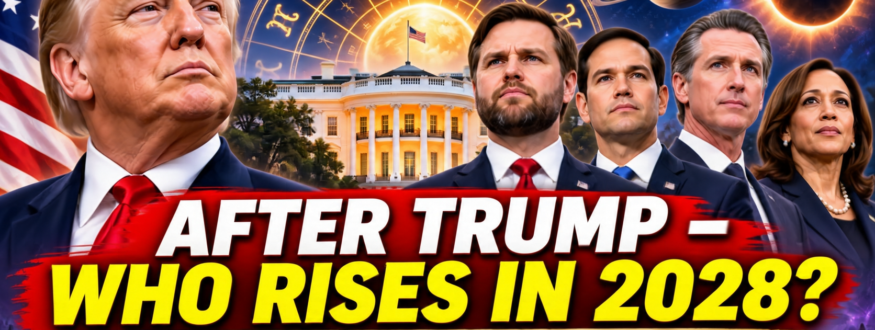
Who Will Rise After Trump’s Midterm Setback? The 2028 US Presidential Race and the Vedic Astrology of Political Power
November 12, 2026 | US Presidential Election, Donald Trump, Raj Yoga, Saturn, Rahu and Vedic Astrology
The 2028 race for the White House has begun taking shape — and the political landscape looks remarkably different after America’s November 2026 midterm elections.
President Donald Trump entered the midterms hoping Republicans would retain control of Congress.
Instead, Democrats won both the House of Representatives and the Senate.
The election exposed widespread dissatisfaction over living costs, the Iran war and the direction of the country.
But the most intriguing question now concerns what happens after Trump.
With the US Constitution preventing him from being elected to a third presidential term, the contest to succeed him is beginning to attract attention across both major parties.
Vice President JD Vance and Secretary of State Marco Rubio are prominent names in the Republican conversation.
On the Democratic side, figures including Gavin Newsom, Josh Shapiro, Pete Buttigieg and Jon Ossoff are attracting attention.
And on November 12, a new Reuters/Ipsos survey offered an early glimpse of how voters view several potential candidates.
For students of Vedic astrology, this political transition raises a fascinating question:
What separates a politician who achieves public recognition from one who eventually occupies the highest office in the country?
Does a powerful Sun signify authority?
Can Saturn represent the responsibility of governing?
Why is Rahu so frequently associated with mass movements, unconventional leadership and political disruption?
And what role do Raj Yogas, the 9th and 10th houses, and Vimshottari Dasha play in classical interpretations of political prominence?
The answers require a distinction between documented political developments and the symbolic principles of Jyotish.
Astrology does not establish election outcomes, and planetary positions cannot substitute for polling, campaign organization or the decisions of voters.
Nevertheless, the classical language of power, responsibility, public image and ambition offers an interesting way to examine the qualities associated with political leadership.
November 3, 2026: The Midterm Election That Changed Washington
The November 2026 midterm elections produced major Democratic gains.
According to Reuters and the Associated Press, Democrats won control of both chambers of Congress.
Their victories extended beyond traditional competitive states.
Democratic Senate candidates prevailed in states including Texas, Kansas, Ohio, North Carolina and South Carolina.
The results demonstrated significant changes in voter sentiment compared with the 2024 presidential election.
Reporting identified several major concerns among voters.
The cost of living remained a central issue.
The war with Iran and its economic consequences also influenced public opinion.
Concerns about government accountability and the country’s direction featured prominently in election coverage.
The results created a new political environment for the remainder of Trump’s presidency.
With Democrats controlling Congress, negotiations over legislation, spending and oversight are likely to become increasingly important.
But the midterms also affected the conversation about presidential succession.
Republicans must consider how to present their record and future agenda.
Democrats must decide which leaders and policy priorities should define their next national campaign.
Neither party has yet settled on a presidential nominee.
Why Donald Trump Cannot Simply Run Again in 2028
The Twenty-Second Amendment to the US Constitution generally prohibits a person from being elected president more than twice.
Trump won presidential elections in 2016 and 2024.
He therefore cannot be elected to a third term under the existing constitutional rules.
This makes the 2028 election a presidential succession contest rather than another conventional Trump reelection campaign.
However, Trump remains an influential figure within Republican politics.
His administration’s record, public statements and relationship with potential successors will continue to shape the political discussion.
The distinction between Trump’s personal political influence and the future leadership of the Republican Party is central to understanding the next election.
For astrology readers, this transition introduces a useful contrast between the Sun’s symbolism of individual authority and Saturn’s symbolism of institutional continuity.
JD Vance: The Vice President in the 2028 Conversation
JD Vance occupies a prominent position in the Republican succession discussion.
As vice president, he holds one of the country’s highest offices and has direct experience within the Trump administration.
Before becoming vice president, Vance served as a US senator from Ohio.
He also became widely known through his memoir, Hillbilly Elegy, which explored family, class and social mobility.
His political career developed rapidly.
Vance moved from public commentary and publishing into elected office and then the vice presidency.
This trajectory makes him an interesting subject for the astrological study of career advancement.
The Sun and the 10th house
In classical Jyotish, the Sun is associated with authority, dignity, leadership and government.
The 10th house represents professional activity, status, responsibility and public recognition.
For a politician, these factors are relevant to traditional discussions of public office.
However, holding a prominent position does not establish that a particular Raj Yoga exists in the natal chart.
A proper astrological assessment would require verified birth details, planetary calculations and examination of the relevant dashas.
Vance’s potential 2028 candidacy must be evaluated through his actual political decisions and public record, rather than assumed planetary combinations.
Marco Rubio: Experience, Diplomacy and the Question of Succession
Marco Rubio is another widely discussed potential Republican candidate.
Rubio previously represented Florida in the US Senate and contested the Republican presidential nomination in 2016.
He now serves as secretary of state.
His experience includes legislative work, foreign policy and national political campaigning.
A Reuters/Ipsos survey published on November 12 found that 45% of Republican voters surveyed rated Rubio an excellent potential presidential candidate, compared with 43% for Vance.
The difference is small and falls within the survey’s reported uncertainty.
The poll is an assessment of potential candidacies, not a presidential election forecast.
Jupiter and political counsel
Jupiter, or Brihaspati, is traditionally associated with wisdom, teachers, counsel, knowledge and dharma.
In political astrology, Jupiter’s symbolism may be considered when discussing advisers, policy judgment and diplomacy.
Rubio’s professional responsibilities provide an opportunity to explore those themes.
But Jupiter’s placement cannot establish whether a politician is wise, ethical or capable.
Those judgments require examination of decisions, conduct and results.
The Democratic Field: A Wide-Open Succession Contest
Democrats enter the post-midterm period with several nationally recognized figures but no formally selected presidential candidate.
Governors, senators and former administration officials have been raising their public profiles, appearing in politically important states and participating in national debates.
Among the frequently discussed names are Gavin Newsom, Josh Shapiro, Pete Buttigieg and Jon Ossoff.
Other figures, including Andy Beshear, Kamala Harris and additional Democratic leaders, remain part of the broader conversation.
Gavin Newsom: The Visibility of Executive Office
California Governor Gavin Newsom has maintained a prominent national profile.
He has participated in political events outside California, published a memoir and engaged in debates over national policy.
From a Jyotish perspective, his public career offers an opportunity to discuss the 10th house of authority and the 11th house of networks.
The astrological comparison concerns the public nature of executive office, not a verified planetary placement.
Josh Shapiro: State Leadership and Public Responsibility
Pennsylvania Governor Josh Shapiro is another frequently discussed figure.
His position in a politically competitive state has attracted national attention.
Traditional astrology would examine the Sun, Saturn and the 10th house when discussing responsibility and public leadership.
But the symbolism does not establish his prospects in a future primary.
Pete Buttigieg: Communication and Public Recognition
Former Transportation Secretary Pete Buttigieg is familiar to national audiences from his previous presidential campaign and service in the Biden administration.
In the November 12 Reuters/Ipsos survey, 29% of Democratic voters rated him an excellent potential candidate.
His public communication and media appearances provide a useful context for discussing Mercury and the 3rd house.
Mercury traditionally signifies intellect, communication and analytical abilities.
However, astrology cannot independently assess a person’s intelligence or competence.
Jon Ossoff: A New Focus of National Attention
Georgia Senator Jon Ossoff has received increased attention following his successful 2026 reelection campaign.
The November 12 Reuters/Ipsos survey found that 29% of Democratic voters rated him an excellent potential presidential candidate.
The survey also indicated that many Democratic voters were not yet familiar with him.
This distinction between recognition and public evaluation is important.
In modern astrology, astrologers sometimes discuss Rahu and the Arudha Lagna when examining visibility and public image.
But those concepts should not be confused with measured voter support.
The November 12 Reuters/Ipsos Poll: What Does It Actually Show?
The Reuters/Ipsos survey provides an early snapshot of attitudes toward potential 2028 candidates.
It surveyed 1,705 US adults, including approximately 500 registered voters from each major party.
Respondents were asked whether particular politicians would make excellent presidential candidates.
Potential CandidatePartyParty Voters Rating Them “Excellent”Marco RubioRepublican45%JD VanceRepublican43%Ron DeSantisRepublican32%Jon OssoffDemocratic29%Pete ButtigiegDemocratic29%Gavin NewsomDemocratic23%Kamala HarrisDemocratic23%Alexandria Ocasio-CortezDemocratic15%
These percentages are not head-to-head election results, primary vote shares or predictions.
They measure respondents’ assessments of potential candidates within their own party.
The reported margin of error for party voters is approximately five percentage points.
The survey also comes nearly two years before the presidential election.
Public opinion, candidate participation and political conditions may change substantially.
Raj Yoga: What Creates Political Authority in Classical Vedic Astrology?
The term Raj Yoga is frequently used in popular astrology.
It is sometimes described as a combination that makes a person a king, ruler or powerful leader.
But classical Jyotish contains many different Raj Yoga principles.
A single planetary conjunction cannot be treated as a universal formula for political power.
One important principle involves relationships between the lords of Kendras and Trikonas.
The Kendras are the 1st, 4th, 7th and 10th houses.
The Trikonas most commonly emphasized in Raj Yoga analysis are the 1st, 5th and 9th houses.
Favourable relationships between certain Kendra and Trikona lords may be associated with prominence, authority or prosperity.
The exact interpretation depends on the Ascendant and the planets involved.
Does Raj Yoga guarantee a presidency?
No.
Classical texts describe combinations associated with status, influence and worldly success.
But a modern presidential election involves legal qualifications, political parties, voters, campaigns, media, financing and numerous other factors.
A Raj Yoga cannot establish that someone will win an election.
It may be examined as part of a traditional horoscope interpretation, but it should not be presented as proof of a future political outcome.
The Sun: The Natural Significator of Government and Authority
The Sun, known as Surya, is traditionally associated with authority, kingship, dignity, fatherhood and the state.
In classical astrology, the Sun occupies an important position when examining government service and positions of responsibility.
But its results depend on house lordship, dignity, aspects and planetary periods.
A strong Sun does not automatically produce a politician.
It may be expressed through leadership in business, administration, public service or other professions.
Similarly, an individual with a challenging Sun placement can still achieve substantial professional recognition.
In the context of the 2028 election, the Sun offers a symbolic framework for discussing the distinction between holding office and exercising authority.
Saturn: Institutions, Public Responsibility and the Limits of Power
Saturn, or Shani, represents time, discipline, responsibility, labour, restriction and endurance.
It is particularly relevant to the institutional dimension of political life.
A president does not operate independently of Congress, the courts, federal agencies or constitutional law.
The November 2026 midterm results provide a concrete example.
The president remains in office, but the composition of Congress has changed.
This alters the political environment in which the administration operates.
Saturn’s symbolism offers a useful way to discuss institutional constraints.
However, it would be inaccurate to say that Saturn caused the Democratic victories.
Those results were determined by voters.
Saturn and political succession
Saturn is also associated with continuity and the passage of time.
Political leaders inherit institutions and responsibilities from their predecessors.
The 2028 succession contest will involve competing ideas about which policies should continue and which should change.
That process reflects the practical importance of institutions, not a predetermined planetary cycle.
Rahu: Mass Movements, Political Disruption and Public Fascination
Rahu is associated in Jyotish with unconventional ambition, desire, disruption and experiences outside established boundaries.
Modern astrologers often connect Rahu with mass media, rapid public visibility and unusual political developments.
These associations are interpretive extensions of traditional symbolism.
Rahu can be used to discuss the way a political figure becomes a focus of intense public attention.
But Rahu cannot establish that a politician is deceptive, charismatic or destined for power.
Those are different claims requiring different forms of evidence.
Rahu and the rise of unconventional candidates
Modern political history includes figures who entered national politics through nontraditional paths.
The growth of digital media has also changed how politicians communicate with voters.
From an astrological perspective, these developments resemble Rahu’s symbolic association with unconventional advancement.
But their real-world causes include technology, campaign strategy, political institutions and voter behaviour.
Jupiter: Counsel, Political Philosophy and the Ninth House
Jupiter represents wisdom, knowledge, teachers, guidance and dharma.
The 9th house is associated with higher principles, law, teachers, fortune and philosophical understanding.
In political astrology, these factors may be examined when discussing a person’s relationship with principles, advisers and institutions.
However, planetary placements do not establish whether a political programme is morally correct.
Political positions must be evaluated through their substance, evidence and consequences.
The 2028 election will involve debates over economic policy, foreign affairs, government accountability and other public issues.
Astrology should not replace those debates.
The Tenth House: The Difference Between Ambition and Public Office
The 10th house, or Karma Bhava, represents profession, action, status and public responsibilities.
It is central to traditional career analysis.
A politician’s 10th house may be examined alongside the Ascendant, Sun, 9th house and relevant planetary periods.
But a successful political career does not necessarily culminate in the presidency.
Governors, senators, diplomats and other public officials may achieve substantial professional prominence without seeking the White House.
This distinction is especially important when discussing potential candidates.
National recognition does not establish that someone will enter the race.
Entering the race does not establish that someone will secure a party nomination.
And winning a nomination does not establish the result of the general election.
The Eleventh House: Political Networks and Public Support
The 11th house, known as Labha Bhava, is associated with gains, networks, influential associations and the fulfilment of ambitions.
In modern political astrology, it is sometimes examined in connection with supporters and organizational relationships.
Political campaigns rely on networks of volunteers, donors, local officials and community organizations.
These relationships are measurable through campaign activity and public records.
The 11th house provides a symbolic analogy for the importance of networks.
It does not independently measure electoral support.
The Arudha Lagna and A10: Political Image Versus Actual Authority
One of the more sophisticated concepts in Jyotish concerns the Arudha Lagna.
In Jaimini-influenced traditions, the Arudha Lagna is used to examine the manifested or perceived image of an individual.
The Arudha of the 10th house, commonly called A10, may be considered in relation to the public presentation of professional activity.
This distinction is especially interesting in politics.
A politician may possess a carefully developed public image.
That image may differ from the complexities of governing.
But astrological Arudha calculations cannot establish whether a public figure is sincere, trustworthy or qualified.
Those assessments require evidence concerning actions, policies and conduct.
Vimshottari Dasha: Can a Planetary Period Coincide With Political Advancement?
Vimshottari Dasha is one of the principal timing systems of Vedic astrology.
It divides life into planetary periods called Mahadashas and Antardashas.
Traditional astrologers examine these periods in connection with natal planetary placements.
A period involving a strong 10th lord or a planet participating in a Raj Yoga may be interpreted as relevant to professional advancement.
But the same planet may signify different outcomes in different horoscopes.
For example, a Saturn period may correspond with increased responsibility in one chart and professional restriction in another.
A Rahu period may be associated with unconventional opportunities, but it does not automatically produce fame or political office.
Can we compare the candidates’ dashas?
A rigorous comparison would require reliable birth dates, birthplaces and verified birth times.
The astrologer would then need to calculate the relevant D1 and D10 charts, planetary strengths and operating periods.
Without dependable birth times for every candidate, comparing exact house placements and divisional charts would be misleading.
Even with accurate calculations, a dasha interpretation cannot establish an election result.
The 2027–2028 Planetary Climate: What Should Astrologers Examine?
For a traditional sidereal analysis of the next presidential cycle, astrologers may examine the movements of Jupiter, Saturn, Rahu and Ketu.
However, the precise dates and degrees should be calculated using a consistent ephemeris and ayanamsha, such as Lahiri.
The most relevant questions would include:
- How do Jupiter’s movements relate to themes of leadership, counsel and institutional growth?
- How does Saturn’s movement symbolize responsibility and the constraints of public office?
- What do the Rahu–Ketu transits suggest within traditional discussions of public image and change?
- Which planetary periods are operating in the horoscopes being studied?
- Are relevant career-related yogas activated according to the chosen Jyotish method?
These questions form an interpretive research framework.
They are not a method for determining the winner of the 2028 presidential election.
Why the 2026 Midterms Matter More Than Any Single Planetary Transit
The November election revealed several concrete issues that will influence the national political conversation.
Voters expressed concerns about affordability.
The Iran war and its economic consequences became important political issues.
Questions about accountability and government performance also featured prominently.
The parties will now debate how to address these concerns.
For Republicans, the discussion includes the future direction of the party after Trump’s presidency.
For Democrats, the discussion includes which policies, leaders and governing approaches should define their national agenda.
Those debates will evolve as the 2028 campaign develops.
The candidates who ultimately participate will be judged through their public records, proposals, campaign performances and interactions with voters.
Astrology cannot replace that process.
Is the 2028 Presidential Race Already Decided?
Absolutely not.
As of November 12, 2026, no candidate has formally entered the presidential race, according to Reuters’ latest overview.
The field remains unsettled.
Early surveys offer information about public perceptions, but they do not determine who will run, secure a nomination or win the election.
Political conditions can change substantially over two years.
New candidates may emerge.
Others may decide not to participate.
Economic developments, international events and public policy debates may alter the issues voters consider most important.
The uncertainty is part of what makes the developing election story significant.
Final Thoughts: Political Power, Raj Yoga and the Unanswered Question of 2028
The November 2026 midterms have changed the political environment in Washington.
Democrats now control Congress.
Trump remains president.
And both major parties face important decisions about their future leadership.
JD Vance and Marco Rubio are prominent figures in the Republican succession discussion.
Democrats are considering a wider group of potential candidates, including governors, senators and former administration officials.
For students of Vedic astrology, the story provides an opportunity to examine the traditional symbolism of political authority.
The Sun represents leadership and government.
Saturn represents responsibility, discipline and institutions.
Rahu represents unconventional ambition and public fascination.
Jupiter represents wisdom, counsel and dharma.
The 9th house represents principles and fortune.
The 10th house represents professional authority.
The 11th house represents gains and networks.
Raj Yogas are traditionally associated with prominence and worldly achievement.
But none of these factors can independently determine an election result.
The American presidency is decided through a constitutional electoral process, not through a planetary configuration.
The question facing the United States is therefore both political and historical.
After Trump’s second presidency, what kind of leadership will Americans seek in 2028 — and which candidates will ultimately offer competing answers?
That story is only beginning.
Frequently Asked Questions
Who will run for US president in 2028?
No candidate had formally entered the race as of November 12, 2026, according to Reuters. JD Vance, Marco Rubio, Gavin Newsom, Josh Shapiro, Pete Buttigieg and Jon Ossoff are among the figures receiving attention.
Can Donald Trump run for president again in 2028?
Trump cannot be elected to a third presidential term under the existing Twenty-Second Amendment.
What happened in the November 2026 midterm elections?
Democrats won control of both the House and Senate, according to Reuters and the Associated Press.
Is JD Vance running for president in 2028?
Vance has been widely discussed as a potential candidate, but he had not formally launched a campaign as of November 12, 2026.
Is Marco Rubio considering the presidency?
Rubio is frequently discussed as a potential Republican successor to Trump, but no formal campaign announcement has been reported.
Which Democrats are being discussed for 2028?
Names include Gavin Newsom, Josh Shapiro, Pete Buttigieg, Jon Ossoff, Andy Beshear, Kamala Harris and other political figures.
What is Raj Yoga in Vedic astrology?
Raj Yoga refers to traditional planetary combinations associated with prominence, authority and worldly success. Different classical texts describe different forms of Raj Yoga.
Which planet represents political authority?
The Sun is a natural significator of kingship, government and authority. Saturn, Jupiter and other factors may also be relevant depending on the horoscope.
Does Rahu give political power?
Rahu is associated with unconventional ambition and worldly desire, but its placement does not guarantee political success.
Which house represents a political career?
The 10th house is central to profession, public activity and status. The Ascendant, 9th house, Sun and relevant planetary periods are also examined.
Can Vedic astrology predict the 2028 presidential winner?
Traditional astrologers use natal charts, dashas and transits to interpret career and leadership themes. However, no scientifically established astrological method reliably predicts election winners.
Written for NJ Shivoham | Vedic Astrology, World Affairs and Classical Jyotish
Editorial Disclaimer: This article distinguishes documented election results and political reporting from traditional astrological symbolism. It does not endorse a candidate, rank candidates by suitability or predict the outcome of the 2028 US presidential election.
#USElection2028 #DonaldTrump #JDVance #MarcoRubio #GavinNewsom #PeteButtigieg #JonOssoff #VedicAstrology #RajYoga #PoliticalAstrology #Saturn #Rahu #NJShivoham
