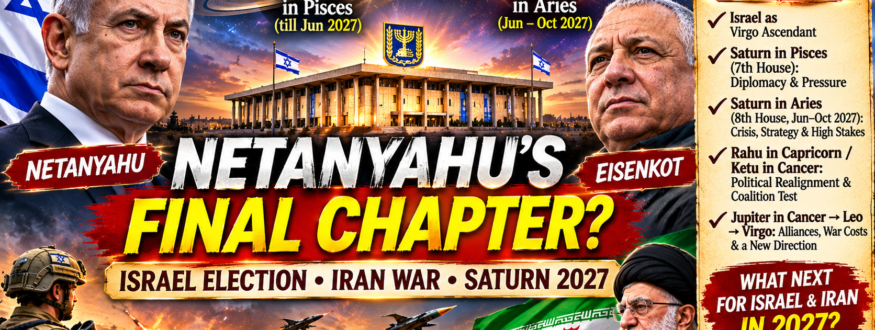
Israel’s Political Earthquake: A New Prime Minister, Another Election or a Wider War With Iran?
Israel has entered one of the most consequential political transitions in its modern history.
The October 27, 2026 parliamentary election has weakened Benjamin Netanyahu’s grip on power, but it has not yet produced a new government.
Former Israeli military chief Gadi Eisenkot has emerged as the leading opposition contender to replace Netanyahu.
Yet Israel’s fragmented parliament has created an extraordinary situation.
Netanyahu has lost his parliamentary majority, but his principal challenger has not secured one either.
Meanwhile, Israel remains deeply involved in a regional confrontation with Iran.
Fresh warnings from Tehran, Israeli military preparations and American diplomatic manoeuvring have raised fears of renewed escalation.
The political uncertainty is particularly significant because Netanyahu remains caretaker prime minister while coalition negotiations continue.
Could a leadership transition change Israel’s strategy toward Iran?
Could the country face another election?
And from the perspective of Vedic Mundane Astrology, what does 2027 indicate when Saturn temporarily enters Aries, the eighth house from Israel’s Virgo Ascendant in one commonly used national horoscope?
To explore these questions, we must first examine the latest political developments.
1. Israel Election Results 2026: What Actually Happened?
Israel held its parliamentary election on October 27, 2026, electing the 120 members of the Knesset.
The election followed years of political division, the October 7, 2023 Hamas-led attacks, the devastating war in Gaza and escalating regional conflict.
Netanyahu’s Likud party remained the largest individual party, winning 27 seats.
However, his broader political alliance failed to secure the 61 seats necessary for a parliamentary majority.
The Parliamentary Arithmetic
The results produced three important political groupings:
- Netanyahu’s Likud-led alliance: 53 seats.
- Eisenkot’s Yashar party and allied factions: 48 seats.
- Arab-led parties: 19 seats.
Neither of the two principal Jewish-led blocs secured an outright majority.
This makes coalition negotiations essential.
The Arab-led parties oppose Netanyahu, but cooperation between them and Eisenkot’s prospective coalition remains politically complicated.
Israel’s parliamentary system requires a government capable of commanding the confidence of the Knesset.
Therefore, winning the largest number of seats does not automatically guarantee the premiership.
The election produced a weakened incumbent, a potential successor and an unresolved struggle for parliamentary power.
2. Who Is Most Likely to Become Israel’s Next Prime Minister?
As of November 13, 2026, the leading contenders are Gadi Eisenkot and Benjamin Netanyahu.
Gadi Eisenkot: The Former General Seeking Political Leadership
Gadi Eisenkot is a former Chief of Staff of the Israel Defense Forces and the leader of the Yashar party.
His political appeal rests partly on his military background, national-security credentials and positioning as an alternative to Netanyahu.
Eisenkot’s party won 21 seats, making it the second-largest party in the new Knesset.
President Isaac Herzog has tasked him with attempting to form a government.
Eisenkot initially has until December 6, 2026, to complete the process, with a possible extension until December 20.
His options include securing support from Arab-led parties, persuading ultra-Orthodox factions to join his coalition or negotiating a broader unity arrangement.
Each option presents serious political obstacles.
Benjamin Netanyahu: Defeated Majority, Not Defeated Politician
Netanyahu remains caretaker prime minister.
His Likud party secured 27 seats, and his alliance holds 53 seats overall.
Although he no longer commands a parliamentary majority, he remains a formidable political figure.
If Eisenkot fails to form a government, Netanyahu could receive another opportunity to assemble a coalition.
A prolonged deadlock could even result in another parliamentary election.
What Is the Most Probable Outcome?
Eisenkot currently has the first opportunity to form a government and is therefore the immediate prospective successor.
However, he cannot yet be described as Israel’s next confirmed prime minister.
Three possibilities remain realistic:
- Eisenkot forms a coalition and replaces Netanyahu.
- Netanyahu secures sufficient parliamentary support to remain in office.
- Coalition negotiations fail, producing further political instability or another election.
The outcome will depend on negotiations, party decisions and parliamentary arithmetic rather than opinion polls or astrological predictions.
3. Why Did Netanyahu Lose His Parliamentary Majority?
The election reflected several overlapping political controversies.
The October 7 Security Failure
The October 7, 2023 attacks fundamentally changed Israeli politics.
Questions concerning intelligence failures, military preparedness and government responsibility became central to public debate.
Eisenkot and his allies have supported establishing a commission of inquiry into the attacks.
Netanyahu’s political opponents argue that accountability is essential to rebuilding public confidence.
Military Service and the Ultra-Orthodox Community
The question of military-service exemptions for ultra-Orthodox men has generated significant political tension.
The issue became particularly sensitive during prolonged military mobilisation and the heavy demands placed on reservists.
The Cost of War
Military expenditure, economic pressures, international isolation and public exhaustion have also shaped political debate.
The election was not solely a referendum on Iran or Gaza.
It reflected broader disagreements over governance, accountability, security and Israel’s political future.
4. Israel and Iran: Why the Conflict Remains Dangerous
Israel and Iran have been strategic adversaries for decades.
Their rivalry involves Iran’s nuclear programme, ballistic missiles, Israeli security concerns, regional armed groups and the balance of power across the Middle East.
Israel considers Iran’s military and nuclear capabilities a major national-security threat.
Iran views Israeli and American military actions as threats to its sovereignty and security.
The confrontation has expanded beyond indirect rivalry into direct military exchanges.
By November 2026, the conflict remained unresolved.
Latest Developments: November 12–13, 2026
Reports on November 12 indicated that Israel’s security cabinet had instructed the military to intensify preparations for a possible attack on Iran.
Iran warned that it could expand retaliation if attacked.
On November 13, Axios reported that Mossad director Roman Gofman was visiting Washington for discussions with senior American officials.
The report indicated that Netanyahu was pressing President Donald Trump to resume military action against Iran.
Trump had reportedly resisted renewed military escalation.
These developments reveal an important political tension.
Israel’s caretaker leadership may favour a more aggressive military approach, while Washington appears reluctant to immediately resume large-scale attacks.
The situation remains fluid, and reported preparations do not establish that a new Israeli attack is inevitable.
5. Could Netanyahu Escalate the Iran War Before Leaving Office?
This is one of the most sensitive questions in Israeli politics.
A caretaker government does not automatically lose its legal authority to make national-security decisions.
Therefore, Netanyahu’s government may retain the ability to authorise military action, subject to applicable Israeli law and institutional procedures.
However, the political legitimacy and consequences of major military decisions during a government transition are highly contested.
A new confrontation with Iran could increase national-security solidarity within Israel.
It could also deepen domestic divisions, produce casualties, disrupt coalition negotiations and create further tensions with the United States.
It would be speculative to assert that Netanyahu intends to initiate military action merely to preserve his political position.
Nevertheless, the combination of political uncertainty and military escalation risk deserves close attention.
Would Eisenkot Follow a Different Policy?
Eisenkot’s military background suggests that he would also treat Iran as a serious security concern.
A change of prime minister would not automatically mean abandoning Israel’s strategic opposition to Iran’s nuclear and missile capabilities.
However, differences could emerge in diplomatic coordination, decision-making procedures, relations with Washington and the willingness to pursue particular military options.
A change of leadership may change the method of confrontation without eliminating the underlying strategic rivalry.
PART II: ISRAEL’S VIRGO ASCENDANT IN VEDIC MUNDANE ASTROLOGY
6. Why Do Some Mundane Astrologers Use Virgo Ascendant for Israel?
Israel declared independence on May 14, 1948, in Tel Aviv.
The declaration ceremony began at approximately 4:00 PM local time.
Different mundane astrologers use different national charts depending on the precise event selected, the timing of the declaration and the astrological system applied.
Some published charts based on the declaration ceremony produce Libra Ascendant, while alternative Vedic mundane chart traditions use Virgo Ascendant.
For this case study, we will adopt the Virgo Ascendant framework, as used in certain Jyotish interpretations of Israel.
This is an interpretive chart choice rather than an undisputed historical or astrological fact.
The distinction matters because a change in Ascendant changes the house positions of transiting planets.
7. Israel as Virgo Ascendant: The Houses That Matter Most
With Virgo as the first house, the major areas of interpretation become:
1st House — Virgo: National identity, public image, collective vitality and the condition of the state.
4th House — Sagittarius: Homeland, territory, domestic stability, infrastructure and internal security.
6th House — Aquarius: Enemies, military conflict, disputes, public health and institutional challenges.
7th House — Pisces: Foreign relations, treaties, open adversaries, diplomacy and international agreements.
8th House — Aries: Crises, sudden disruptions, vulnerability, national transformations and shared financial obligations.
10th House — Gemini: Government, executive authority, political leadership and national reputation.
11th House — Cancer: Alliances, strategic gains, parliamentary support and the fulfilment of national objectives.
12th House — Leo: Foreign expenditure, losses, isolation, covert activity and the costs of prolonged conflict.
For a country simultaneously experiencing a leadership crisis and regional warfare, the 6th, 7th, 8th, 10th and 12th Houses deserve particular attention.
8. Saturn in Pisces: The Seventh House of Diplomacy and Open Adversaries
Saturn entered sidereal Pisces in March 2025.
For Virgo Ascendant, Pisces becomes the seventh house.
In mundane astrology, the seventh house governs foreign relations, treaties, alliances and open adversaries.
Saturn represents restriction, prolonged struggles, accountability and institutional responsibility.
Its transit through the seventh house can therefore be interpreted symbolically as a period when international relationships face difficult tests.
For Israel, the relevant themes include:
- Relations with Iran and other regional adversaries.
- Diplomatic negotiations with the United States.
- International criticism and diplomatic pressure.
- The difficulty of establishing durable regional security arrangements.
- The consequences of prolonged military confrontation.
Saturn’s Tenth Aspect on the Fourth House
From Pisces, Saturn casts its special tenth aspect on Sagittarius, Israel’s fourth house under the Virgo framework.
The fourth house represents homeland, domestic security and territorial stability.
This creates a symbolic connection between foreign confrontation and internal security.
Military threats, border concerns and diplomatic decisions may have direct consequences for domestic stability.
Saturn’s Seventh Aspect on the Ascendant
Saturn also aspects Virgo, the national Ascendant, from Pisces.
Traditionally, this may symbolise a period of pressure on national identity, public confidence and the collective burden of prolonged challenges.
Again, these are interpretive associations rather than established causes of political events.
9. Rahu in Aquarius: The Sixth House of Enemies and Military Competition
Until early December 2026, Rahu occupies Aquarius in the commonly used Lahiri sidereal framework.
For Virgo Ascendant, Aquarius is the sixth house.
The sixth house is traditionally associated with enemies, conflict, competition, disputes and the ability to confront adversity.
Rahu represents unconventional tactics, amplification, technological disruption and strategic ambition.
Modern mundane astrologers may connect this symbolism with cyberwarfare, drones, intelligence operations, information warfare and unconventional military strategies.
These themes are particularly relevant to the technological nature of the Israel–Iran confrontation.
However, Rahu in the sixth house should not automatically be interpreted as military victory.
Its symbolism may also represent prolonged disputes, miscalculation and escalating rivalry.
10. Ketu in Leo: The Twelfth House of Losses and Foreign Expenditure
While Rahu occupies Aquarius, Ketu transits Leo.
For Virgo Ascendant, Leo becomes the twelfth house.
The twelfth house represents losses, expenditure, foreign involvement, isolation and activities conducted away from public visibility.
Ketu is traditionally associated with separation, detachment and unexpected discontinuities.
In a modern geopolitical interpretation, the combination may symbolise the financial and strategic costs of prolonged conflict.
It may also be associated symbolically with covert operations and the difficulty of achieving lasting satisfaction through military means.
This does not establish the existence of any particular secret operation.
Rather, it highlights the traditional twelfth-house themes of expenditure, sacrifice and loss.
PART III: THE MAJOR PLANETARY TRANSITIONS OF 2027
11. Rahu Enters Capricorn: Israel’s Fifth House of Political Strategy
In early December 2026, Rahu shifts from Aquarius into Capricorn.
For Virgo Ascendant, Capricorn is the fifth house.
In mundane astrology, the fifth house may be associated with political strategy, legislative deliberation, education, speculation and the future generation.
Rahu in the fifth house may symbolically emphasise unconventional political calculations, strategic risk-taking and uncertainty surrounding political decision-making.
The timing is particularly interesting because Israel’s coalition negotiations are expected to reach an important stage during December 2026.
However, the transit cannot determine whether Eisenkot or Netanyahu will form a government.
Ketu Enters Cancer: The Eleventh House of Alliances
Ketu simultaneously moves into Cancer, the eleventh house from Virgo.
The eleventh house represents alliances, gains, parliamentary support and collective objectives.
Ketu’s symbolism of detachment and separation may be interpreted as highlighting unstable alliances or the need to reconsider political partnerships.
For Israel, this creates an intriguing symbolic connection with coalition politics.
The country requires parliamentary alliances to establish a government, yet its political parties remain divided over major policy questions.
The Rahu–Ketu axis may therefore be interpreted as a tension between political strategy and coalition stability.
The central question becomes whether political leaders can convert electoral competition into a functioning government.
12. Jupiter Returns to Cancer: The Eleventh House of Alliances and Gains
In late January 2027, Jupiter retrogrades back into sidereal Cancer, its sign of exaltation.
For Virgo Ascendant, Cancer is the eleventh house.
Jupiter represents wisdom, law, diplomacy, guidance and ethical judgment.
The eleventh house represents alliances, gains and the fulfilment of objectives.
From a traditional Jyotish perspective, exalted Jupiter in the eleventh house may be interpreted as supportive of opportunities for diplomatic cooperation and the strengthening of strategic relationships.
For Israel, this symbolism could be applied to relations with the United States, regional partners and potential diplomatic intermediaries.
Jupiter’s Aspects From Cancer
Jupiter’s fifth aspect falls on Scorpio, the third house of communication and initiatives.
Its seventh aspect falls on Capricorn, the fifth house of strategy.
Its ninth aspect falls on Pisces, the seventh house of diplomacy and open adversaries.
This last aspect is particularly relevant.
Jupiter from Cancer aspects Saturn’s position in Pisces during the early part of 2027.
The combination symbolically connects diplomatic opportunity with difficult international obligations.
In traditional Jyotish terms, Jupiter’s influence may be interpreted as offering a moderating or constructive element.
However, it cannot guarantee peace negotiations or prevent military escalation.
13. Saturn Enters Aries: The Eighth House From Israel’s Virgo Ascendant
This is arguably the most important astrological transition of 2027 for the Virgo Ascendant case study.
Around June 2–3, 2027, Saturn temporarily enters sidereal Aries.
For Virgo Ascendant, Aries is the eighth house.
The eighth house is traditionally associated with crises, sudden changes, vulnerability, hidden matters, shared resources and major transformations.
Saturn is debilitated in Aries.
Why Is This Transit Significant?
Saturn represents restriction, institutional responsibility and the consequences of accumulated decisions.
Aries, ruled by Mars, represents initiative, confrontation and military assertiveness.
The eighth house represents vulnerability and transformative events.
Together, these symbols suggest a period when unresolved structural tensions may demand difficult decisions.
In a geopolitical interpretation, the relevant themes could include:
- Political restructuring.
- Institutional accountability.
- Unexpected security challenges.
- The financial consequences of warfare.
- Difficult decisions concerning military strategy.
- Reassessment of leadership and national priorities.
Saturn in the eighth house is not a prediction of assassination, national collapse or military defeat.
Such claims would be sensational and unjustified.
The more defensible astrological interpretation concerns structural pressure, vulnerability and the need to manage accumulated risks.
Saturn’s Aspects From Aries
From Aries, Saturn aspects Gemini by its third aspect.
Gemini is Israel’s tenth house of government under the Virgo framework.
This is especially interesting because the tenth house represents executive authority, administration and political leadership.
Saturn also aspects Libra, the second house of national resources, through its seventh aspect.
Its tenth aspect falls on Capricorn, the fifth house of political strategy.
Therefore, Saturn’s temporary movement into Aries symbolically connects:
National crisis → Government authority → Financial resources → Political strategy.
For an astrologer studying Israel’s 2027 political environment, this is a significant configuration to examine.
14. Could Saturn’s Third Aspect on the Tenth House Indicate a Change of Prime Minister?
Saturn’s third aspect from Aries falls on Gemini, the tenth house of government.
In traditional mundane interpretation, the tenth house is associated with the ruling administration and executive authority.
A challenging Saturn influence may be interpreted as pressure on political leadership or demands for institutional accountability.
However, a transit aspect alone cannot establish that a prime minister will resign, lose office or be replaced.
Israel’s leadership outcome depends on coalition negotiations and parliamentary support.
The symbolism becomes more interesting when considered alongside the actual political situation.
The country has already experienced an inconclusive election.
The incumbent remains in caretaker office.
The opposition leader is attempting to form a coalition.
The political system faces the possibility of further deadlock.
Saturn’s 2027 movement may therefore be interpreted as a symbolic continuation of unresolved institutional pressures rather than proof of a future leadership change.
15. Saturn Retrogrades Back Into Pisces: Unfinished Diplomatic Business
Around October 20, 2027, Saturn retrogrades from Aries back into Pisces.
For Virgo Ascendant, Saturn returns from the eighth house to the seventh house.
The symbolic sequence becomes:
Seventh House → Eighth House → Seventh House
Diplomacy and adversaries → Crisis and transformation → Reconsideration of international relationships.
This sequence may be interpreted as a period in which difficult political or security decisions are followed by renewed attention to negotiations and external obligations.
However, it should not be assumed that military escalation must occur during Saturn’s eighth-house transit.
The sequence may also manifest symbolically through political reform, institutional investigations or changes in diplomatic strategy.
16. Jupiter Enters Leo: Israel’s Twelfth House of Foreign Expenditure
In late June 2027, Jupiter moves from Cancer into Leo.
For Virgo Ascendant, Leo is the twelfth house.
The twelfth house represents foreign expenditure, losses, overseas commitments, isolation and humanitarian concerns.
Jupiter’s transit may symbolically draw attention to the financial and diplomatic costs of Israel’s regional security commitments.
It may also represent increased emphasis on humanitarian assistance, foreign negotiations or international responsibilities.
Jupiter’s Aspects From Leo
Jupiter aspects Sagittarius, the fourth house of homeland and domestic security, through its fifth aspect.
Its seventh aspect falls on Aquarius, the sixth house of adversaries and conflict.
Its ninth aspect falls on Aries, the eighth house of crises.
During the period when Saturn occupies Aries, Jupiter from Leo also aspects that sign.
This creates an important symbolic relationship between Jupiter and Saturn.
Jupiter’s ninth aspect falls upon Saturn’s eighth-house position.
From a traditional perspective, this may be interpreted as a potential moderating influence on difficult circumstances.
However, it is not sufficient to predict that Jupiter will prevent conflict or ensure diplomatic success.
17. Jupiter Enters Virgo in November 2027: A New National Cycle?
Around November 26–27, 2027, Jupiter enters sidereal Virgo.
Under the Virgo Ascendant framework, Jupiter moves into Israel’s first house.
The first house represents national identity, collective vitality, public confidence and the general condition of the state.
Jupiter’s transit through the Ascendant may symbolically represent a period of reassessment, renewed direction or efforts to rebuild confidence.
Its seventh aspect from Virgo falls on Pisces, the seventh house of foreign relations.
Its fifth aspect falls on Capricorn, the fifth house of political strategy.
Its ninth aspect falls on Taurus, the ninth house of law, ideology and international principles.
This configuration may be interpreted as drawing attention to national direction, diplomacy and long-term policy choices.
Yet the actual political significance will depend on which government is in office and the regional security environment at that time.
PART IV: WHAT COULD HAPPEN TO ISRAEL AND IRAN IN 2027?
18. Scenario One: Eisenkot Becomes Prime Minister
If Eisenkot succeeds in forming a coalition, Israel could enter 2027 under new political leadership.
A new government might place greater emphasis on institutional investigations, political reform and changes to the decision-making process.
However, Eisenkot’s military background suggests that Israel’s core security concerns regarding Iran would remain significant.
The difference might lie in diplomatic coordination, military timing and relations with Washington.
From a symbolic astrological perspective, Jupiter’s early-2027 transit through the eleventh house could be interpreted as highlighting alliances and political cooperation.
Saturn’s later influence on the tenth house might symbolise the challenges of governing under difficult conditions.
19. Scenario Two: Netanyahu Remains Prime Minister
If Eisenkot fails to form a coalition and Netanyahu secures sufficient parliamentary support, Israel could continue under its longstanding leader.
In that scenario, the existing approach toward Iran may remain influential.
However, Netanyahu would still confront political opposition, questions of accountability and the challenge of maintaining parliamentary support.
Saturn’s transit through the eighth house in mid-2027 could symbolically represent intensified pressure on institutions and leadership.
This is not evidence that Netanyahu would face a particular political or personal event.
20. Scenario Three: Another Election and Prolonged Political Instability
If neither political bloc can establish a workable government, Israel could face another election.
Such an outcome would prolong uncertainty at a time of substantial regional security challenges.
A caretaker government may continue making important decisions, but prolonged political deadlock could complicate domestic reform and diplomatic planning.
From the Virgo Ascendant perspective, Rahu in the fifth house and Ketu in the eleventh may symbolically reflect the tension between political manoeuvring and unstable alliances.
The outcome remains a matter of parliamentary politics rather than planetary inevitability.
21. Could the Israel–Iran War Escalate in 2027?
Several factors could increase the risk of renewed confrontation.
These include the failure of diplomatic negotiations, military miscalculation, attacks involving regional armed groups, disagreements over Iran’s nuclear programme and changes in American policy.
Conversely, diplomacy, deterrence, mediation and political restraint could reduce the danger of escalation.
From a traditional mundane-astrology perspective, the most noteworthy period is June through October 2027, when Saturn temporarily occupies Aries.
For Virgo Ascendant, this places Saturn in the eighth house while its third aspect influences the tenth house of government.
Jupiter’s movement into Leo adds emphasis to the twelfth house of foreign expenditure and international commitments.
These are meaningful symbolic themes for an astrological case study.
They are not sufficient to predict a new war, an Israeli victory, an Iranian defeat or the collapse of either government.
22. The United States: The Decisive External Factor
No analysis of Israel’s confrontation with Iran is complete without considering the United States.
Washington remains Israel’s most important strategic partner.
American decisions concerning military support, diplomatic negotiations, sanctions and regional security can significantly influence Israel’s options.
The November 2026 reports concerning Netanyahu’s attempts to persuade Trump to resume military action highlight this relationship.
However, Trump has reportedly resisted immediate renewed escalation.
The disagreement demonstrates that Israel and the United States do not necessarily share identical preferences concerning military timing.
A new Israeli prime minister might seek to recalibrate the relationship.
Alternatively, the existing government could continue attempting to secure greater American support for its strategic objectives.
The direction of American policy will remain one of the most important variables affecting the regional conflict.
23. What Does the Virgo Ascendant Framework Ultimately Suggest?
The most interesting feature of Israel’s 2027 transit pattern is the movement of Saturn between the seventh and eighth houses.
Saturn begins the year in the house of foreign relations and open adversaries.
It temporarily enters the house of crises and structural transformation.
It then returns to the house of diplomacy and international obligations.
Meanwhile, Jupiter moves through the eleventh, twelfth and first houses.
This creates a symbolic progression involving:
Alliances → Foreign expenditure → National direction.
Rahu and Ketu move through the fifth and eleventh houses, emphasising political strategy and alliances in the chosen interpretive framework.
Taken together, the configuration suggests a useful set of questions for mundane astrologers:
Will Israel establish a stable government?
Will the next administration pursue a different strategy toward Iran?
Can the United States and regional powers prevent renewed military escalation?
Will domestic political accountability become a greater priority?
Can Israel balance security concerns with economic and institutional stability?
These questions are grounded in the country’s actual political challenges.
Astrology provides a symbolic framework for discussing them, not a reliable method of determining their answers.
Conclusion: Israel’s Greatest Challenge in 2027 May Be Political Stability as Much as Military Security
Israel stands at a critical political crossroads.
The October 2026 election weakened Benjamin Netanyahu’s parliamentary position without producing a clear successor.
Gadi Eisenkot has been given the first opportunity to form a new government, but coalition negotiations remain difficult.
At the same time, the confrontation with Iran continues to pose serious risks for Israel and the wider Middle East.
The United States remains a decisive external actor, while the possibility of renewed military escalation complicates the domestic political transition.
From the perspective of the Virgo Ascendant framework in Vedic Mundane Astrology, the planetary movements of 2027 offer a fascinating symbolic narrative.
Saturn in Pisces: Foreign relations, adversaries and diplomatic responsibility.
Saturn in Aries: Structural pressure, vulnerability and the consequences of unresolved crises.
Rahu in Capricorn: Political strategy and unconventional calculations.
Ketu in Cancer: Coalition uncertainty and the reassessment of alliances.
Jupiter in Cancer: Opportunities for cooperation and strategic gains.
Jupiter in Leo: Foreign expenditure, international obligations and the costs of confrontation.
Jupiter in Virgo: National direction, confidence and reassessment.
The most intriguing period may be June through October 2027, when Saturn temporarily occupies Israel’s eighth house and aspects the tenth house of government.
However, planetary transits cannot establish who will become prime minister or whether military conflict will intensify.
Those outcomes depend on political negotiations, military decisions, international diplomacy and the actions of the governments involved.
The central question for Israel in 2027 is not simply whether Netanyahu remains in power or Eisenkot replaces him.
It is whether a politically divided country can establish stable leadership while navigating one of the most dangerous security environments in the Middle East.
The answer will have consequences far beyond Israel’s borders.
Frequently Asked Questions
Who won Israel’s October 2026 election?
Netanyahu’s Likud won the largest number of seats as an individual party, but his broader alliance failed to secure a parliamentary majority. No new government had been formed as of November 13, 2026.
Who is most likely to become Israel’s next prime minister?
Gadi Eisenkot is the leading immediate contender because he has been tasked with forming a coalition. However, Netanyahu could remain prime minister if Eisenkot fails and another viable coalition emerges.
When is the deadline for Israel’s new government?
Eisenkot initially has until December 6, 2026, with a possible extension to December 20, to form a government.
Can Netanyahu order military action against Iran while caretaker prime minister?
A caretaker government may retain substantial security powers, subject to Israeli law and institutional procedures. The political and legal implications of major military decisions during a transition are complex.
What is Israel’s Ascendant in Vedic Mundane Astrology?
Different national charts use different founding times and astrological conventions. This article adopts a Virgo Ascendant framework used in certain Jyotish interpretations. It is not the only published national horoscope for Israel.
What happens when Saturn enters Aries in 2027?
Saturn temporarily enters sidereal Aries around June 2–3, 2027, and retrogrades back into Pisces around October 20. For Virgo Ascendant, Aries is the eighth house.
Will the Israel–Iran war intensify in 2027?
There is no reliable way to predict military escalation from planetary transits. The outcome depends on political decisions, military developments and diplomatic efforts.
Disclaimer: This article combines contemporary geopolitical reporting with traditional and modern Vedic Mundane Astrology interpretations. The astrological framework is symbolic and is not scientifically validated as a method of predicting elections, leadership changes or armed conflicts. The article does not endorse military escalation or violence.
References and Further Reading
- Reuters — Israel’s Parliament Sworn In as Eisenkot Tries to Forge a Government, November 10, 2026.
- Council on Foreign Relations — Israel’s Election: Understanding Who’s Who and What’s at Stake, October 22, 2026.
- Axios — Israeli Spy Chief in D.C. as Netanyahu Presses Trump to Resume War, November 13, 2026.
- Al Jazeera — Iran Warns of Expanded Retaliation as Israel Reportedly Readies to Attack, November 12, 2026.
- Al Jazeera — Can Netanyahu Launch a Strike on Iran Before He Leaves?, November 13, 2026.
- Reuters — Israeli Elections: How They Work and Who Is in the Race, updated October 19, 2026.
- Brihat Parashara Hora Shastra — Classical principles concerning houses, planetary significations and Graha Drishti.
- Lahiri Sidereal Ephemeris — Major Saturn, Jupiter and Rahu–Ketu transits for 2027.
- Nicholas Campion — The Book of World Horoscopes, for national horoscope methodology and historical chart considerations.
