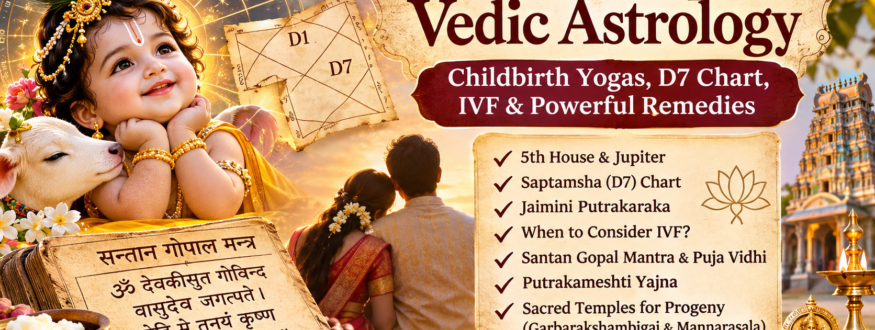
Santan Prapti in Vedic Astrology: Understanding the Divine Promise of Progeny
In Sanatan Dharma, the birth of a child is traditionally considered a sacred blessing, representing the continuation of family lineage, ancestral responsibilities and the unfolding of Purva Janma Punya, or merits accumulated through previous births.
However, why do some couples experience childbirth naturally and effortlessly while others face prolonged delays, repeated disappointments or the need for modern fertility treatments such as IVF?
Classical Vedic Astrology, or Jyotish Shastra, examines progeny through several interconnected factors, including the 5th House, its lord, Jupiter, the Saptamsha (D7) divisional chart, Jaimini Putrakaraka and the operating planetary Dashas.
One of the most important principles in Jyotish is that delay in childbirth does not necessarily mean denial of progeny.
The purpose of this article is to explore the traditional astrological combinations associated with childbirth and consolidate the most widely practised Sanatan Dharma remedies for Santan Prapti, including the Santan Gopal Mantra, Putrakameshti Yajna and sacred temple pilgrimages.
These astrological and spiritual traditions should be understood as matters of faith and interpretation, not as scientifically established methods of assessing fertility.
1. The 5th House: The Primary House of Children in Vedic Astrology
The 5th House, known as Putra Bhava, is the principal house associated with children, intelligence, creativity, education and Purva Punya.
Its strength, planetary occupation, aspects and relationship with its ruling planet form the foundation of progeny-related predictions.
Auspicious Combinations for Childbirth
Classical Jyotish considers the following combinations traditionally supportive of progeny:
- A strong 5th Lord placed in a Kendra or Trikona, particularly when supported by benefic planets.
- Jupiter influencing the 5th House or its lord through conjunction or recognised planetary aspects.
- A favourable relationship between the 5th Lord and the 9th Lord, connecting progeny with Dharma and fortune.
- Benefic influences from Jupiter, Venus or a well-supported waxing Moon.
- A strong 5th Lord in the birth chart, further supported in the Saptamsha (D7) chart.
- Favourable Dasha and Antardasha periods involving the 5th Lord, Jupiter or other relevant progeny significators.
However, the presence of an auspicious combination does not automatically guarantee conception.
Similarly, an afflicted 5th House cannot independently establish infertility or permanent denial of children.
2. Jupiter: The Natural Putra Karaka
In Parashari Jyotish, Jupiter, or Brihaspati, is regarded as the natural significator of children.
A strong Jupiter, particularly when connected with the 5th House, its lord or other auspicious houses, is traditionally considered supportive of progeny.
Jupiter’s dignity, conjunctions, aspects and condition in the D7 chart are therefore important considerations.
When Jupiter is weakened, afflicted or connected with challenging houses, astrologers may interpret the configuration as requiring greater examination of timing and obstacles.
Nevertheless, Jupiter’s weakness alone should never be interpreted as a definitive indication of childlessness.
3. Saptamsha (D7): The Divisional Chart of Progeny
The Saptamsha, or D7 chart, is one of the most important divisional charts used in traditional Jyotish for understanding matters concerning children.
Each zodiac sign is divided into seven equal portions to construct this chart.
The D7 chart is examined in conjunction with the natal D1 chart rather than independently.
Important factors include:
- The D7 Ascendant and its lord.
- The 5th House and 5th Lord of D7.
- Jupiter’s dignity and planetary influences.
- Connections between the D1 and D7 charts.
- Relevant planetary Dashas and Antardashas.
For instance, a challenged 5th Lord in D1 receiving substantial benefic support in D7 may lead to a more nuanced traditional interpretation.
The central principle is correlation between charts rather than reliance on one isolated planetary placement.
4. Jaimini Putrakaraka: The Chara Karaka of Progeny
Jaimini Astrology introduces the concept of Chara Karakas, where planets receive significations based on their degrees within their respective zodiac signs.
Under the commonly used seven-Chara-Karaka system, the planet holding the fifth-highest longitude within its sign becomes Putrakaraka.
Putrakaraka is associated with children, intelligence, learning and creative expression.
Its placement, dignity, conjunctions, Jaimini aspects and relevant divisional-chart positions may be studied for further insight.
The eight-karaka system follows a different ordering because Rahu is included.
Putrakaraka should not be confused with Jupiter’s fixed role as the natural Putra Karaka in Parashari Jyotish.
5. Childbirth Timing Through Dasha and Planetary Transits
Even when traditional childbirth combinations appear favourable, the timing of progeny is examined through the operating Mahadasha and Antardasha.
Astrologers frequently consider planetary periods associated with:
- The 5th Lord.
- Jupiter.
- Planets occupying or influencing the 5th House.
- Relevant D7 chart significators.
- Benefic connections involving the 2nd, 5th, 9th and 11th Houses.
Jupiter’s transit is also examined, particularly when it influences the natal 5th House, its lord or other relevant planetary combinations.
Saturn’s involvement may traditionally be interpreted as delay, responsibility or obstacles requiring perseverance.
These are astrological interpretations, not reliable methods of predicting the medical timing of pregnancy.
6. IVF and Medical Intervention: Can Vedic Astrology Indicate Complications?
In traditional Jyotish, a severely afflicted 5th House, weakened 5th Lord, challenging Jupiter configurations, difficult connections with the 6th, 8th or 12th Houses, and repeated afflictions in the D7 chart may be interpreted as obstacles or delays concerning progeny.
Some contemporary astrologers associate such configurations with unconventional routes to parenthood, including assisted reproductive technologies.
However, no astrological combination can establish that IVF is necessary or diagnose medical conditions such as endometriosis, blocked fallopian tubes, diminished ovarian reserve, sperm abnormalities or hormonal disorders.
These require qualified medical assessment.
Modern reproductive science offers several options, including fertility medication, intrauterine insemination (IUI), in vitro fertilisation (IVF) and intracytoplasmic sperm injection (ICSI).
Medical guidance generally recommends fertility evaluation after 12 months of unsuccessful attempts when the female partner is under 35, after six months at 35 or older, and potentially sooner above 40 or where known fertility concerns exist.
Seeking medical assistance is not a rejection of spirituality.
For spiritually inclined couples, prayer and medical treatment can coexist. Religious rituals should never delay medically indicated fertility care.
7. Santan Gopal Mantra: A Sacred Prayer for Childbirth
Among the most cherished Sanatan Dharma practices associated with Santan Prapti is the worship of Lord Krishna in his divine childhood form, Bal Gopal.
Devotees seek the blessings of Lord Krishna for family happiness, parenthood and the well-being of children.
Santan Gopal Mantra in Sanskrit
ॐ देवकीसुत गोविन्द वासुदेव जगत्पते।
देहि मे तनयं कृष्ण त्वामहं शरणं गतः॥
English Transliteration
Om Devaki-suta Govinda Vasudeva Jagat-pate,
Dehi me Tanayam Krishna Tvam Aham Sharanam Gatah.
Meaning of Santan Gopal Mantra
“O Krishna, son of Devaki, Govinda, Vasudeva and Lord of the Universe, I seek refuge in you. Please bless me with a child.”
This prayer is widely used in Santan Gopal worship. Its precise ritual prescriptions vary across traditions.
8. Santan Gopal Mantra Puja Vidhi: Which Day and Moon Phase Should You Begin?
For devotees wishing to undertake a disciplined spiritual practice, the following is a commonly adopted household routine.
Step 1: Choose an Auspicious Day
Thursday, or Guruvar, is a popular choice because Jupiter is traditionally associated with children and divine blessings.
Beginning during Shukla Paksha, the waxing phase of the Moon, is also considered auspicious in many Hindu devotional traditions.
A Thursday falling during Shukla Paksha can therefore be chosen as a convenient starting point.
However, there is no universally compulsory weekday or lunar phase for this mantra.
Step 2: Establish a Bal Gopal Altar
Place an image or murti of Bal Gopal in a clean prayer area.
Offer fresh flowers, water, a lamp and Tulsi leaves according to family tradition.
Devotees may also offer fruits or suitable vegetarian food as Naivedya.
Step 3: Take a Sankalpa
The couple may take a simple Sankalpa expressing their desire for parenthood, the well-being of their family and their intention to undertake the devotional practice with sincerity.
Both partners may participate.
Step 4: Chant the Mantra 108 Times
Recite the Santan Gopal Mantra 108 times daily.
A Tulsi mala may be used for counting.
Devotion, concentration and consistency are more important than elaborate arrangements.
Step 5: Continue for 40 or 41 Days
A 40- or 41-day observance may be undertaken as a personal devotional commitment.
This duration is customary rather than a universal scriptural requirement.
At the conclusion, devotees may offer prayers of gratitude, distribute food or perform charitable service.
The mantra is a spiritual practice and has not been scientifically demonstrated to increase fertility or IVF success rates.
9. Putrakameshti Yajna: The Sacred Story of King Dasharatha
One of the most celebrated accounts of a ritual performed for progeny appears in the Valmiki Ramayana.
King Dasharatha of Ayodhya, despite his prosperity and royal position, longed for children who would continue his lineage.
Under the guidance of Sage Rishyasringa, he performed the sacred Putrakameshti ritual.
The Bala Kanda of the Valmiki Ramayana describes the ritual undertaken for the blessing of sons.
In the subsequent narrative, a divine being emerged from the sacrificial fire carrying a sacred preparation, which King Dasharatha distributed among his queens.
The story culminates in the birth of Lord Rama, Bharata, Lakshmana and Shatrughna.
This sacred narrative established Putrakameshti Yajna as one of the most recognised Hindu rituals associated with prayers for progeny.
Putrakameshti Yajna in Contemporary Practice
Today, couples may arrange a Putrakameshti Homa under the guidance of a qualified Vedic priest.
Depending on the tradition, the ceremony may include:
- Sankalpa and Ganapati Puja.
- Invocation of the relevant deities.
- Sacred fire offerings with prescribed mantras.
- Purnahuti and concluding prayers.
- Charitable offerings and distribution of Prasadam.
The exact procedure varies across Vedic lineages and regional traditions.
The Ramayana account is a sacred religious narrative, not medical evidence that a ritual can treat infertility.
10. Garbarakshambigai Temple: The Divine Mother Associated With Pregnancy and Childbirth
Location: Thirukkarugavur, Tamil Nadu, India
Sri Garbarakshambigai Amman Temple is among the best-known pilgrimage destinations associated with prayers for conception, pregnancy and childbirth.
The Goddess Garbarakshambigai is revered as the Divine Mother who protects the unborn child.
According to the temple’s traditional narrative, a woman named Vedikai received the Goddess’s protection when her pregnancy was endangered.
This sacred account forms an important part of the temple’s devotional identity.
Traditional Santan Prapti Practices
Couples seeking the blessing of children traditionally offer prayers to Goddess Garbarakshambigai.
The temple is also associated with a ghee-prasadam observance for devotees praying for conception.
A separate oil-prasadam tradition is associated with prayers during pregnancy.
These practices belong to religious tradition and should not be regarded as medical fertility treatments. Pregnant individuals or those undergoing fertility treatment should consult their clinician before consuming unfamiliar preparations.
11. Mannarasala Nagaraja Temple: The Sacred Uruli Kamazhthal Ritual
Location: Haripad, Alappuzha, Kerala, India
Mannarasala Sree Nagaraja Temple is an important centre of serpent-deity worship and is especially associated with prayers for progeny.
One of its distinctive traditions is Uruli Kamazhthal.
Couples praying for children participate in a ritual involving a traditional bronze vessel, performed according to temple customs.
When a child is subsequently born, devotees traditionally return to offer thanksgiving through a ceremony known as Uruli Nivarppu.
This ritual reflects the temple’s longstanding association with family blessings and prayers for childbirth.
It should be understood as a religious observance rather than a guaranteed method of conception.
12. Consolidated Santan Prapti Remedies in Sanatan Dharma
For couples wishing to follow a focused spiritual routine, the following practices may be considered according to their faith and family traditions.
Remedy 1: Santan Gopal Mantra
Chant the Santan Gopal Mantra 108 times daily.
A Thursday during Shukla Paksha may be selected as the starting day.
Remedy 2: Bal Gopal Worship
Offer prayers to Lord Krishna in his childhood form.
Simple daily worship may include flowers, Tulsi leaves, a lamp and devotional offerings.
Remedy 3: Vishnu Sahasranama
Recite or listen to Vishnu Sahasranama daily or on Thursdays.
This practice is traditionally associated with devotion, spiritual discipline and seeking divine grace.
Remedy 4: Guru Brihaspati Worship
Since Jupiter is the natural Putra Karaka, Thursday prayers dedicated to Guru Brihaspati or Lord Vishnu may be incorporated into the routine.
Remedy 5: Putrakameshti Homa
Couples who wish to undertake a formal Vedic ceremony may consult a qualified priest regarding Putrakameshti Homa.
The procedure and expenses should be explained beforehand.
Remedy 6: Dana and Seva
Charitable activities may include donating food, supporting children’s education or assisting families in need.
These acts reflect the values of compassion and selfless service.
Remedy 7: Sacred Temple Pilgrimage
Devotees may consider pilgrimage to Garbarakshambigai Temple in Tamil Nadu or Mannarasala Nagaraja Temple in Kerala.
Pilgrimage arrangements and ritual requirements should be confirmed with the temples.
13. Are Rahu, Ketu and Saturn Responsible for Delayed Childbirth?
In traditional Jyotish, the involvement of Rahu, Ketu or Saturn with the 5th House, 5th Lord or Jupiter may prompt further examination of progeny-related combinations.
However, the presence of Rahu or Ketu in the 5th House does not automatically establish Sarpa Dosha, Pitru Dosha or permanent denial of children.
Likewise, Saturn’s association with the 5th House cannot independently establish infertility.
Planetary remedies should be selected carefully, considering the complete horoscope and the individual’s religious beliefs.
Expensive rituals should never be prescribed through fear, and couples experiencing fertility difficulties should not be blamed for supposed ancestral or past-life wrongdoing.
14. A Simple 41-Day Santan Prapti Spiritual Routine
For couples seeking a manageable devotional programme, the following routine may be adopted:
Day 1: Begin on a convenient Thursday during Shukla Paksha. Establish the Bal Gopal altar and take a Sankalpa.
Days 1–41: Recite the Santan Gopal Mantra 108 times daily.
Every Thursday: Offer prayers to Lord Vishnu or Guru Brihaspati and recite or listen to Vishnu Sahasranama.
Once Every Week: Perform an act of charity, food donation or service.
Day 41: Conclude the observance with gratitude, prayer and an optional charitable offering.
The 41-day period represents a devotional commitment rather than a scientifically established or universally mandated fertility prescription.
Couples should continue all recommended medical consultations and treatment throughout the observance.
Frequently Asked Questions About Santan Prapti
Which planet is responsible for childbirth in Vedic Astrology?
Jupiter is the principal natural significator of progeny in Parashari Jyotish. However, the 5th House, its lord, Saptamsha chart and relevant planetary periods are also examined.
Can an afflicted 5th House still give children?
Within traditional Jyotish interpretation, yes. A challenged 5th House may receive support from other planetary combinations, its lord, Jupiter or the D7 chart. Astrology cannot conclusively establish biological fertility.
Can Santan Gopal Mantra be chanted during IVF treatment?
Yes, couples may practise the mantra as a form of spiritual devotion while undergoing IVF or other fertility treatment. There is no reliable scientific evidence that chanting increases IVF success rates.
Which day is best to begin Santan Gopal Mantra?
Thursday during Shukla Paksha is a commonly preferred devotional choice. However, sincere prayer is not restricted to a particular weekday or lunar phase.
Which temple is famous for Santan Prapti?
Garbarakshambigai Amman Temple in Tamil Nadu and Mannarasala Sree Nagaraja Temple in Kerala are both renowned for traditions associated with prayers for children.
Is Putrakameshti Yajna mentioned in the Ramayana?
Yes. The Bala Kanda of the Valmiki Ramayana describes the Putrakameshti ritual associated with King Dasharatha’s desire for progeny.
Conclusion: Santan Prapti Through Jyotish, Faith and Modern Science
Santan Prapti occupies an important place in the spiritual and astrological traditions of Sanatan Dharma.
Classical Jyotish examines childbirth through the 5th House, Jupiter, Saptamsha (D7), Jaimini Putrakaraka and relevant planetary periods.
At the same time, devotional practices such as Santan Gopal Mantra, Bal Gopal worship, Vishnu Sahasranama, Putrakameshti Yajna and sacred temple pilgrimages continue to offer spiritual meaning and comfort to many families.
However, the most compassionate approach recognises that spiritual practice and modern reproductive medicine can coexist.
Faith may provide emotional strength, prayer may provide spiritual comfort, and medical science can offer evidence-based pathways toward parenthood.
Couples should not interpret fertility challenges as divine punishment, nor should they feel compelled to undertake expensive rituals or postpone necessary medical treatment.
Parenthood may also take different forms, including adoption and other family-building paths.
May Lord Krishna bless every family with peace, wisdom, resilience and the grace to follow the path that is right for them.
Hare Krishna!
Disclaimer: This article discusses traditional Vedic Astrology, Hindu religious narratives and devotional practices for educational and spiritual purposes. Astrology and religious rituals are not scientifically validated methods of diagnosing or treating infertility. Consult qualified healthcare professionals for fertility assessment, pregnancy care and reproductive treatment.
References and Further Reading:
- Valmiki Ramayana, Bala Kanda, Sarga 15–16 — Putrakameshti narrative.
- Brihat Parashara Hora Shastra — Traditional discussions of progeny, the 5th House and divisional charts.
- Jaimini Sutras — Chara Karaka principles.
- Sri Garbarakshambigai Amman Temple — Traditional temple worship and prasadam observances.
- Mannarasala Sree Nagaraja Temple — Uruli Kamazhthal and related offerings.
- American Society for Reproductive Medicine — Clinical guidance on fertility evaluation.
