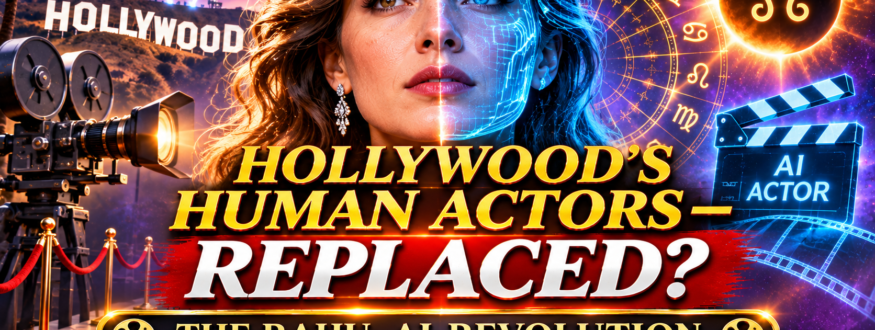
Rahu and Artificial Intelligence: Is Cinema Entering a New Karmic Era? | Hollywood’s AI Actors and the Future of Human Performance
November 12, 2026 | Hollywood News, Artificial Intelligence, Celebrity Astrology and Classical Jyotish
Imagine watching a Hollywood film in which the leading actress never attended an audition, never stood before a camera, never experienced heartbreak — and does not actually exist.
Her face appears convincing.
Her voice sounds natural.
She laughs, cries, falls in love and delivers an emotionally charged performance.
Yet there is no human performer behind that face in the conventional sense.
Welcome to Hollywood’s artificial intelligence revolution.
For more than a century, cinema has depended on human actors to bring fictional characters to life.
But in 2026, that relationship is being challenged by a new generation of synthetic performers, digitally replicated voices and AI-generated screen personalities.
The controversy has become particularly intense following the emergence of Tilly Norwood, a computer-generated character positioned as a potential Hollywood star.
Meanwhile, established actors are licensing their voices to artificial intelligence companies, and professional voice performers are questioning whether their livelihoods can survive the rapid expansion of synthetic speech.
The Hollywood actors’ union, SAG-AFTRA, has responded by negotiating stronger protections for performers.
For students of Vedic astrology, this technological transformation raises a fascinating question.
Are we witnessing a modern expression of Rahu — the shadow planet associated with illusion, unconventional ambition, fascination and the blurring of familiar boundaries?
And what happens when Rahu’s symbolism intersects with Mercury’s domain of speech, Venus’s domain of artistic expression and Saturn’s domain of labour?
To understand this extraordinary moment, we must first examine what is actually happening in Hollywood.
Tilly Norwood: The AI Actress Who Challenged Hollywood’s Definition of Acting
One of the most controversial developments in entertainment technology concerns Tilly Norwood.
Unlike traditional film stars, Tilly is not a human being.
She is a digitally generated character developed by the entertainment technology company Particle6, led by filmmaker and entrepreneur Eline van der Velden.
The character attracted international attention after being introduced in 2025.
But the controversy intensified in July 2026 when plans were announced for Tilly to headline a feature film titled Misaligned.
The proposed film explores a fictional digital world and features a synthetic character capable of displaying human-like emotional responses.
According to reporting by the Los Angeles Times, the production team uses artificial intelligence to generate possible performances and then reviews and refines the results.
This introduces a fundamental change in the creative process.
A conventional actor interprets a script through personal experience, imagination, physical expression and collaboration.
An AI-generated character produces screen behaviour through computational systems, training data and decisions made by human creators.
The final images may resemble acting.
But the process behind them is profoundly different.
Can an artificial character really be called an actor?
This question has divided the entertainment industry.
Supporters of AI-generated performers argue that the technology represents another stage in the evolution of animation and visual effects.
They emphasize that human writers, directors, editors and designers still contribute to the finished production.
Critics argue that calling a synthetic character an actor obscures the difference between a human performance and computer-generated imitation.
SAG-AFTRA has objected strongly to presenting synthetic characters as equivalent to professional performers.
The union has also raised concerns about whether AI systems have been trained using the work of real actors without appropriate authorization or compensation.
For audiences, the debate introduces a new uncertainty.
If a digital face can convincingly imitate emotion, does the audience need to know whether a human being actually performed it?
That question takes us directly into the symbolism of Rahu.
Rahu: The Shadow Planet of Illusion, Fascination and Unconventional Reality
In classical Vedic astrology, Rahu is the north lunar node.
Along with Ketu, it is associated with eclipses and the intersection of the Sun’s and Moon’s apparent paths.
Rahu is traditionally regarded as a shadow graha.
It does not possess a physical planetary body comparable to Mars or Jupiter.
Its astrological significance arises from the lunar-node framework and the mythological symbolism associated with eclipses.
In the story of the churning of the cosmic ocean, Rahu is connected with the attempt to obtain Amrita, the nectar of immortality.
The Sun and Moon expose the deception, and Vishnu separates Rahu’s head from the body.
The myth provides a striking symbolic foundation for Rahu’s association with disguise, desire and unusual forms of existence.
Why modern astrologers associate Rahu with artificial intelligence
Contemporary Jyotish practitioners frequently extend Rahu’s symbolism to technological disruption, virtual environments, unconventional careers and mass fascination.
These are modern applications rather than explicit references to computers in ancient astrological texts.
Rahu’s association with AI can be understood through several symbolic themes.
Illusion: A digitally generated face can resemble a human being without belonging to one.
Imitation: AI systems can reproduce characteristics of speech, appearance and artistic style.
Unconventional advancement: New technology can create opportunities outside traditional professional structures.
Mass fascination: Synthetic personalities can attract enormous public attention despite having no physical existence.
Desire without obvious limits: Technology companies continually pursue increasingly realistic forms of artificial expression.
This makes Rahu a compelling metaphor for the transformation taking place in Hollywood.
But an important distinction must be maintained.
Classical Jyotish does not contain a doctrine stating that Rahu creates artificial intelligence or that a particular Rahu transit causes technological breakthroughs.
The connection is a contemporary symbolic interpretation.
AI Voice Cloning: When Hollywood Can Reproduce a Star’s Voice
Visual performances are only one part of the controversy.
Voice cloning may be even more disruptive.
Modern AI systems can generate synthetic speech that resembles a particular person’s vocal characteristics.
Depending on the technology and available recordings, such systems can reproduce tone, accent, rhythm and other features of a voice.
This creates opportunities for film dubbing, audiobooks, advertising, accessibility and multilingual entertainment.
But it also raises serious questions about consent, ownership and employment.
Michael Caine and the licensing of celebrity voices
In 2026, the Los Angeles Times reported that actor Sir Michael Caine had licensed his voice to AI company ElevenLabs.
A synthetic version of his voice was used to narrate an audiobook of The Odyssey.
Other public figures have explored similar arrangements.
Matthew McConaughey has used AI voice technology to produce a Spanish-language version of his newsletter.
These examples demonstrate that some established performers view voice cloning as an opportunity.
A recognizable voice can become a licensed digital asset.
Instead of recording every version of a project personally, an actor may authorize specific synthetic uses.
However, the financial opportunities are not distributed equally.
The uncomfortable reality for working voice actors
Many freelance voice performers face a very different situation.
Voice actors traditionally earn income from commercials, educational videos, audiobooks, animation, dubbing and online content.
Some of these projects are now being completed with synthetic voices.
The Los Angeles Times documented performers reporting reduced opportunities, concerns about unauthorized cloning and pressure to license their voices to AI companies.
This creates a difficult economic dilemma.
A performer may receive immediate compensation for allowing their voice to be replicated.
But the resulting technology could potentially compete with their future work.
Not every AI licensing arrangement has this effect, and the terms vary considerably.
Nevertheless, the possibility of replacing recurring human work with a reusable digital replica has become one of the industry’s central concerns.
Mercury: The Planet of Speech, Communication and Artificial Voices
Mercury, known as Budha, is traditionally associated with intellect, speech, language, calculation, commerce and communication.
It is therefore particularly relevant to a symbolic discussion of AI-generated voices.
Human speech combines several dimensions.
Words communicate meaning.
Tone communicates emotion.
Rhythm and emphasis communicate intention.
Voice actors use these qualities to create recognizable characters.
Artificial intelligence can reproduce many of their audible characteristics.
But reproducing the sound of speech is not identical to possessing the human experiences or intentions that originally shaped it.
Mercury and Rahu: A modern interpretation
In contemporary astrology, a Mercury–Rahu relationship is sometimes interpreted through unconventional intelligence, persuasive communication, unusual analytical abilities or technological interests.
However, this interpretation must be qualified.
A Mercury–Rahu conjunction does not automatically indicate genius, deception, software engineering or artificial intelligence.
The results depend on the sign, house, dignity, dispositor, aspects and planetary periods.
Nor does the combination establish that a person’s communication is false or manipulative.
For the Hollywood AI debate, Mercury and Rahu provide a useful symbolic contrast.
Mercury represents the communication itself. Rahu represents the possibility of making an imitation appear indistinguishable from the original.
The challenge for society is determining when imitation is creative expression and when it becomes unauthorized appropriation.
Venus: Can Artificial Intelligence Replace Artistic Expression?
Venus, known as Shukra, is traditionally associated with beauty, pleasure, refinement, artistic expression and aesthetic enjoyment.
Cinema is deeply connected with these themes.
Film combines visual beauty, music, performance, costume design and emotional storytelling.
Actors help audiences connect with fictional experiences.
But artificial intelligence introduces a new possibility.
What if an entire screen performance can be synthesized without a conventional human actor?
The difference between artistic output and artistic experience
An AI-generated character can display sadness.
It can produce a convincing smile.
It can appear frightened, angry or romantically attracted.
But these visual representations do not establish that the system experiences the corresponding emotions.
The philosophical distinction matters.
A human actor may draw on memory, observation, imagination and lived experience to create a performance.
A synthetic performer is produced through computational processes and human creative direction.
Whether audiences find the resulting performance moving is a separate question.
A film can be emotionally effective even when its characters are animated or fictional.
The controversy concerns the creative process, the credit given to contributors and the potential displacement of performers.
Is Venus threatened by Rahu?
In popular astrology, Rahu’s influence on Venus is sometimes associated with unusual attractions, heightened desires or unconventional forms of pleasure.
But the relationship is not universally negative.
Its meaning depends on the full horoscope.
Applied symbolically to cinema, Rahu and Venus can represent a tension between authentic artistic expression and technologically manufactured beauty.
An AI-generated performer may possess flawless facial symmetry, endlessly adjustable expressions and a carefully optimized appearance.
Yet some audiences may continue to value the imperfections, spontaneity and individuality of human performance.
The future of cinema may depend not on whether machines can imitate beauty, but on what audiences consider meaningful artistic expression.
Saturn: The Karma of Work, Employment and Technological Change
Saturn, or Shani, represents labour, discipline, responsibility, endurance, restriction and the passage of time.
This makes Saturn especially relevant to the economic consequences of artificial intelligence.
Hollywood is not merely debating aesthetics.
It is debating livelihoods.
Actors, dubbing artists, background performers and other creative professionals depend on paid opportunities.
When technology reduces the labour required for a production, the financial consequences can be substantial.
Can automation create prosperity and hardship simultaneously?
Yes.
A production company may reduce costs by using AI for certain tasks.
A small filmmaker may gain access to tools previously available only to major studios.
A performer may earn licensing income from an authorized digital replica.
At the same time, another performer may lose assignments previously completed by human workers.
The effects depend on contracts, industry structure, competition and regulation.
In astrological symbolism, Saturn provides a framework for examining the obligations associated with work.
It raises questions about fair compensation, professional dignity and long-term consequences.
But Saturn does not determine whether an employer will adopt AI.
Those decisions are made by people and organizations.
November 2026: SAG-AFTRA Strengthens Protections for Voice Actors
One of the most important recent developments came in early November.
SAG-AFTRA members ratified new television animation agreements containing stronger protections concerning AI-generated voice dubbing.
The agreements address situations in which a performer’s digital replica is used to produce dialogue in another language.
A significant change concerns consent.
Under the revised provisions, performers must authorize certain uses that previously could occur without their specific approval.
The new consent requirement has an important implementation detail: it applies to productions beginning principal photography on or after July 1, 2027.
The agreements also include wage increases and extend through June 2030.
This follows earlier union negotiations over digital replicas in television, film and video games.
The central principle is that technological capability does not automatically grant a producer unlimited rights to reproduce a person’s performance.
What are digital-replica protections?
Depending on the applicable contract, protections may address:
- Whether a performer must give informed consent before a replica is created or used.
- Whether the intended use must be described clearly.
- Whether additional compensation is required.
- Whether a replica can generate material that the performer never personally recorded.
- What happens when a performer is deceased or when a production seeks additional uses.
The precise rules vary across agreements and types of production.
They should not be treated as a universal ban on AI performers.
Nevertheless, they demonstrate that Hollywood’s labour organizations are actively negotiating the boundaries of synthetic performance.
The Tilly Norwood Controversy and the Fear of Digital Replacement
Tilly Norwood represents a different issue from cloning an existing actor.
A digital replica imitates an identifiable performer.
A synthetic character may be designed without corresponding to any one real individual.
That distinction matters for consent, compensation and creative ownership.
However, critics argue that synthetic performers may still rely on patterns learned from human-created material.
They also worry that production companies could replace roles traditionally performed by actors with entirely computer-generated characters.
Supporters argue that synthetic performers may expand creative possibilities and generate new kinds of work for filmmakers, animators and technical artists.
Both possibilities deserve consideration.
A new technology can create jobs in some areas while reducing demand in others.
The ultimate effects depend on how it is adopted.
The 3rd House: Media, Communication and Digital Production
In traditional Jyotish, the 3rd house is associated with courage, initiative, skills, communication and personal effort.
Modern astrologers also examine it in relation to media production and digital communication.
The entertainment industry’s AI transition is especially relevant to these modern applications.
A filmmaker can now experiment with synthetic dialogue, digital characters and AI-assisted production workflows.
A small creator may produce material that previously required a much larger team.
However, the 3rd house should not be interpreted as a classical signification of artificial intelligence itself.
The association with modern media is an extension of its traditional meanings.
The 5th House: Creativity, Intelligence and the Future of Storytelling
The 5th house represents intelligence, learning, creativity, children, mantra and Purva Punya.
For performers and filmmakers, its symbolism is relevant to creative expression.
But AI raises a challenging question.
If software generates dialogue, images and performances, where does creativity reside?
Is it in the system?
The person writing the instructions?
The developers who built the technology?
The actors whose work may have contributed to the training material?
Or the director selecting and refining the output?
The answer may differ across productions.
AI-assisted filmmaking often involves substantial human judgment.
But the presence of human supervision does not eliminate questions about consent, attribution or compensation.
From a Jyotish perspective, the 5th house provides a symbolic framework for discussing creative intelligence.
It does not determine whether a work of art is authentic or valuable.
The 10th House: When Technology Changes an Entire Profession
The 10th house, known as Karma Bhava, governs profession, public activity, status and responsibility.
It is central to traditional career analysis.
Artificial intelligence may alter the professional structure of the entertainment industry.
Some occupations may become more technologically specialized.
Others may experience reduced demand.
New roles may emerge in synthetic-character development, digital-performance direction, AI production supervision and rights management.
But these possibilities are not guaranteed.
The effect of AI on employment depends on technological capability, cost, audience preferences, regulation and commercial decisions.
In individual astrology, the 10th house would need to be examined alongside the Ascendant, planetary periods and other career-related factors.
No single Rahu or Mercury placement can establish that an actor will lose their profession to AI.
The 12th House: Virtual Reality, Illusion and the Disappearance of Physical Presence
The 12th house is traditionally associated with withdrawal, seclusion, expenditure, sleep, foreign residence and liberation.
Some contemporary astrologers extend its symbolism to virtual environments and experiences separated from ordinary physical presence.
An AI-generated performer exists on screen without occupying the production environment in the same way as a conventional actor.
A cloned voice may deliver dialogue without the original performer entering a recording studio.
These developments offer an interesting modern analogy to the 12th house’s symbolism of absence and withdrawal.
But classical texts do not explicitly assign artificial intelligence or virtual reality to the 12th house.
The association is interpretive rather than doctrinal.
Rahu and Maya: Is Hollywood Creating a New Form of Illusion?
The Sanskrit term Maya has complex meanings across Indian philosophical traditions.
It is often discussed in relation to appearance, perception and the nature of experienced reality.
Rahu is frequently associated in popular Jyotish with illusion and distorted perception.
But Rahu and Maya should not be treated as interchangeable concepts.
The relationship is philosophical and symbolic.
Cinema has always involved illusion.
Actors portray people they are not.
Film sets imitate places that may not exist.
Editing creates continuity between separate moments.
Visual effects make impossible events appear convincing.
Artificial intelligence does not introduce illusion into cinema for the first time.
It changes the methods by which that illusion is produced.
The new concern is whether audiences, performers and rights holders can identify the origin of what they see and hear.
When a voice can be reproduced without the speaker, and a face can perform without a person, the distinction between representation and reality becomes increasingly important.
Can AI Make Dead Actors Perform Again?
Digital technology has already been used to recreate or modify the appearances of deceased performers.
AI may expand the range of possible posthumous performances.
This raises complicated questions.
Who can authorize the use of a deceased actor’s likeness?
Should permission granted during life extend to future technologies?
How should an estate, studio or union determine appropriate compensation?
And should audiences be informed when a performance is digitally generated?
These questions involve law, contracts, ethics and creative judgment.
Different jurisdictions may provide different protections.
In Jyotish, the 8th house is traditionally associated with longevity, inheritance, hidden matters and transformation.
It can provide a symbolic context for discussing the preservation and commercial use of a performer’s legacy.
But no classical rule establishes that the 8th house governs digital resurrection.
Is Rahu’s Transit Responsible for the AI Revolution?
This question deserves a careful answer.
Using the Lahiri sidereal zodiac, Rahu is transiting Aquarius in November 2026, with the next nodal sign change approaching.
Aquarius is traditionally ruled by Saturn and is associated with groups, networks and collective systems.
Modern astrologers frequently connect Aquarius with technological infrastructure and social organization.
The combination provides an interesting symbolic backdrop for discussing AI, digital networks and collective changes in employment.
However, there is no established evidence that Rahu’s transit caused advances in artificial intelligence or Hollywood’s adoption of synthetic performers.
AI development has been driven by research, computing infrastructure, investment, market demand and human decisions over many years.
Nor should a modern transit interpretation be presented as a prediction explicitly made in classical Sanskrit texts.
The astrological value lies in the symbolism, not in claiming a demonstrated causal relationship.
What Do Classical Jyotish Principles Actually Say?
A responsible discussion must distinguish classical significations from contemporary applications.
| Factor | Traditional Jyotish Signification | Modern AI and Cinema Interpretation | Rahu | Eclipse, desire, unconventional experience | Synthetic identities, imitation, technological disruption | Mercury | Speech, intellect, calculation, commerce | Voice synthesis, language models, digital communication | Venus | Art, beauty, pleasure, refinement | Cinema, screen aesthetics, synthetic performances | Saturn | Labour, discipline, time, responsibility | Employment disruption, contracts, workers’ rights | 3rd house | Skills, courage, communication | Digital media production | 5th house | Intelligence, creativity, expression | Storytelling and creative technology | 8th house | Inheritance, hidden matters, transformation | Likeness rights and posthumous digital use | 10th house | Profession, status, public activity | Changing careers in entertainment | 12th house | Withdrawal, seclusion, liberation | Virtual presence and digitally mediated experiences |
|---|
These associations are not predictive guarantees.
Their usefulness depends on the question being examined and the broader interpretive framework.
Will Artificial Intelligence Completely Replace Hollywood Actors?
There is no reliable basis for claiming that all human actors will disappear.
AI can already perform some tasks that previously required human voice recording or visual production.
It may continue improving.
But human performers offer qualities that extend beyond the technical reproduction of appearance or sound.
They contribute improvisation, collaboration, physical presence, personal interpretation and lived experience.
Audiences also develop relationships with performers as individuals.
Celebrity culture depends partly on the public’s interest in the person behind the performance.
Whether synthetic stars can generate comparable long-term loyalty remains uncertain.
The future may involve a mixture of human performances, authorized digital replicas, AI-assisted production and entirely synthetic characters.
The relative importance of each will depend on audience preferences, labour agreements, law and technological development.
The Ethical Question: Who Owns a Human Voice?
One of the most important debates concerns ownership and control.
A person’s voice is part of their recognizable identity.
It may also be an important professional asset.
AI technology makes it possible to reproduce vocal characteristics in new contexts.
Without appropriate safeguards, such reproductions may create opportunities for impersonation, misrepresentation or unauthorized commercial use.
But authorized licensing can also provide new income opportunities.
The distinction is consent.
An actor who knowingly licenses a digital voice under a clearly defined agreement is in a different position from someone whose voice is replicated without authorization.
This principle is becoming central to Hollywood’s negotiations.
It also illustrates a broader issue that extends beyond entertainment.
As synthetic media becomes more convincing, individuals and institutions will need reliable ways to establish authenticity and accountability.
What Can Actors and Creators Learn From This Transition?
The Hollywood AI controversy offers lessons for performers, filmmakers, voice artists and independent digital creators.
Technology may change the tools used in production.
But contracts, ownership and professional skills remain important.
Creators may need to understand how their voice, likeness and original work can be licensed.
They may also benefit from learning AI-assisted production techniques without surrendering control over their identities.
For independent filmmakers, these tools may reduce some production costs.
For professional performers, the same tools may create new forms of competition.
The challenge is developing practices that support innovation while protecting legitimate creative interests.
In the symbolic language of Jyotish, this resembles a balance between Rahu’s unconventional possibilities and Saturn’s emphasis on responsibility.
Final Thoughts: Is Cinema Entering a New Karmic Era?
Hollywood is undergoing a transformation that would have seemed extraordinary only a generation ago.
A digital character can be presented as a potential film star.
A familiar voice can be reproduced without a new recording session.
A performer may license their identity for synthetic use.
And labour organizations are negotiating rules for forms of performance that did not exist when many established entertainment contracts were written.
For students of Vedic astrology, the symbolism is compelling.
Rahu represents the fascination of the unfamiliar and the uncertainty of appearances.
Mercury represents speech, calculation and communication.
Venus represents beauty, performance and artistic enjoyment.
Saturn represents work, responsibility and the long-term consequences of human decisions.
The 5th house represents creativity, while the 10th house represents professional activity.
Together, these principles provide a philosophical framework for discussing the AI revolution.
But technology itself is not evidence of a planetary curse or predetermined karmic event.
Its consequences will depend on how people choose to develop, regulate and use it.
The greatest question facing Hollywood is therefore not simply whether artificial intelligence can imitate a human performance.
It is whether the entertainment industry can preserve meaningful consent, fair compensation and artistic integrity while embracing new creative possibilities.
Perhaps the real karmic test of artificial intelligence is not what machines become capable of doing — but what human beings decide they should be allowed to do.
And in that sense, cinema may indeed be entering a new era.
Not because Rahu has written the script.
But because humanity must now decide who owns the voice, who creates the performance and who deserves the credit.
Frequently Asked Questions
Is artificial intelligence replacing Hollywood actors in 2026?
AI is being used for certain voice, visual and production tasks. Some performers report losing opportunities, but there is no evidence that AI has replaced Hollywood actors as a profession.
Who is Tilly Norwood?
Tilly Norwood is a computer-generated entertainment character created by Particle6. Plans announced in 2026 for a feature-film role intensified debate about synthetic performers.
Can AI legally clone an actor’s voice?
The rules depend on jurisdiction, contracts, consent and the intended use. Certain union agreements require specific authorization and compensation for digital replicas.
What changed in SAG-AFTRA’s November 2026 animation agreements?
The agreements strengthened consent protections for certain AI dubbing uses. A key requirement applies to productions beginning principal photography on or after July 1, 2027.
Is Rahu associated with artificial intelligence?
Many modern Vedic astrologers associate Rahu with technological disruption and unconventional forms of experience. Ancient Jyotish texts do not explicitly identify Rahu with artificial intelligence.
Which planet represents speech in Vedic astrology?
Mercury, or Budha, is traditionally associated with speech, language, intellect and communication.
Which planet represents cinema and artistic performance?
Venus is a natural significator of art, beauty and refinement. The 5th and 10th houses are also relevant to creative and professional activity.
Does Rahu–Mercury indicate technological intelligence?
Some contemporary astrologers interpret the combination through unconventional communication or analytical interests, but it does not automatically indicate technical ability or AI-related success.
Does Saturn represent job loss through automation?
Saturn signifies labour, responsibility and restriction, among other themes. It does not automatically predict unemployment or technological displacement.
Can Vedic astrology predict the future of artificial intelligence?
Jyotish provides a traditional symbolic framework for interpreting life themes. There is no scientifically established astrological method that reliably predicts AI breakthroughs or industry-wide employment outcomes.
Written for NJ Shivoham | Vedic Astrology, Hollywood News, Technology and Classical Jyotish
Editorial Disclaimer: This article separates documented entertainment-industry developments from traditional and contemporary astrological interpretations. It does not claim that planetary transits caused technological change or that astrology can predict the employment consequences of artificial intelligence.
#ArtificialIntelligence #HollywoodAI #TillyNorwood #Rahu #RahuTransit2026 #VedicAstrology #AIVoiceCloning #SAGAFTRA #Mercury #Venus #Saturn #CelebrityAstrology #NJShivoham
