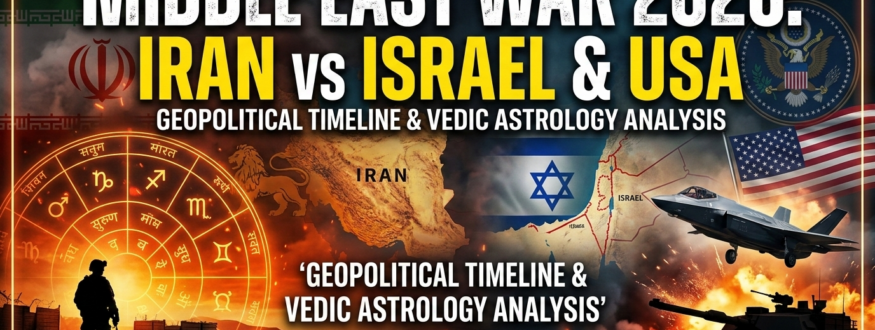
Are There Planetary Cycles Behind Major Wars?
Throughout history, major global conflicts have rarely appeared randomly.
Historians study political tensions, economic pressures, and ideological conflicts to explain wars. But astrologers observe another layer — planetary cycles that coincide with periods of large-scale global upheaval.
In both Western mundane astrology and Vedic astrology, certain planetary combinations have repeatedly appeared during eras of:
- world wars
- revolutions
- regime collapses
- geopolitical realignments
The period between 2026 and 2032 shows several rare planetary alignments that astrologers associate with intense geopolitical transformation.
This does not guarantee a world war — but it indicates a historically volatile cosmic climate.
The Saturn–Neptune Cycle: The Signature of Global Conflict
One of the most studied war cycles in astrology is the Saturn–Neptune conjunction.
Saturn represents:
- political structures
- governments
- authority systems
- national boundaries
Neptune represents:
- ideological movements
- mass psychology
- illusions and propaganda
- dissolving existing systems
When Saturn and Neptune align, they often coincide with periods when old political systems collapse and new ideological orders emerge.
Previous Saturn–Neptune Alignments and Wars
Astrologers frequently point to historical parallels:
World War I Era
The early 20th century saw strong Saturn–Neptune alignments during the years leading to World War I (1914–1918).
This period involved the collapse of major empires including:
- Ottoman Empire
- Austro-Hungarian Empire
- Russian Empire
World War II Era
The 1930s also featured significant Saturn–Neptune interactions during the rise of:
- Nazi Germany
- Imperial Japan
- Fascist Italy
This ultimately culminated in World War II (1939–1945).
The 2026 Saturn–Neptune Conjunction
In February 2026, Saturn and Neptune align at 0° Aries — the very beginning of the zodiac.
In astrology, 0° Aries is considered the cosmic reset point, representing the birth of new cycles.
Such an alignment suggests a period where old global power structures could undergo transformation.
This conjunction occurs at a time when the world is already experiencing:
- geopolitical polarization
- military escalation in multiple regions
- technological warfare expansion
- shifting global alliances
Pluto in Aquarius: The Era of Revolutionary Technology
Another major astrological factor shaping the coming decade is Pluto’s long transit through Aquarius (2024–2044).
Pluto symbolizes:
- deep transformation
- power struggles
- hidden forces
- destruction followed by rebirth
Aquarius represents:
- technology
- networks
- collective movements
- revolutionary ideas
Together, Pluto in Aquarius suggests an era defined by:
- artificial intelligence dominance
- cyber warfare
- digital propaganda
- technological power struggles between nations
This shift alone is enough to redefine how conflicts unfold in the modern world.
Uranus Changing Signs: Sudden Global Shocks
Uranus, the planet of disruption and sudden change, also plays a role in geopolitical instability.
Whenever Uranus shifts signs, the world often experiences unexpected turning points.
These transitions historically coincide with:
- revolutions
- economic upheavals
- sudden military escalations
The late 2020s will see several significant Uranus aspects interacting with Saturn and Pluto cycles.
Eclipse Cycles and Leadership Destinies
Another factor astrologers monitor is the eclipse cycle, governed by Rahu and Ketu.
Eclipses often correspond with moments when:
- leaders rise or fall
- wars begin or end
- global events accelerate rapidly
In Vedic astrology, eclipses are considered karmic reset points.
The mid-2020s contain several powerful eclipse patterns affecting signs connected to leadership and power structures, particularly Leo and Aquarius.
Multipolar World Order
Astrology does not replace geopolitical analysis — but it often mirrors it.
Today’s world is moving toward a multipolar power structure, where multiple major powers compete for influence.
Major geopolitical tensions currently include:
- US–China rivalry
- Russia–NATO confrontation
- Iran–Israel conflict
- instability across the Middle East
- shifting alliances in Asia and Europe
Astrologically, periods when several heavy planets activate simultaneously often coincide with restructuring of the global order.
The Late 2020s: A Period of Transformation
Between 2026 and 2032, several powerful astrological cycles overlap:
Saturn–Neptune conjunction
Pluto in Aquarius transformation cycle
Uranus disruptive transitions
Major eclipse cycles
Such clustering of long-term planetary forces often corresponds with historical turning points.
The late 2020s may therefore represent a period where:
- global alliances shift dramatically
- new technologies reshape warfare
- old political systems face structural challenges
A Time of Uncertainty — and Transformation
Astrology does not claim that wars are predetermined.
Rather, it highlights periods when global tensions are more likely to intensify.
The coming decade appears to be one of those times.
History suggests that when powerful planetary cycles align, humanity often experiences moments of crisis — but also opportunities for profound transformation.
The choices made by leaders and nations will ultimately determine whether the coming years lead to conflict, cooperation, or a redefinition of the global order.
