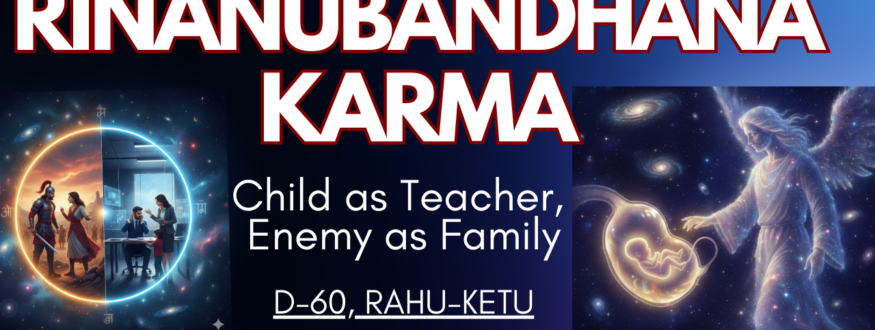
Introduction: When Destiny Rewrites Roles
One of the most profound truths of Vedic Astrology is this: relationships do not end with death; they change roles. The person guiding you today may once have depended on you. The child you nurture now may have been your Guru, protector, or karmic creditor in a previous incarnation.
This law of Rinanubandhana—the binding force of karmic debts—explains why some relationships feel instantly familiar, emotionally intense, or duty-bound beyond logic.
What Is Rinanubandhana in Vedic Astrology?
Rina means debt, obligation, or karmic residue.
Bandhana means bondage or binding.
Together, Rinanubandhana signifies unfinished karmic accounts carried across lifetimes. These accounts are not always negative—they can be debts of love, protection, knowledge, sacrifice, or neglect.
In Jyotish, Rinanubandhana manifests through:
- Parents & children
- Guru–Shishya connections
- Spouses with intense karmic pull
- Siblings, rivals, or dependents
Your Child Was Once Your Teacher: How Role Reversal Happens
Across incarnations, souls evolve by switching positions. Authority becomes humility. Dependence becomes responsibility.
A soul that once taught you wisdom may return as your child so that:
- You repay guidance through protection
- Ego dissolves into seva (service)
- Compassion replaces authority
This concept is beautifully illustrated in the Mahabharata, where Abhimanyu—who knew the secret of the Chakravyuha even before birth—entered the world to complete a karmic loop, not merely to live a life.
Astrological Indicators of Role Shifts Across Incarnations
1. 5th House & 9th House Axis (Pūrva Puṇya)
- The 5th house shows past-life merit and children
- The 9th house shows Guru, dharma, and higher wisdom
Strong links between these houses often indicate teacher–student role reversals.
2. Ketu: The Marker of Past-Life Mastery
- Ketu in the 5th or 9th house suggests a soul that has already learned
- Such children appear detached, wise, or spiritually mature early in life
3. D9 (Navāṁśa): Soul Contracts
The Navāṁśa reveals why souls reunite.
Repeated planetary links between charts point to unfinished dharmic contracts.
4. D60 (Ṣaṣṭiāṁśa): Deep Karma Ledger
D60 exposes the original cause of the bond—whether it is repayment, protection, or correction.
Debtor, Protector, or Guide? Types of Rinanubandhana
Śatru-Rina (Enemy Debt)
Souls return as difficult relatives or rivals to balance past harm.
Pitṛ-Rina (Ancestral Debt)
Children may incarnate to heal lineage karma or complete ancestral duties.
Guru-Rina (Wisdom Debt)
A former teacher may return as a dependent so knowledge transforms into compassion.
Why These Bonds Feel So Intense
Rinanubandhana relationships often bring:
- Instant emotional recognition
- Deep responsibility without reason
- Sacrifice that feels “destined”
- Pain mixed with devotion
The Bhagavata Purana repeatedly emphasizes that the soul travels, not the role—roles are merely costumes worn to complete karma.
Spiritual Purpose: Evolution, Not Punishment
Rinanubandhana is not about suffering—it is about completion.
When karma is balanced:
- Attachment softens
- Control dissolves
- Love becomes unconditional
- The soul moves closer to Mokṣa
This is why some relationships naturally loosen over time—they have served their karmic purpose.
How to Consciously Heal Rinanubandhana
- Practice seva without expectation
- Avoid ego in parent–child or authority roles
- Honor elders, teachers, and dependents equally
- Perform Pitṛ tarpaṇa and Guru vandana
- Most importantly: do not resist role reversal
Resistance creates bondage; acceptance creates liberation.
Conclusion: The Soul Remembers
In Vedic Astrology, no relationship is random.
Your child may have once guided you.
Your dependent may have once protected you.
Roles shift, but the soul remembers.
When you understand Rinanubandhana, relationships stop feeling confusing—and start feeling sacred, purposeful, and liberating.
