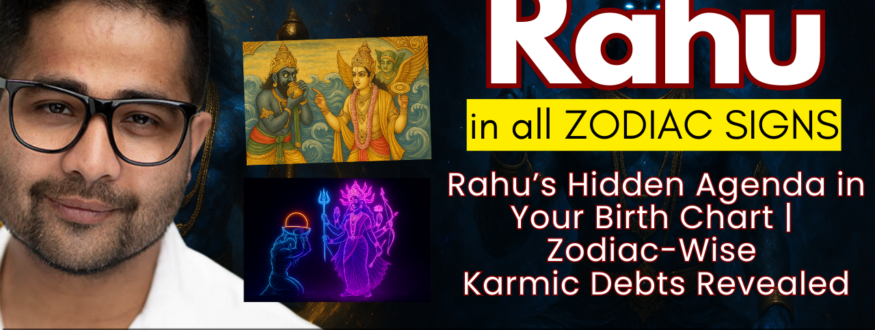
Rahu in All 12 Zodiac Signs: Soul Trap, Past-Life Entanglement, Karmic Debt & Puranic Connection
An introductory note on Rahu as a spiritual teacher, not a villain
In serious Vedic astrology, Rahu is not treated as a “bad planet” that randomly disrupts life, but as a karmic intelligence that forces the soul to meet the very craving it tried to postpone in previous incarnations, because Rahu is not the maker of desire so much as the keeper of unfinished desire, and this is why it is called a chhaya graha, a shadow planet, whose power lies in reflection, amplification, and obsession rather than physical substance. Where benefics tend to protect and nourish, and where Saturn tends to test and mature through discipline, Rahu tends to accelerate karmic evolution by intensifying a particular hunger until the native can no longer remain unconscious about it, because the whole function of Rahu is to expose the illusion that something external will complete the inner void.
When advanced students begin to read Rahu properly, they notice that Rahu does not merely give “events,” it gives a specific kind of psychological texture, a spiritual restlessness, an aching dissatisfaction even when one’s life seems externally stable, because Rahu’s real domain is not outer reality but the subtle field of samskara, where impressions from previous births remain stored like unresolved loops. In the language of Nadi and karmic astrology, Rahu is often understood as a point of rin, a debt that must be metabolized, and in the language of spiritual practice, Rahu is that force which compels the aspirant to move from blind wanting to conscious wanting, and finally from wanting to understanding, because once desire is understood at its root, it loses its power to bind.
The Puranic birth story of Rahu: Samudra Manthan and the cosmic psychology of desire
The Puranic foundation of Rahu’s symbolism is most famously preserved in the episode of Samudra Manthan, the churning of the cosmic ocean, where devas and asuras cooperate for the extraction of amrita, the nectar of immortality, and this very cooperation contains a metaphysical teaching, because it reveals that light and shadow both participate in cosmic processes, even though their motives are different. When Mohini, the enchanting form of Lord Vishnu, begins distributing the amrita to the devas, an asura disguises himself and slips into the line of the gods, and just as he manages to taste the nectar, Surya and Chandra recognize the impostor and alert Vishnu, who immediately severes his head with the Sudarshana Chakra. Yet because the nectar has already touched his throat, the head becomes immortal, and this immortal head becomes Rahu, while the severed body becomes Ketu, and from that moment onward the myth encodes an eternal psychological truth: desire that is cut off from the body becomes a ceaseless hunger, a craving without satisfaction, and such hunger periodically seeks revenge against Surya and Chandra by swallowing them, which the tradition remembers as eclipse symbolism, where the luminaries are temporarily obscured by shadow.
For the spiritually inclined astrologer, this story is not just mythology but a symbolic map of human consciousness, because Surya represents the stable inner authority of the self, Chandra represents the fluctuating mind and emotional memory, and Rahu represents that part of the psyche that wants immortality without purification, attainment without surrender, and shortcut without tapas. Vishnu, the preserver, represents higher intelligence that protects cosmic order, and the beheading of Rahu is a direct teaching that desire cannot be destroyed by violence or suppression, but only transformed through awareness, because even after the head is severed, it lives, which means craving lives on even after external circumstances change, and therefore the true battle is always internal.
With this Puranic foundation in mind, we can now decode Rahu in all 12 zodiac signs as a spiritual map of where the soul carries its most potent “unfinished knot,” where it repeats a pattern of entanglement across lifetimes, where it accrues a particular rin, or karmic debt, and where it can also unlock unusual gifts once the illusion is pierced and the energy is integrated.
Rahu in Aries: the soul trap of power without dharma
When Rahu occupies Aries, the karmic memory often revolves around the intoxication of will, where in past incarnations the soul learned the thrill of initiating, conquering, or asserting dominance, but failed to mature into the sacred discipline that makes power dharmic. Aries is the field of raw ignition, and Rahu here often indicates a previous-life entanglement where action was prized over reflection, and victory was chased without fully bearing the moral weight of consequence, so the present life becomes a stage where the native is repeatedly confronted with the spiritual question of whether courage will be used as protection or as aggression. The soul trap here is not simply anger, but the deeper illusion that intensity equals truth, and that decisive force is always justified, and therefore Rahu in Aries often brings situations where the native must learn restraint without losing confidence, because the karmic debt begins to clear when the individual becomes a warrior of awareness rather than a warrior of ego, and when the will is offered as seva to something higher than personal craving.
In Puranic symbolism, this Rahu placement resonates with archetypes of unchecked valor that becomes self-destruction, where the lesson is not to extinguish fire but to consecrate it, because the highest Aries expression is not conquest but righteous initiative guided by inner law.
🔒 Soul Trap: Power without wisdom
Past-life entanglement
-
Abuse or misuse of strength, authority, weapons, or courage
-
Acting without moral restraint
-
Warrior karma without dharmic alignment
Karmic debt
-
Debt toward those harmed by impulsive or violent actions
-
Laal Kitab hints: rin of bloodshed, rash leadership
Spiritual lesson
-
Learn restraint before action
-
Convert raw will into disciplined courage
Scriptural echo
-
Rakshasic Mars-Rahu archetype: force without dharma
Rahu in Taurus: the soul trap of pleasure, possession, and the hunger for permanence
Rahu in Taurus often carries a karmic residue of bhoga, where the soul became deeply identified with security through matter, and in previous incarnations learned to equate stability with accumulation, sensual enjoyment, and control of resources. Taurus is the earth’s promise of continuity, and when Rahu sits here it can create a powerful attachment to comfort that becomes bondage, because the mind begins to treat pleasure as a spiritual substitute, seeking peace through consumption rather than through inner grounding. The past-life entanglement is often a story of abundance that was either misused, hoarded, or pursued at the cost of ethics, and thus the karmic debt returns as intense desire for wealth, beauty, taste, and physical reassurance, but also as repeated lessons that show how fragile and impermanent external security truly is.
In a more Laal Kitab style interpretation, this can resemble rin connected to food, luxury, land, or material promises, where the soul must learn that the true wealth is steadiness of consciousness, and once this lesson is absorbed, Rahu in Taurus can produce an extraordinary capacity to master the material plane without being enslaved by it, because Rahu always turns into a gift after it turns into awareness.
🔒 Soul Trap: Attachment to matter & pleasure
Past-life entanglement
-
Excessive indulgence in wealth, food, sensuality
-
Hoarding or misusing resources
-
Pleasure chosen over responsibility
Karmic debt
-
Debt related to food, land, money, sensual harm
-
Nadi: “Bhoga without balance creates rebirth hunger”
Spiritual lesson
-
Detachment from possession
-
Understanding impermanence of comfort
Blessing
-
Ability to master material plane after detachment
Rahu in Gemini: the soul trap of speech, cleverness, and the manipulation of meaning
Rahu in Gemini is one of the most psychologically active placements because Gemini governs language, logic, perception, and the nervous system’s constant scanning, and Rahu amplifies this into a karmic theater where the soul repeatedly confronts the power of words. In past lives, the entanglement may have involved using speech as a weapon, using information for control, spreading half-truths, or misguiding others through intellectual charm, and therefore in this life the native may experience both the gift and the burden of a mind that never stops, where curiosity becomes obsession and cleverness becomes temptation.
The karmic debt here is toward truth, because the deepest trap is not lying in a crude way, but using intelligence to justify what the heart already wants, and the spiritual evolution occurs when the native learns that speech is a form of karma, and every sentence carries consequences, and thus the purification of Mercury becomes a spiritual practice. In Puranic and dharmic language, this is the journey from vak-chhal (deceptive speech) to satya-vak (truthful speech), where silence is not emptiness but a sacred discipline that rebuilds the integrity of mind.
🔒 Soul Trap: Manipulation of knowledge
Past-life entanglement
-
Misuse of speech, lies, deception, half-truths
-
Manipulating minds through words
-
Intellectual arrogance
Karmic debt
-
Debt toward truth
-
Laal Kitab: curse of speech distortion
Spiritual lesson
-
Purification of communication
-
Silence as sadhana
Scriptural tone
-
Shadow of Mercury: बुद्धि without विवेक
Rahu in Cancer: the soul trap of emotional dependency and ancestral attachment
Rahu in Cancer often indicates a past-life bond to family, lineage, mother-energy, and emotional safety, where nurturing was either overly clung to, overly manipulated, or deeply feared, and the soul may have carried unresolved maternal karma or ancestral obligations into the present. Cancer is the womb of belonging, and Rahu here creates a compulsive need to feel protected, to feel held, to feel emotionally secure, yet the paradox is that Rahu’s hunger is insatiable, so even when love is available, the mind finds reasons to worry, because the deeper karmic pattern is not lack of love but addiction to reassurance.
In Nadi-style thinking, this placement often indicates that the soul is still working through a particular rin connected to motherline, home, homeland, or emotional duty, and therefore the spiritual lesson is to love without binding and to care without controlling, because attachment is not the same as devotion. The Puranic echo here is subtle: when the heart becomes a cage, even affection becomes karma, and liberation comes when the native becomes emotionally sovereign, capable of holding others in compassion without collapsing into dependency.
🔒 Soul Trap: Emotional dependency
Past-life entanglement
-
Clinging to family, lineage, emotional security
-
Using emotions to bind others
-
Fear-based nurturing
Karmic debt
-
Debt to motherline / ancestral women
-
Unresolved lineage karma
Spiritual lesson
-
Emotional sovereignty
-
Serving without attachment
Nadi hint
-
Birth repeats until emotional independence is learned
Rahu in Leo: the soul trap of recognition, kingship, and the thirst for significance
Rahu in Leo often reveals a karmic memory of authority, fame, leadership, or public identity, where in a previous incarnation the soul tasted the sweetness of recognition and either became attached to it or misused it. Leo is the solar throne, and Rahu here intensifies the hunger to be seen, to matter, to shine, and the soul trap is not merely pride, but the deeper illusion that one’s value is dependent on applause, status, and dominance. This can manifest as a repeating cycle of rising and falling, where success comes but peace does not, because Rahu does not allow the soul to rest in superficial victories.
In a Puranic sense, Leo-Rahu echoes stories of kings who ascend quickly but fall due to ahankara, and the karmic evolution occurs when leadership becomes seva rather than performance, when authority becomes responsibility rather than entitlement, and when the native learns that true radiance does not need witnesses. When this maturation occurs, Rahu in Leo can produce leaders who transform society because they are no longer seeking worship, but offering protection, which is the divine form of kingship.
🔒 Soul Trap: Ego, fame, recognition
Past-life entanglement
-
Desire for authority, kingship, applause
-
Ego placed above dharma
-
Leadership used for self-glory
Karmic debt
-
Debt to followers or subjects
-
Laal Kitab: curse of false pride
Spiritual lesson
-
Humble leadership
-
Authority as service
Scriptural archetype
-
Fallen king seeking redemption
Rahu in Virgo: the soul trap of control, purity obsession, and service without softness
Rahu in Virgo is a refined but demanding karmic placement, because Virgo governs discernment, analysis, healing, and the craft of improvement, and Rahu magnifies these into a compulsive drive for perfection. The past-life entanglement often involves criticism, rigidity, fault-finding, or the misuse of knowledge in ways that diminished others, and in the present life the soul may be drawn toward service, medicine, healing, or problem-solving, yet may suffer from inner anxiety because nothing ever feels “good enough.” The trap is that perfection becomes a substitute for peace, and control becomes a substitute for trust.
The karmic debt here is often subtle, where the soul must repay by learning compassion, because spiritual evolution demands that discernment be balanced with empathy. In dharmic terms, this is the path of transforming viveka into karuna, where the mind learns that healing is not only about correcting flaws but also about accepting the human condition. Once Virgo-Rahu is purified, it can yield a master healer whose presence heals not by judgment but by understanding.
🔒 Soul Trap: Perfectionism & control
Past-life entanglement
-
Obsession with purity, details, control
-
Judgment of others
-
Service without compassion
Karmic debt
-
Debt from criticism, fault-finding
-
Mental over-analysis karma
Spiritual lesson
-
Compassion over correction
-
Acceptance of imperfection
Blessing
-
Master healer after surrender
Rahu in Libra: the soul trap of karmic relationships and unfinished vows
Rahu in Libra is one of the most potent signatures of relationship rin, because Libra governs partnership, balance, agreement, and the moral mathematics of give-and-take, and Rahu here often indicates that the soul carries unresolved contracts from previous lifetimes, whether in love, marriage, alliances, or social promises. The past-life entanglement may involve betrayal, abandonment, imbalance, or a pattern where relationships were used for advantage rather than for mutual evolution, and thus in the present life the native may repeatedly encounter intense, fated connections that feel magnetic yet complicated.
The trap is the belief that another person will complete the inner emptiness, and therefore Rahu in Libra can create cycles of craving, disappointment, and negotiation, until the soul learns a higher form of love that is neither dependency nor transaction. Laal Kitab’s idea of rin fits well here, because the repayment is not merely through endurance but through ethical relational behavior, where promises are honored, where fairness becomes a spiritual practice, and where the native learns to love without bargaining, which is when the karmic knot begins to dissolve.
🔒 Soul Trap: Karmic relationships
Past-life entanglement
-
Unresolved partnerships
-
Manipulation in love, contracts, alliances
-
Dependency masked as harmony
Karmic debt
-
Strong rin to partners
-
Laal Kitab: rin of broken promises
Spiritual lesson
-
Balance without attachment
-
Love without transaction
Nadi principle
-
Relationship karma repeats until neutrality is achieved
Rahu in Scorpio: the soul trap of secret power, fear, and obsession with transformation
Rahu in Scorpio is a deep karmic placement that often indicates entanglement with hidden forces, whether psychological, sexual, occult, or power-related, and in past incarnations the soul may have sought control through secrecy, manipulation, or forbidden knowledge without adequate purification. Scorpio is the realm of death and rebirth, and Rahu here can create a compulsion to pierce reality, to uncover secrets, to hold power behind the scenes, yet it can also create fear, suspicion, and the sense that one must control in order to be safe.
The karmic debt here is often connected to misuse of influence, where the soul must learn ethical transformation, because without dharma, depth becomes darkness. Puranic symbolism supports this: power granted without wisdom becomes self-destruction, and therefore Rahu in Scorpio matures when the native chooses truth over secrecy, transparency over manipulation, and surrender over domination. When purified, this placement can produce profound spiritual alchemists, healers, and tantric practitioners who carry integrity, because Rahu’s intensity becomes a tool for liberation rather than bondage.
🔒 Soul Trap: Occult power & secrecy
Past-life entanglement
-
Misuse of tantra, secrets, hidden knowledge
-
Power through fear or control
-
Obsession with transformation
Karmic debt
-
Heavy karmic residue
-
Laal Kitab: curse of hidden enemies
Spiritual lesson
-
Purification of power
-
Truth over secrecy
Scriptural echo
-
Shadow of Mahākāla energy
Rahu in Sagittarius: the soul trap of belief, dogma, and teaching without embodiment
Rahu in Sagittarius often indicates a karmic story involving dharma, philosophy, religion, gurus, and the pursuit of truth, where in previous lives the soul may have taught, preached, judged, or guided others, yet lacked embodiment, humility, or direct realization. Sagittarius is the sign of higher meaning, and Rahu here can produce intense spiritual hunger, pilgrimage energy, fascination with scriptures and systems, yet it can also create the trap of dogma, where belief becomes identity and identity becomes arrogance.
The karmic debt is often toward disciples, students, or communities that were misled, and thus life may repeatedly force the native to become a student again, to face contradictions, to be humbled by reality, because the soul must learn that truth cannot be owned. In a deeply spiritual framing, Rahu in Sagittarius is a placement where the false guru inside must die so that the true seeker can live, and when this transformation occurs, the native becomes a genuine teacher, not because they claim authority, but because their life becomes the teaching.
🔒 Soul Trap: False belief systems
Past-life entanglement
-
Misguiding others spiritually
-
Dogma without realization
-
Teaching without embodiment
Karmic debt
-
Debt toward students or followers
-
Distortion of dharma
Spiritual lesson
-
Humility before higher truth
-
Learning before teaching
Blessing
-
Becomes true guru after surrender
Rahu in Capricorn: the soul trap of ambition, hierarchy, and control of systems
Rahu in Capricorn is strongly connected to karma of authority, social structures, institutions, governance, and the pursuit of status, where the soul in past incarnations may have climbed hierarchies, managed systems, or wielded power in bureaucratic or political contexts, sometimes at the cost of compassion. Capricorn is Saturn’s disciplined domain, and Rahu here creates a relentless hunger for achievement, legitimacy, and control, and the trap is the belief that external rank will provide inner stability.
Laal Kitab style logic often frames this as rin toward subordinates, workers, or those affected by one’s decisions, and spiritual evolution occurs when ambition becomes ethical, when discipline becomes service, and when the native learns that true authority is not domination but responsibility. Puranically, this is the shadow of rulers who build empires without conscience, and the liberation is found when the native becomes a protector of systems rather than an exploiter of them, because then Rahu gives mastery without bondage.
🔒 Soul Trap: Ambition & control of systems
Past-life entanglement
-
Ruthless ambition
-
Exploiting structures, governments, hierarchies
-
Material success without soul alignment
Karmic debt
-
Debt to workers, subordinates
-
Laal Kitab: rin of authority misuse
Spiritual lesson
-
Ethical responsibility
-
Building without oppression
Scriptural note
-
Saturn–Rahu karma of endurance
Rahu in Aquarius: the soul trap of detachment, isolation, and serving systems over hearts
Rahu in Aquarius is a particularly significant placement for advanced spiritual students because Aquarius is the sign of collectives, networks, humanity, and future vision, and Rahu here often indicates an old-soul karmic pattern where the individual is drawn toward large systems, innovation, institutions, and social causes, yet may struggle with personal intimacy, warmth, and emotional connection. The past-life entanglement can involve serving the collective in ways that demanded emotional detachment, or prioritizing ideology over relationships, and therefore the present life may bring a repeating pattern of isolation, outsider identity, or intense mental clarity that feels emotionally distant.
In Nadi-style spiritual framing, Aquarius-Rahu can indicate collective karma, where the soul’s evolution is tied to broader societal currents, and liberation occurs when intellect bows to compassion, because the highest Aquarius expression is humanitarian service that remains human. The Puranic eclipse story becomes symbolic here: Rahu tries to swallow Surya and Chandra, meaning the shadow can eclipse both self-authority and mind-peace, and thus the remedy is not fear but conscious integration, where the native becomes a servant of humanity with an open heart, not merely a strategist of systems.
🔒 Soul Trap: Isolation & detachment from humanity
Past-life entanglement
-
Serving systems over individuals
-
Emotional detachment
-
Scientific or intellectual coldness
Karmic debt
-
Debt to collective humanity
-
Neglect of emotional bonds
Spiritual lesson
-
Serve masses with compassion
-
Balance intellect with heart
Nadi insight
-
Old soul repeating incarnation for collective dharma
Rahu in Pisces: the soul trap of spiritual escapism and illusion mistaken for moksha
Rahu in Pisces is the most mystical and most dangerous placement spiritually, not because it denies spirituality, but because it can confuse fantasy with liberation, and desire with devotion. Pisces governs transcendence, dissolution, compassion, and the oceanic longing to merge, and Rahu here can create past-life entanglement with renunciation, bhakti, mystical experience, or spiritual movements, where the soul may have escaped worldly duties in pursuit of “higher” states, or may have pursued spiritual power rather than spiritual truth.
Laal Kitab and karmic logic here often resemble rin connected to abandoning responsibilities, because true moksha is not running away from life but completing life consciously, and therefore Rahu in Pisces evolves when spirituality becomes grounded, when compassion is expressed through service, when surrender is paired with responsibility, and when the native learns to distinguish genuine intuition from emotional projection. Puranically, this is the archetype of the wandering ascetic who must return to fulfill unfinished dharma, because liberation is not the denial of the world but the sanctification of it.
🔒 Soul Trap: Spiritual escapism
Past-life entanglement
-
Escaping reality through spirituality
-
Renunciation without responsibility
-
Illusion mistaken for moksha
Karmic debt
-
Debt from abandoning duties
-
Laal Kitab: rin of false renunciation
Spiritual lesson
-
Moksha through responsibility
-
Grounded spirituality
Scriptural archetype
-
The wandering ascetic who must return to society
The deeper conclusion: Rahu as the place where karma turns into consciousness
When we contemplate Rahu through signs, we realize that Rahu is not simply a location of “bad results,” but a spiritual hotspot where the soul is compelled to evolve because the very hunger it carries begins to reveal its own emptiness. Rahu’s lesson is always the same, though its costume changes through Aries to Pisces: the soul tries to become immortal through amrita without purification, meaning it tries to gain fulfillment without inner maturity, and therefore Vishnu’s intervention is symbolic, because higher intelligence always interrupts shortcuts, and the interruption becomes grace when understood.
For the advanced student, the real mastery is not to fear Rahu or to romanticize Rahu, but to read Rahu as the precise map of one’s most persistent illusion, because the moment illusion is seen clearly, it begins to dissolve, and then Rahu, the great binder, transforms into Rahu, the great liberator, because a shadow only controls you as long as you refuse to turn toward the light.
