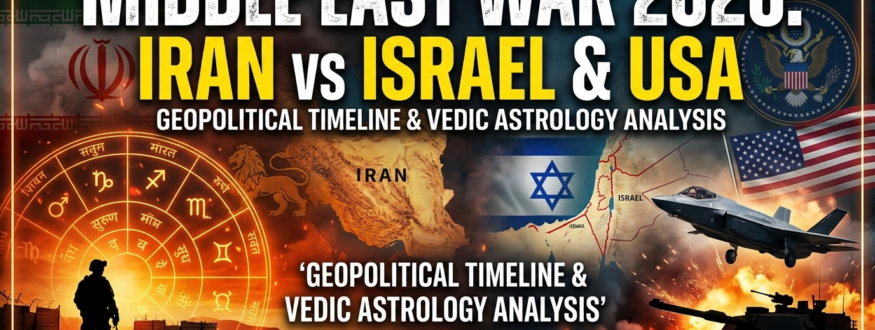
Middle East on the Brink: Iran vs Israel & USA — Geopolitics Meets Vedic Astrology
The Middle East has once again become the epicenter of global instability.
By March 2026, tensions between Iran, Israel, and the United States have escalated into one of the most dangerous geopolitical confrontations of the 21st century.
But beyond military strategy and political ideology, some analysts and astrologers argue that cosmic patterns may also be mirroring the unfolding crisis.
To understand the current moment, we must examine three layers simultaneously:
- The historical enmity between Iran and Israel
- The chain of geopolitical events from 2023 to 2026
- The astrological alignments surrounding the leaders involved
Historical Roots of the Iran–Israel Conflict
The hostility between Iran and Israel did not emerge overnight.
Before the 1979 Iranian Revolution, Iran under Shah Mohammad Reza Pahlavi maintained relatively cooperative relations with Israel.
However, when Ayatollah Ruhollah Khomeini established the Islamic Republic, the new regime adopted a strong ideological position against Israel, declaring it an illegitimate state.
From that point onward, Iran began supporting groups hostile to Israel, including:
- Hezbollah in Lebanon
- Hamas in Gaza
- Various militia networks across Syria and Iraq
Israel, in turn, has viewed Iran as its largest existential threat, particularly due to Iran’s nuclear ambitions.
Over decades, this rivalry evolved into a shadow war involving:
- Intelligence operations
- Cyber warfare
- Proxy conflicts across the Middle East
- Targeted assassinations
- Airstrikes in Syria and Iraq
Yet until recently, both sides avoided direct full-scale confrontation.
That fragile balance began collapsing after October 7, 2023.
October 7, 2023 — The Event That Changed Everything
The modern escalation began with the Hamas attack on Israel on October 7, 2023.
Militants launched a surprise assault that killed over a thousand Israelis and triggered a massive Israeli military response in Gaza.
Israel’s leadership accused Iran of indirectly enabling Hamas through funding, training, and weapons support.
The Gaza war rapidly expanded into a regional crisis, with multiple fronts opening across the Middle East.
Soon the conflict involved:
- Hezbollah attacks from Lebanon
- Iranian-backed militias targeting US bases in Iraq and Syria
- Naval tensions in the Red Sea
- Missile exchanges involving multiple countries
The region had entered a new era of instability.
2025 — The Twelve Day Bombing Campaign
By 2025 the confrontation intensified dramatically.
Israel launched a series of coordinated strikes against Iranian military infrastructure, targeting facilities believed to be linked to missile development and nuclear research.
The campaign, which analysts later called the “Twelve Day Bombing”, involved:
- Israeli airstrikes
- Cyber attacks
- Intelligence operations deep inside Iran
The strikes triggered nationwide protests within Iran, as economic pressure, sanctions, and internal political tensions intensified.
The Iranian government accused Israel and the United States of orchestrating regime destabilization operations.
For the first time in decades, the possibility of direct state-to-state war between Israel and Iran seemed real.
February 28, 2026 — The Killing of Iran’s Supreme Leader
The geopolitical situation reached its most dramatic turning point on February 28, 2026.
A massive joint US–Israeli military strike against Iranian targets reportedly resulted in the death of Iran’s Supreme Leader, Ayatollah Ali Khamenei.
Khamenei had ruled Iran for more than three decades, holding near-absolute authority over the country’s military, religious institutions, and foreign policy.
His death sent shockwaves across the region.
Within hours:
- Iranian military units were placed on high alert
- Missile batteries were mobilized
- Global oil markets reacted sharply
- Governments worldwide began preparing for escalation
The Middle East was now standing at the edge of a potential regional war.
March 2026 — Iran’s Retaliation Begins
As of March 8, 2026, Iran has begun retaliatory actions against American and Israeli interests.
Reports indicate multiple possible responses including:
- Missile strikes targeting strategic military locations
- Cyber attacks against infrastructure
- Mobilization of proxy forces across the region
- Increased naval tension in the Persian Gulf
Military analysts fear that the situation could spiral into a multi-front conflict involving several Middle Eastern states.
The stakes are enormous — not just for the region, but for global stability.
The Astrology Behind the Crisis
While geopolitics explains the human decisions, astrology attempts to analyze the cosmic timing behind events.
What makes the current moment particularly unusual is that three central leaders connected to this conflict share a rare astrological pattern.
All three were born under eclipse conditions.
Those leaders are:
- Donald Trump
- Benjamin Netanyahu
- Ali Khamenei
In classical Vedic astrology, eclipses are considered karmically intense birth signatures.
Ancient texts often associate eclipse births with individuals who become instruments of large historical transformations.
Pattern 1 — Leaders Born Under Eclipses
Each of the three leaders connected to the 2026 crisis has a birth chart marked by eclipse signatures.
| Leader | Eclipse Type | Astrological Signature |
|---|---|---|
| Donald Trump | Lunar Eclipse | Moon eclipsed |
| Benjamin Netanyahu | Solar Eclipse | Sun eclipsed |
| Ali Khamenei | Annular Solar Eclipse | Sun shadowed by Moon |
In traditional Jyotish interpretation, such births often indicate destinies tied to major global events.
Pattern 2 — The Leo Connection
Another striking pattern among these charts is the prominence of Leo (Simha) — the sign associated with kingship, power, and leadership.
Leo is ruled by the Sun, the planetary symbol of authority.
Astrologically this emphasizes themes of:
- Leadership
- Power struggles
- Political dominance
- Global stage influence
The March 2026 eclipse falling in Leo further intensifies this symbolism.
Pattern 3 — Magha, Chitra, and Ashlesha Nakshatra Archetypes
Vedic astrology also analyzes Nakshatras (lunar constellations).
Each leader reflects a distinct archetype.
Magha — The King
Associated with ancestral authority and royal power.
This energy is connected with leadership roles that command loyalty and decisive action.
Chitra — The Architect
Linked to Vishwakarma, the celestial craftsman.
Represents strategy, design, and the construction of complex systems.
Ashlesha — The Serpent
Connected with covert power, intelligence networks, and hidden influence.
These archetypes mirror the roles played in the current geopolitical drama.
Pattern 4 — Mars Alignment in Leo
One of the most unusual astrological coincidences is the near-identical Mars placement shared between two of the leaders involved.
Mars symbolizes:
- War
- Military strategy
- Aggression
- Courage
A close alignment of Mars in Leo suggests parallel martial energy influencing leadership decisions.
Pattern 5 — Rahu–Ketu Axis and Eclipse Karma
In Vedic astrology, eclipses are governed by the Rahu–Ketu axis, representing karmic forces and collective destiny.
Rahu represents:
- amplification
- disruption
- global events
- sudden shifts
Ketu represents:
- karmic endings
- detachment
- spiritual closure
When eclipses activate this axis in leadership charts, astrologers often associate it with historical turning points.
A Rare Alignment of History and Cosmos
Whether one believes in astrology or not, the present Middle East crisis is undeniably a historical inflection point.
The combination of:
- decades-long geopolitical rivalry
- cascading military escalations since 2023
- the death of a long-standing Supreme Leader
- and rare eclipse-linked leadership charts
creates a moment that feels unusually consequential.
As events continue unfolding through 2026, both political analysts and astrologers will be watching closely.
The Middle East has entered another volatile chapter — one where history, power, and perhaps even cosmic timing intersect.
