Introduction: Can You Inherit a Debt You Never Created?
Imagine a family where successive generations experience similar struggles.
The grandfather loses ancestral property. His son faces repeated financial setbacks. The grandson, despite education and hard work, struggles to establish stability.
Elsewhere, a family experiences recurring disagreements between parents and children, delayed marriages, or disputes over inheritance.
Are these merely coincidences, the consequences of family circumstances, or something deeper?
Within the traditional framework of Lal Kitab astrology, certain recurring difficulties are interpreted through a concept known as Rin — a symbolic or karmic debt.
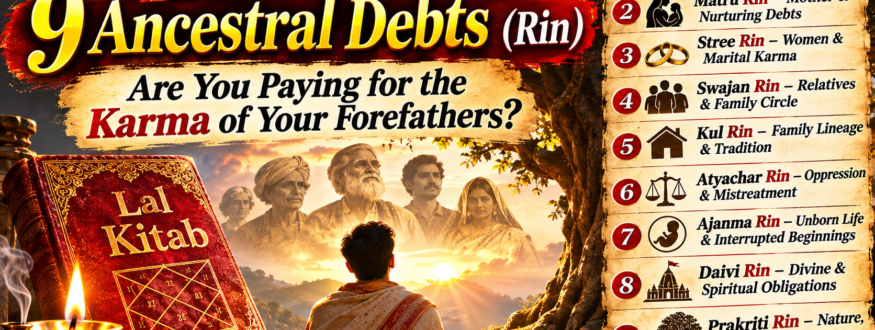
Lal Kitab describes nine categories of debt associated with planetary relationships, family obligations, and conduct toward other living beings.
These are commonly referred to as the Nine Ancestral Debts of Lal Kitab, although not all nine concern forefathers directly.
The intriguing premise is that some obligations may remain unresolved across generations and manifest symbolically in the horoscope of a descendant.
But there is an important distinction.
Lal Kitab does not justify declaring that every hardship is caused by an ancestor’s wrongdoing. Nor can a horoscope scientifically establish that a particular forefather committed a particular act.
Instead, the nine debts form a traditional astrological framework for interpreting planetary afflictions, family responsibilities, and corrective conduct.
Let us examine all nine categories, their planetary associations, and the remedies traditionally discussed in Lal Kitab.
What Are the Nine Rin in Lal Kitab?
The term Rin (ऋण) means debt, obligation, or something owed.
In Lal Kitab, the concept extends beyond financial indebtedness. It encompasses symbolic obligations involving ancestors, mothers, women, relatives, living beings, and moral conduct.
The nine categories commonly described in Lal Kitab literature are:
| No. | Traditional name | Principal association |
|---|---|---|
| 1 | Pitru Rin (पितृ ऋण) | Ancestors and paternal obligations |
| 2 | Matru Rin (मातृ ऋण) | Mother and maternal responsibilities |
| 3 | Stree Rin (स्त्री ऋण) | Women and marital relationships |
| 4 | Swajan Rin (स्वजन ऋण) | Relatives and one’s own people |
| 5 | Kul Rin (कुल ऋण) | Family lineage and inherited obligations |
| 6 | Atyachar Rin (अत्याचार ऋण) | Oppression and mistreatment |
| 7 | Ajanma Rin (अजन्मा ऋण) | Unborn life and interrupted beginnings |
| 8 | Daivi Rin (दैवी ऋण) | Divine and spiritual obligations |
| 9 | Prakriti Rin (प्रकृति ऋण) | Nature and living beings |
Terminology note: English spellings and translations differ among Lal Kitab editions and modern commentaries. The list above follows a commonly circulated nine-debt classification. Exact planetary diagnostic rules should be checked against the relevant original edition rather than assumed from the names alone.
1. Pitru Rin — The Debt Toward Ancestors
Pitru Rin is perhaps the most widely discussed ancestral obligation in Indian astrological traditions.
The word Pitru refers to forefathers or departed ancestors.
In Lal Kitab interpretations, this debt concerns obligations associated with paternal lineage, inherited responsibilities, and respect toward family elders.
Planetary significance
The Sun is traditionally associated with the father, paternal authority, and lineage.
Jupiter is associated with wisdom, teachers, ethics, and family guidance.
Some Lal Kitab commentaries associate Pitru Rin with particular afflictions involving Jupiter and other planets, but a universal diagnosis cannot be established merely from a weak Sun or Jupiter.
A specific Lal Kitab rule must be applied.
How might Pitru Rin be interpreted?
Traditionally, astrologers may investigate this category when a family reports repeated difficulties involving paternal relationships, inherited property, or obligations toward elders.
However, these experiences do not prove the presence of Pitru Rin.
Traditional remedial themes
Remedial traditions may emphasize respectful remembrance of ancestors, fulfilling responsibilities toward parents, resolving legitimate family obligations, and making appropriate charitable offerings.
Some traditions also discuss collective family participation in particular remedies.
Important: Pitru Rin in Lal Kitab should not automatically be equated with every form of Pitru Dosha described in other branches of Jyotish.
2. Matru Rin — The Debt Toward the Mother
Matru Rin concerns obligations associated with motherhood, maternal care, and nurturing.
The Moon is the principal natural significator of the mother in Vedic astrology.
Within Lal Kitab’s symbolic language, maternal relationships and their associated planetary conditions can become important in interpreting this debt.
What does Matru Rin symbolize?
The traditional interpretation emphasizes responsibilities toward the mother and maternal figures.
Modern readers may also understand it as a symbolic reminder of caregiving, emotional responsibility, and the intergenerational transmission of family behavior.
Possible manifestations in traditional interpretations
Some astrologers connect this category with repeated maternal-family tensions, emotional insecurity, or neglect of caregiving obligations.
These are interpretive associations, not reliable diagnostic signs.
Traditional remedial themes
Respecting and caring for one’s mother, supporting elderly caregivers, fulfilling family duties, and performing carefully selected Moon-related remedies are frequently discussed.
A remedy should not be reduced to indiscriminately donating milk, rice, or silver.
The exact action depends on the relevant Lal Kitab prescription.
3. Stree Rin — The Debt Toward Women
Stree Rin concerns obligations toward women and, in many interpretations, the treatment of wives and female family members.
Venus is commonly associated with relationships, marriage, beauty, and feminine significations in traditional astrology.
The deeper karmic theme
Stree Rin is often interpreted in relation to the misuse of trust, exploitation, or mistreatment within relationships.
From a contemporary ethical perspective, its most constructive lesson is straightforward:
Relationships require dignity, consent, fairness, and responsibility.
Does Stree Rin cause delayed marriage?
Some astrologers associate it with relationship difficulties, but delayed marriage alone cannot establish the presence of Stree Rin.
Marriage timing involves many practical factors, including personal circumstances, compatibility, opportunities, and choice.
Traditional remedial themes
Remedial interpretations emphasize treating women respectfully, fulfilling legitimate marital obligations, avoiding exploitation, and examining the precise Venus-related condition before prescribing any ritual.
No person should be blamed for an ancestor’s alleged behavior based solely on a horoscope.
4. Swajan Rin — The Debt Toward Relatives
Swajan refers to one’s own people, relatives, or members of one’s social and family circle.
Swajan Rin is traditionally associated with obligations involving relatives and close family relationships.
The underlying principle
Families often depend on mutual assistance, trust, and shared responsibilities.
When these relationships break down, the effects may extend across generations through inheritance disputes, estrangement, or financial hardship.
Lal Kitab interprets certain family obligations through planetary symbolism.
Planetary associations
Mercury is commonly associated with communication, exchange, calculation, and certain relatives.
However, identifying Swajan Rin requires a specific Lal Kitab planetary rule rather than assuming every afflicted Mercury indicates this debt.
Traditional remedial themes
Fairness in family transactions, avoiding deception, resolving legitimate disputes, and maintaining responsible relationships are constructive themes associated with this category.
This does not mean a person must tolerate abuse or sacrifice their financial security to satisfy a supposed karmic obligation.
5. Kul Rin — The Debt Toward Family Lineage
Kul Rin concerns obligations associated with one’s family lineage or household tradition.
Unlike Pitru Rin, which specifically emphasizes ancestral or paternal obligations, Kul Rin is commonly interpreted more broadly in relation to family continuity and collective responsibilities.
Why is Kul Rin important?
In traditional Indian society, the family unit carried responsibilities involving elders, dependents, shared property, and the preservation of family customs.
Kul Rin can be understood symbolically as the consequences of neglected family duties.
Can Kul Rin affect future generations?
Within Lal Kitab belief, certain karmic obligations may be interpreted as continuing through a lineage.
In everyday life, family decisions can also have intergenerational consequences through finances, education, caregiving, and learned behavior.
These observable consequences should not be confused with proof of supernatural inheritance.
Traditional remedial themes
The emphasis is often on restoring fairness, fulfilling legitimate obligations, and maintaining family responsibilities.
Specific ritual prescriptions require verification from the relevant Lal Kitab text.
6. Atyachar Rin — The Debt of Oppression or Mistreatment
The word Atyachar means oppression, cruelty, or unjust treatment.
Atyachar Rin is one of the more morally serious categories in popular Lal Kitab interpretations.
It concerns the symbolic consequences of wrongdoing, exploitation, or abuse of power.
The karmic interpretation
Traditional commentators may describe this debt in relation to harmful actions committed against others.
However, it is inappropriate to use a horoscope to accuse someone’s ancestors of cruelty or criminal behavior.
Astrology cannot establish historical guilt.
Planetary considerations
Saturn and Mars are frequently discussed in broader astrological interpretations of punishment, conflict, authority, and harsh conduct.
Nevertheless, neither a difficult Saturn nor an afflicted Mars is sufficient to diagnose Atyachar Rin.
Traditional remedial themes
Avoiding exploitation, treating workers and dependents fairly, correcting injustices where possible, and practising nonviolence are constructive interpretations.
These ethical actions are worthwhile regardless of planetary placements.
7. Ajanma Rin — The Debt Associated With Unborn Life
Ajanma Rin is among the most sensitive categories in the nine-debt framework.
The term is commonly interpreted in relation to unborn life, interrupted beginnings, or obligations associated with potential descendants.
Traditional astrological context
Some commentators connect this category with matters involving pregnancy, children, or family continuity.
The 5th house is traditionally associated with children and progeny in Vedic astrology.
However, an afflicted 5th house does not establish Ajanma Rin, and difficulties involving pregnancy or childbirth must never be treated as evidence of ancestral wrongdoing.
A necessary ethical distinction
Miscarriage, infertility, pregnancy complications, and childlessness have medical, biological, and personal dimensions.
They are not proof of karmic punishment.
No woman, parent, or family should be blamed for such experiences on the basis of Lal Kitab.
Constructive remedial themes
The most responsible interpretation emphasizes compassion, support for children and families, and respect for reproductive autonomy.
Anyone experiencing fertility or pregnancy concerns should seek appropriate medical guidance rather than relying on astrological remedies.
8. Daivi Rin — The Debt Toward Divine or Spiritual Obligations
Daivi Rin concerns obligations associated with spiritual conduct, religious institutions, teachers, or sacred responsibilities.
Jupiter frequently appears in broader astrological discussions involving religion, wisdom, and spiritual guidance.
What does Daivi Rin represent?
In traditional interpretations, this debt may be connected with disrespect toward spiritual obligations, misuse of religious authority, or neglect of certain duties.
But ordinary differences in religious belief do not establish Daivi Rin.
Can avoiding temples create Daivi Rin?
No such universal conclusion is justified.
Some Lal Kitab remedies contain specific temple-related cautions, while other prescriptions involve spiritual practices.
These instructions must be understood within their exact planetary context.
A person should not be frightened into religious participation or expensive rituals.
Traditional remedial themes
Honesty in spiritual matters, respect for teachers, ethical conduct, and appropriate charitable service are common interpretive themes.
9. Prakriti Rin — The Debt Toward Nature and Living Beings
Prakriti means nature.
Prakriti Rin is commonly interpreted as an obligation toward the natural world and other living beings.
The symbolic significance
Traditional Indian thought frequently emphasizes the interdependence of humans, animals, plants, and the environment.
Lal Kitab remedies also contain numerous references to animals, grains, water, trees, and natural objects.
These associations contribute to the interpretation of Prakriti Rin.
Does harming animals create ancestral debt?
Within the traditional karmic framework, cruelty toward living beings may be interpreted as spiritually consequential.
However, astrology cannot establish that an individual’s present difficulties were caused by an ancestor harming animals.
Constructive remedial themes
Caring responsibly for animals, protecting trees, conserving resources, and avoiding unnecessary environmental harm are practical ways to honor the underlying principle.
Feeding animals should be done safely and in accordance with local wildlife guidance.
How Are the Nine Ancestral Debts Identified in a Lal Kitab Horoscope?
This is the most important technical question.
Many online articles simply assign one planet to each debt and conclude that any affliction to that planet indicates inherited karma.
That approach is unreliable.
Lal Kitab’s debt-related rules are generally more specific.
A proper examination should distinguish the following elements:
-
The precise planetary placement or combination described in the relevant text.
-
Whether the rule depends on another planet occupying a particular house.
-
Whether the interpretation belongs to the natal chart or an annual Lal Kitab chart.
-
Whether the rule describes an actual debt, a general affliction, or a suggested remedy.
-
Whether the remedy is intended for an individual or requires participation from family members.
The nine-debt framework should not be diagnosed merely from zodiac signs, Moon signs, or an isolated planetary affliction.
A note on planetary combinations
Some popular English-language Lal Kitab guides reproduce elaborate tables connecting each Rin to specific planets and houses.
Unfortunately, these tables are not always consistent across translations and later compilations.
For this reason, it would be misleading to publish an exact nine-row diagnostic formula without identifying and verifying the source edition.
For serious classical study, the original Lal Kitab texts traditionally attributed to Pandit Roop Chand Joshi, including the 1939 and 1952 editions, are important starting points.
Are Ancestral Debts the Same as Pitru Dosha?
Not exactly.
Although the concepts overlap in popular discussion, they belong to different interpretive frameworks.
| Feature | Lal Kitab’s Nine Rin | Pitru Dosha in broader Jyotish |
|---|---|---|
| Central concept | Nine categories of symbolic obligation | Ancestral affliction or obligation |
| Interpretive approach | Lal Kitab-specific planetary and house rules | Varies by astrological tradition |
| Main emphasis | Family conduct, obligations, and remedies | Ancestors, lineage, and related afflictions |
| Remedies | Chart-specific Lal Kitab prescriptions | May include ancestral rites and other practices |
| Universal diagnosis | No | No |
A horoscope interpreted as showing Pitru Dosha does not automatically establish all nine Lal Kitab debts.
Similarly, Lal Kitab’s Rin framework should not be merged indiscriminately with every popular theory of ancestral curses or generational karma.
Can One Person Carry More Than One Ancestral Debt?
Within the traditional framework, different debt-related conditions may be considered simultaneously.
However, the presence of multiple difficult planetary placements does not automatically establish multiple Rin.
Each category requires its own textual criteria.
It is also important to avoid turning the concept into a source of fear.
A person should not be told that they carry several ancestral curses simply because they are experiencing financial setbacks, relationship problems, or family disagreements.
Can Lal Kitab Ancestral Debts Be Cleared Through Remedies?
Lal Kitab’s remedial tradition includes symbolic acts involving donations, conduct, household practices, and, in some cases, family participation.
Yet these actions should not be presented as guaranteed solutions to financial, marital, or medical problems.
A remedy should be selected only after establishing the relevant traditional rule.
A useful distinction is between three forms of response:
Spiritual: A person may choose prayer, remembrance, or traditional rites according to their beliefs.
Ethical: Individuals can address actual obligations by acting fairly, supporting dependents, and correcting harmful behavior.
Practical: Families can resolve documented financial debts, seek professional assistance, address health concerns, and improve communication.
These approaches need not be mutually exclusive, but spiritual remedies should never replace necessary practical action.
The Deeper Meaning: Are We Really Paying for Our Forefathers’ Karma?
This question gives Lal Kitab’s nine debts their enduring fascination.
Across generations, families transmit far more than property and surnames.
They also transmit habits, opportunities, financial circumstances, responsibilities, cultural expectations, and sometimes unresolved conflicts.
A child may grow up within circumstances shaped by decisions made decades earlier.
That is a genuine form of intergenerational influence.
Lal Kitab interprets certain inherited obligations through a spiritual and astrological language of Rin.
But the belief that a descendant is being punished for an ancestor’s moral wrongdoing is not scientifically established.
The more constructive question is not:
Which ancestor caused my suffering?
It is:
Which inherited patterns, obligations, or behaviors can I understand and improve in my own lifetime?
That question preserves the philosophical appeal of Lal Kitab while encouraging personal responsibility rather than fear.
Frequently Asked Questions
1. What are the nine ancestral debts in Lal Kitab?
They are commonly listed as Pitru Rin, Matru Rin, Stree Rin, Swajan Rin, Kul Rin, Atyachar Rin, Ajanma Rin, Daivi Rin, and Prakriti Rin. Names and translations can vary across commentaries.
2. Does everyone have ancestral debt according to Lal Kitab?
No universal conclusion should be drawn. Traditional interpretations require specific conditions rather than assuming every person carries all nine debts.
3. Can ancestral debt cause delayed marriage?
Some astrologers associate particular debt categories with family or relationship difficulties, but delayed marriage does not prove ancestral debt.
4. Is Pitru Rin the same as Pitru Dosha?
Not necessarily. The terms are often conflated, but Lal Kitab’s Pitru Rin should be interpreted according to its own textual rules.
5. Can ancestral debts affect children and grandchildren?
Lal Kitab’s traditional framework allows for interpretations involving family lineage. There is no scientific evidence that astrological debts are transmitted across generations.
6. Can donating food remove ancestral debt?
Some traditions prescribe donations as remedies, but no single donation can be assumed to remove every category of Rin.
7. Can one person have several types of Rin?
Traditional astrologers may examine more than one debt-related condition, but each requires its own specific criteria.
8. What is the best remedy for ancestral karma?
There is no universal Lal Kitab remedy. Ethical conduct, fulfilling legitimate obligations, and carefully examining the traditional prescription are more responsible than following generic remedies.
Conclusion: Your Ancestors May Shape Your Story, But They Do Not Have to Define Your Future
Lal Kitab’s nine ancestral debts offer a distinctive way of thinking about responsibility, family relationships, and karmic obligations.
From Pitru Rin and Matru Rin to Daivi Rin and Prakriti Rin, the framework extends beyond conventional ideas of ancestral worship.
It asks readers to consider their relationships with parents, partners, relatives, society, and the natural world.
Yet its symbolic teachings should not be turned into accusations against ancestors or predictions of unavoidable suffering.
The most meaningful way to approach ancestral karma is not through fear of the past, but through responsibility in the present.
Whether one understands Rin spiritually, symbolically, or philosophically, the central question remains compelling:
Are you repeating an inherited pattern, or are you becoming the generation that finally changes it?
