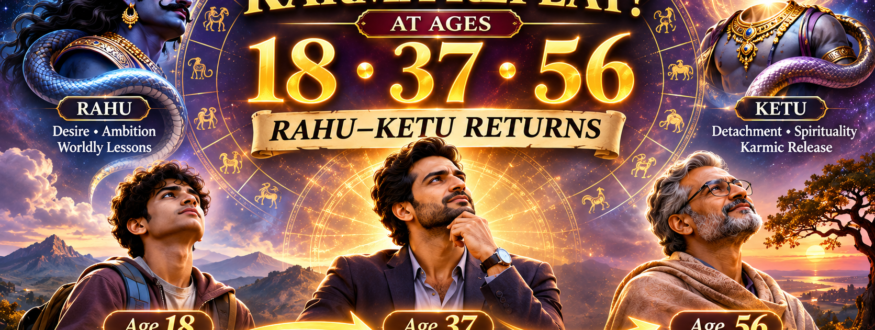
Why the Same Life Lessons Return at 18, 37 & 56 | Rahu–Ketu Returns in All 12 Houses
Have you ever noticed that certain situations seem to return at different stages of your life?
A relationship pattern you encountered in your teenage years may reappear in your late thirties. A career decision that once seemed insignificant may become important again. Questions about family, independence, money, or personal identity may resurface after decades.
In Vedic astrology, one fascinating framework for examining these recurring themes is the Rahu–Ketu nodal return cycle.
Rahu and Ketu are the lunar nodes, traditionally associated with desire, attachment, detachment, worldly ambition, and spiritual development.
Unlike physical planets, Rahu and Ketu are mathematical points where the Moon’s orbital path intersects the ecliptic.
Because their positions move through the zodiac in a repeating cycle of approximately 18.6 years, the lunar nodes return near their natal positions at roughly ages 18–19, 37–38, and 55–56.
Astrologers interpret these returns as periods when themes associated with the natal Rahu–Ketu axis may become more noticeable.
But do the same karmic lessons truly return every 18 years? And how does the house placement of Rahu and Ketu influence the interpretation?
Let us explore the astronomical cycle, traditional Jyotish symbolism, and possible manifestations of Rahu–Ketu returns across all twelve houses.
What Is a Rahu–Ketu Return in Vedic Astrology?
A Rahu–Ketu return occurs when the transiting lunar nodes return to approximately the same zodiacal positions they occupied at birth.
In the sidereal Vedic astrology framework, Rahu and Ketu are always positioned approximately 180 degrees apart.
Therefore, when Rahu returns to its natal position, Ketu simultaneously returns to its corresponding natal position.
This creates a recurrence of the natal nodal axis.
In Jyotish, Rahu is commonly associated with:
- Desire, ambition, and worldly pursuits.
- Unconventional experiences and unfamiliar environments.
- Material attachment and fascination.
- Social advancement and recognition.
- Foreign influences and innovation.
- Confusion, obsession, and dissatisfaction when poorly expressed.
Ketu is commonly associated with:
- Detachment and renunciation.
- Spiritual inquiry and introspection.
- Separation from familiar attachments.
- Withdrawal and simplification.
- Investigation and subtle perception.
- Liberation-oriented experiences.
Together, the nodes are often interpreted as a symbolic tension between what we pursue and what we gradually learn to release.
A nodal return may therefore be used as a period for examining recurring personal priorities, unresolved conflicts, and changes in direction.
However, the idea that every nodal return necessarily repeats a specific past-life event is not an established astronomical fact or a universally demonstrated classical Jyotish rule.
Why Do Rahu–Ketu Returns Occur Around Ages 18, 37 and 56?
The lunar nodes complete a full retrograde revolution through the zodiac in approximately 18.6 years.
This produces a repeating sequence of nodal returns.
Nodal ReturnApproximate AgeSymbolic Life ThemeFirst Return18–19Independence, identity, education, early ambitionsSecond Return37–38Career, relationships, responsibility, reassessmentThird Return55–56Legacy, priorities, detachment, accumulated wisdomFourth Return74–75Reflection, life experience, changing responsibilities
These themes are broad interpretive possibilities, not fixed outcomes.
The exact return date depends on the natal node longitude, the node calculation method, and the ephemeris used.
Mean Nodes vs True Nodes
Vedic astrology software may calculate Rahu and Ketu using either mean-node or true-node positions.
Mean Rahu moves smoothly in retrograde motion, while true-node calculations include periodic oscillations.
Consequently, exact return dates can differ between calculation methods.
For precise timing, use the same sidereal zodiac, ayanamsa, and node calculation convention for both the natal chart and transit chart.
First Rahu–Ketu Return: Age 18–19 — Discovering Your Direction
The first nodal return commonly occurs during the transition from adolescence into adulthood.
This is a period when many people begin making independent decisions about education, relationships, employment, and personal identity.
From an astrological perspective, Rahu may symbolize the desire to explore unfamiliar opportunities, while Ketu may represent the gradual separation from childhood attachments.
Possible themes include:
- Choosing a field of education.
- Leaving home or entering a new environment.
- Beginning important relationships.
- Questioning family expectations.
- Exploring personal ambitions.
- Developing independence.
For example, someone with natal Rahu in the tenth house may become particularly interested in career direction and public achievement.
A person with Rahu in the seventh house may instead focus more strongly on relationships and interpersonal experiences.
The return does not guarantee these events, but it provides an astrological framework for reflecting on them.
The central question of the first nodal return is: What direction do I want my life to take?
Second Rahu–Ketu Return: Age 37–38 — Reassessing the Path
The second nodal return occurs approximately 18.6 years after the first.
By this stage, many individuals have accumulated substantial experience involving work, relationships, financial obligations, and family responsibilities.
Astrologically, the second return may be interpreted as an opportunity to reassess earlier choices.
Questions that seemed important around age 18 may reappear in a more mature form.
For example:
A person who prioritized career advancement during the first return may reconsider the meaning of professional success during the second.
Someone who struggled with independence in early adulthood may now confront similar themes through marriage, family, or business partnerships.
A person who moved abroad during the first return may revisit questions of belonging, settlement, or long-term security.
The central question of the second nodal return is: Am I still moving toward what truly matters to me?
The same natal houses are involved, but the circumstances and responsibilities of life may be very different.
Third Rahu–Ketu Return: Age 55–56 — Legacy and Reorientation
The third nodal return occurs around age 55–56.
In astrological interpretation, this period may emphasize the reassessment of accumulated achievements and long-term priorities.
Rahu may continue to symbolize ambitions that remain unfulfilled, while Ketu may encourage reflection on attachments that no longer seem meaningful.
Potential themes include:
- Reconsidering professional commitments.
- Retirement or later-career planning.
- Family and generational responsibilities.
- Spiritual exploration.
- Reassessment of wealth and security.
- Desire for a simpler or more meaningful lifestyle.
For some, this may be a period of continued ambition and expansion.
For others, it may coincide with greater interest in personal freedom, family, or spiritual development.
The central question of the third nodal return is: What do I want my remaining contributions to represent?
Rahu–Ketu Returns in All 12 Houses
To interpret a nodal return, begin with the natal house occupied by Rahu.
Because Ketu is always opposite Rahu, the two nodes form a house axis in the standard whole-sign approach commonly used in Vedic astrology.
The following twelve interpretations describe the possible themes when Rahu returns to each natal house.
1. Rahu Return in the 1st House — Identity vs Relationships
Natal Axis: Rahu in 1st House, Ketu in 7th House
The first house represents identity, personality, independence, and personal direction.
Rahu’s return here may emphasize questions about self-definition and individual ambition.
The person may feel drawn toward reinventing their identity, developing confidence, or pursuing goals that require greater independence.
Meanwhile, Ketu in the seventh house introduces themes involving relationships and partnerships.
At age 18–19, this axis may symbolize the tension between personal independence and early romantic attachments.
At age 37–38, similar themes may appear through marriage, business partnerships, or personal reinvention.
At age 55–56, the focus may shift toward balancing personal freedom with established relationships.
Recurring Lesson: Develop individuality without neglecting meaningful partnerships.
2. Rahu Return in the 2nd House — Wealth vs Shared Resources
Natal Axis: Rahu in 2nd House, Ketu in 8th House
The second house represents accumulated wealth, family values, speech, and financial security.
Rahu’s return may emphasize the desire to establish material stability or improve financial circumstances.
Ketu in the eighth house introduces themes involving shared resources, uncertainty, inheritance, and transformation.
At the first return, the person may become increasingly conscious of financial independence.
At the second return, questions about savings, property, debt, or family responsibilities may become important.
At the third return, the individual may reassess the purpose of accumulated wealth and long-term financial security.
Recurring Lesson: Build resources without allowing financial concerns to dominate personal identity.
3. Rahu Return in the 3rd House — Courage vs Belief Systems
Natal Axis: Rahu in 3rd House, Ketu in 9th House
The third house represents initiative, communication, courage, skills, and personal effort.
Rahu here may encourage experimentation, entrepreneurship, writing, or the development of new abilities.
Ketu in the ninth house introduces themes involving philosophy, teachers, faith, and inherited beliefs.
During the first return, the individual may question established ideas and begin exploring independent interests.
During the second, the person may seek greater control over career decisions or creative expression.
During the third, accumulated knowledge may become something they wish to communicate or teach.
Recurring Lesson: Balance independent thinking with wisdom and broader perspective.
4. Rahu Return in the 4th House — Home vs Career
Natal Axis: Rahu in 4th House, Ketu in 10th House
The fourth house represents home, emotional security, family, property, and domestic foundations.
Rahu’s return may highlight the desire to establish a secure personal environment.
Ketu in the tenth house introduces questions about professional identity, authority, and public achievement.
At age 18–19, the person may experience changing priorities involving education, residence, or family independence.
At age 37–38, housing, property, family responsibilities, and work-life balance may become prominent.
At age 55–56, the individual may reassess the relative importance of career recognition and domestic fulfillment.
Recurring Lesson: Create emotional security without abandoning meaningful professional responsibilities.
5. Rahu Return in the 5th House — Creativity vs Social Expectations
Natal Axis: Rahu in 5th House, Ketu in 11th House
The fifth house represents intelligence, creativity, romance, children, education, and speculative interests.
Rahu’s return may intensify the desire for personal expression and recognition of individual talents.
Ketu in the eleventh house introduces themes involving social networks, collective goals, and group expectations.
During the first return, romance, education, or creative exploration may become important.
During the second, the person may reconsider ambitions involving children, entrepreneurship, or personal achievements.
During the third, the focus may shift toward sharing knowledge and leaving a creative or educational legacy.
Recurring Lesson: Pursue meaningful personal creativity without becoming excessively dependent on recognition.
6. Rahu Return in the 6th House — Service vs Escape
Natal Axis: Rahu in 6th House, Ketu in 12th House
The sixth house represents work, service, competition, debts, health-related routines, and practical responsibilities.
Rahu’s return may emphasize the desire to overcome obstacles or improve everyday circumstances.
Ketu in the twelfth house introduces themes involving solitude, retreat, expenditure, and spiritual release.
At the first return, the person may develop greater independence through work and disciplined routines.
At the second, professional responsibilities or the need to improve work-life balance may become prominent.
At the third, the individual may reconsider how much time should be devoted to service versus rest and personal freedom.
Recurring Lesson: Develop practical discipline without neglecting inner peace.
7. Rahu Return in the 7th House — Relationships vs Independence
Natal Axis: Rahu in 7th House, Ketu in 1st House
The seventh house represents marriage, partnerships, contracts, and significant interpersonal relationships.
Rahu’s return may bring greater attention to the desire for companionship, collaboration, or external validation.
Ketu in the first house introduces questions about individuality and self-definition.
At age 18–19, the person may explore romantic attraction or important friendships.
At age 37–38, relationship commitments, marriage, separation, or business alliances may become subjects of reassessment.
At age 55–56, the individual may reflect on the quality and meaning of long-established partnerships.
Recurring Lesson: Build relationships without losing personal identity.
A nodal return in the seventh house does not independently predict marriage or divorce.
8. Rahu Return in the 8th House — Transformation vs Security
Natal Axis: Rahu in 8th House, Ketu in 2nd House
The eighth house represents transformation, shared finances, hidden knowledge, inheritance, and psychological depth.
Rahu’s return may emphasize the desire to investigate complex subjects or confront uncertainty.
Ketu in the second house introduces themes involving family traditions, accumulated wealth, and personal security.
During the first return, the person may begin questioning inherited values.
During the second, shared finances, major transitions, or psychological reassessment may become relevant.
During the third, the individual may become more interested in legacy, inheritance planning, or deeper philosophical questions.
Recurring Lesson: Learn to navigate uncertainty without abandoning practical stability.
9. Rahu Return in the 9th House — Beliefs vs Personal Experience
Natal Axis: Rahu in 9th House, Ketu in 3rd House
The ninth house represents higher education, Dharma, philosophy, teachers, long-distance travel, and belief systems.
Rahu’s return may encourage exploration of unfamiliar cultures, philosophies, or educational opportunities.
Ketu in the third house introduces themes involving personal effort and established communication patterns.
At the first return, higher education or philosophical exploration may become important.
At the second, the person may reconsider spiritual beliefs, international opportunities, or long-term life direction.
At the third, they may wish to transmit accumulated knowledge through teaching, mentoring, or writing.
Recurring Lesson: Expand your worldview while remaining grounded in personal experience.
10. Rahu Return in the 10th House — Ambition vs Inner Fulfillment
Natal Axis: Rahu in 10th House, Ketu in 4th House
The tenth house represents profession, reputation, authority, and public responsibilities.
Rahu’s return may intensify professional ambition or the desire for recognition.
Ketu in the fourth house introduces themes involving emotional security, home, and personal contentment.
During the first return, the individual may begin defining career ambitions.
During the second, professional advancement, career changes, or dissatisfaction with existing achievements may become important.
During the third, the person may reconsider how professional success fits into a broader sense of fulfillment.
Recurring Lesson: Pursue meaningful achievement without sacrificing emotional well-being.
11. Rahu Return in the 11th House — Ambitions vs Personal Creativity
Natal Axis: Rahu in 11th House, Ketu in 5th House
The eleventh house represents income, gains, networks, social organizations, and fulfillment of desires.
Rahu’s return may encourage the pursuit of ambitious goals or the expansion of social and professional connections.
Ketu in the fifth house introduces themes involving creativity, children, romance, and personal expression.
At the first return, the individual may become strongly influenced by peer groups and future ambitions.
At the second, financial goals, friendships, and professional networks may be reassessed.
At the third, the person may question whether accumulated achievements have provided genuine satisfaction.
Recurring Lesson: Balance collective success with personal fulfillment.
12. Rahu Return in the 12th House — Material Desire vs Spiritual Release
Natal Axis: Rahu in 12th House, Ketu in 6th House
The twelfth house represents foreign lands, solitude, expenditure, spiritual liberation, and withdrawal from ordinary activities.
Rahu’s return may emphasize unfamiliar environments, private ambitions, international experiences, or the search for meaning beyond conventional routines.
Ketu in the sixth house introduces themes involving service, work, and daily responsibilities.
During the first return, the person may develop an interest in foreign cultures, travel, or private exploration.
During the second, questions about work-life balance, expenditure, relocation, or spiritual interests may arise.
During the third, the individual may increasingly value contemplation, charitable work, or freedom from unnecessary obligations.
Recurring Lesson: Balance worldly responsibilities with the need for inner freedom.
Rahu–Ketu Return: Quick Reference for All 12 Houses
Natal Rahu HouseNatal Ketu HouseMain Recurring Theme1st7thIdentity vs partnerships2nd8thPersonal wealth vs shared resources3rd9thPersonal effort vs higher beliefs4th10thHome vs career5th11thCreativity vs social ambitions6th12thService vs spiritual withdrawal7th1stRelationships vs independence8th2ndTransformation vs security9th3rdPhilosophy vs personal experience10th4thCareer vs emotional fulfillment11th5thCollective gains vs personal creativity12th6thLiberation vs everyday obligations
Rahu–Ketu Return vs Rahu–Ketu Opposition
An important distinction exists between a nodal return and a nodal opposition.
A nodal return occurs approximately every 18.6 years.
A nodal opposition occurs roughly halfway through that cycle, around 9.3 years after a return.
During a nodal opposition, transiting Rahu approaches the natal position of Ketu, while transiting Ketu approaches natal Rahu.
Approximate ages for nodal oppositions include:
- 9–10 years.
- 28 years.
- 46–47 years.
- 65 years.
In contemporary astrological interpretation, nodal oppositions may be viewed as periods of reassessment or tension involving the natal nodal axis.
However, the return and opposition are different configurations and should not be interpreted identically.
Does a Rahu–Ketu Return Activate Past-Life Karma?
Rahu and Ketu have long been associated with eclipses and powerful symbolic themes in Indian astrology.
Modern karmic astrology frequently interprets the nodal axis as representing patterns of attachment, desire, and detachment.
However, the specific claim that Rahu represents exclusively future-life growth while Ketu represents exclusively past-life karma is a simplified modern interpretation rather than a universally accepted classical dictum.
Likewise, a nodal return should not be presented as proof that an event from a previous lifetime is repeating.
A more careful approach is to examine the natal houses occupied by Rahu and Ketu, their dispositors, conjunctions, and the active planetary periods.
These factors can be used within the traditional astrological framework to explore recurring life themes.
How to Analyze Your Own Rahu–Ketu Return
Step 1: Identify Your Natal Rahu–Ketu Axis
Locate Rahu and Ketu in your birth chart.
Record their signs, houses, and exact degrees.
Step 2: Examine the Sign Dispositors
Identify the planetary rulers of the signs occupied by Rahu and Ketu.
For example, if Rahu occupies Capricorn and Ketu occupies Cancer, examine Saturn and the Moon.
Their house placements and relationships with other planets can add important interpretive detail.
Step 3: Calculate the Exact Nodal Return
Use a reliable sidereal ephemeris to determine when transiting Rahu returns to its natal longitude.
Remember that mean-node and true-node calculations may produce different dates.
Step 4: Examine the Active Vimshottari Dasha
The Dasha system provides an additional timing framework.
A nodal return during Rahu Mahadasha may be interpreted differently from one occurring during Jupiter, Saturn, or Venus Mahadasha.
Step 5: Examine Other Major Transits
Jupiter and Saturn transits may coincide with the nodal return and introduce additional themes.
For example, a Rahu return in the tenth house occurring alongside a significant Saturn transit may place greater emphasis on professional responsibilities.
Step 6: Compare Earlier Returns
If you are approaching your second or third nodal return, reflect on the themes that were prominent during previous returns.
Look for broad patterns involving the same areas of life rather than expecting identical events.
This can provide a useful personal reflection exercise, even though astrology has not been scientifically demonstrated to predict such recurrences.
Frequently Asked Questions
1. What Happens During a Rahu–Ketu Return?
In Vedic astrology, a nodal return is interpreted as a period when themes associated with the natal Rahu–Ketu axis may become prominent. Specific outcomes depend on the full horoscope and cannot be guaranteed.
2. Is the Rahu Return Always at Age 18?
No. The first return occurs approximately 18.6 years after birth. The exact timing depends on the natal node position and calculation method.
3. Is the Second Rahu Return More Powerful Than the First?
There is no universal classical rule establishing that the second return is always stronger. Its significance depends on the individual’s chart, planetary periods, and life circumstances.
4. Can a Rahu Return Bring Marriage?
A nodal return may coincide with relationship developments, particularly when the natal nodal axis connects with marriage indicators. However, the return alone does not establish marriage timing.
5. Can a Rahu Return Bring Career Success?
Career-related themes may be emphasized when the nodal axis involves the tenth house or other professional indicators. Success is not guaranteed by the nodal return alone.
6. Does Ketu Return at the Same Time as Rahu?
Yes. Because Rahu and Ketu occupy opposite points of the nodal axis, their returns occur together.
7. Are Rahu–Ketu Returns Mentioned in Classical Jyotish Texts?
Classical Jyotish recognizes Rahu and Ketu, their transits, and their astrological significations. However, the modern framework emphasizing life lessons repeating specifically at ages 18, 37, and 56 should not be attributed to a particular classical text without a verifiable passage.
8. Should Nodal Returns Be Calculated From the Ascendant or Moon?
The nodal return itself is calculated by comparing transiting Rahu with natal Rahu’s zodiacal longitude.
Its house interpretation can then be examined from the Ascendant, with the Moon chart providing additional context.
Final Thoughts: Why Do the Same Life Lessons Seem to Return?
The approximately 18.6-year lunar nodal cycle is a genuine astronomical phenomenon.
Its astrological interpretation offers a symbolic way to examine recurring themes involving ambition, relationships, family, career, identity, and personal priorities.
The first return around age 18–19 may coincide with early independence.
The second around age 37–38 may encourage reassessment of established choices.
The third around age 55–56 may invite reflection on long-term priorities and legacy.
Yet the same event does not necessarily repeat at each return.
The more meaningful question may not be whether life repeats itself, but whether our response to familiar challenges changes as we mature.
In Vedic astrology, the natal Rahu–Ketu axis provides one perspective on this process, while the Dasha system and broader horoscope add further interpretive context.
For more detailed Rahu–Ketu transit predictions, karmic astrology discussions, and personalized Vedic birth chart consultations, visit NJ Shivoham.
